
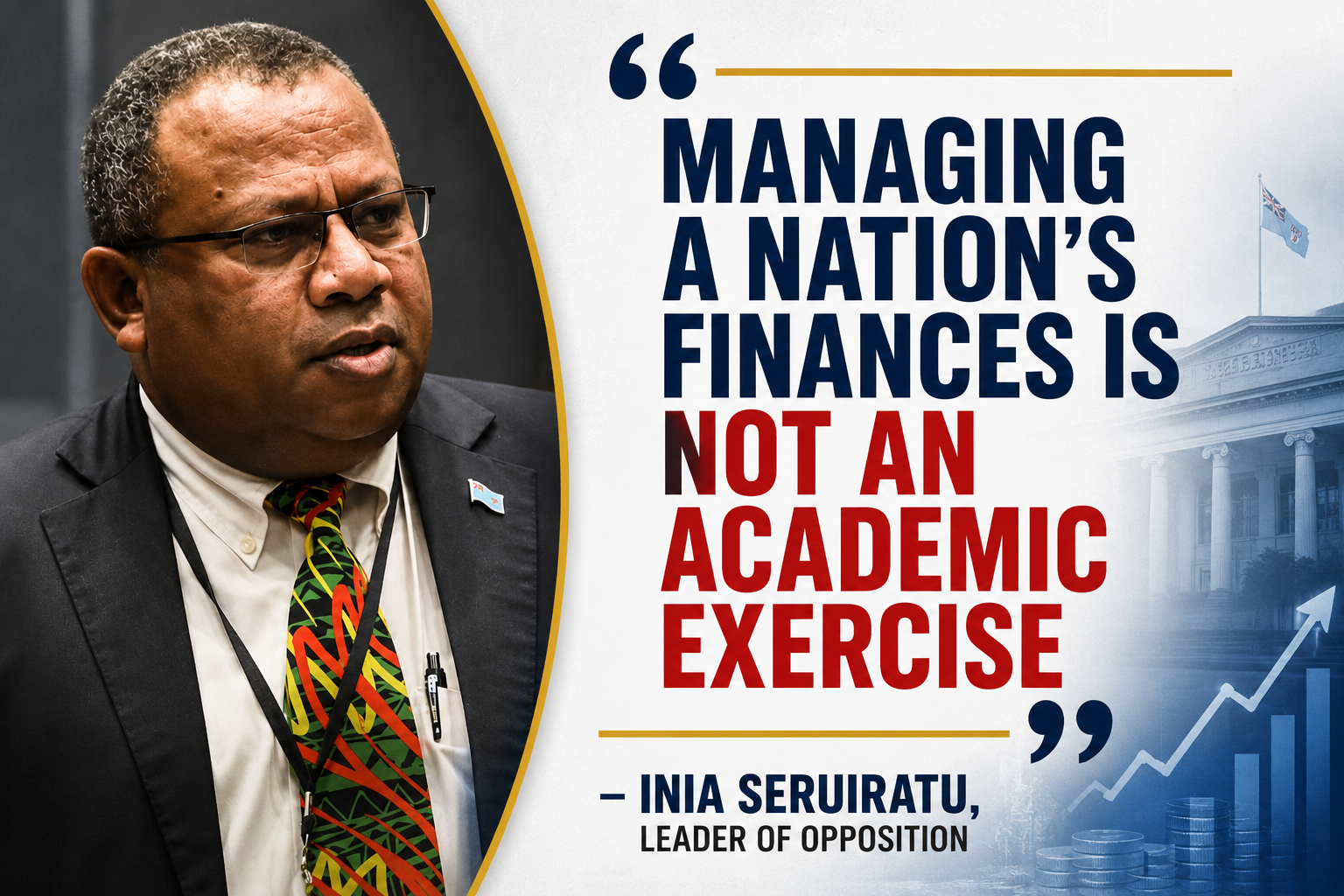
Opposition Leader Inia Seruiratu has accused the Coalition Government of failing to deliver on its promises of prudent fiscal management, arguing that higher taxes, rising public debt and increasing living costs have left many Fijian families worse off after nearly four years in office.
In the first of a series of social media posts titled “The State of Our Nation – Part 1,” Seruiratu said there is “a world of difference between theory and practice” when it comes to managing a country’s economy.
He said governing a nation requires more than academic knowledge.
“Managing a nation’s finances is not an academic exercise. It is about making difficult decisions, setting priorities, living within our means and ensuring that every dollar borrowed today does not become an unnecessary burden on future generations.”
Seruiratu said the Coalition Government had promised fiscal discipline when it took office and established the Fiscal Review Committee to chart a sustainable financial path.
He said the committee’s recommendations focused on raising government revenue through higher taxes, including increasing corporate tax and Value Added Tax, on the expectation that higher revenue would be matched by spending restraint and lower debt.
However, he claimed that has not happened.
“Despite collecting significantly more revenue from taxpayers, Government expenditure has continued to rise each year. Rather than using increased revenue to slow borrowing and restore fiscal space, public debt has continued its upward trajectory.”
Seruiratu pointed to Government budget documents, saying public debt is projected to increase from $11.54 billion at the end of the 2025–2026 financial year to $12.58 billion in 2026–2027.
He also highlighted the rising cost of living, saying households continue to face higher prices for everyday necessities.
“Today, Fijian families are paying more for many of the basic items they rely on every week.”
The Opposition Leader said rising fuel prices have increased transport costs for workers, students, families and businesses, with those additional costs ultimately passed on to consumers.
He argued that despite imposing higher taxes, the Government has failed to create enough fiscal space to provide meaningful relief or reduce VAT back to nine per cent.
“The hard truth is that without stronger economic growth and genuine fiscal discipline, promises of lower taxes and enhanced benefits become increasingly difficult to deliver.”
Seruiratu also criticised the decision to reduce the employer contribution to the Fiji National Provident Fund by two per cent, saying it will weaken retirement savings at a time when many members already have low balances.
Quoting figures from the Fund’s Annual Report, he said almost 45 per cent of FNPF members have savings of $5,000 or less, while more than 72 per cent have accumulated less than $20,000.
“Government argues that reducing the contribution will lower business costs. But for many workers, the question is simple, if the cost of living remains high today and retirement savings are reduced tomorrow, where is the economic relief?”
Seruiratu concluded that effective economic management requires disciplined spending, reform of inefficient government programmes and leadership that ensures borrowing creates future prosperity rather than placing a heavier burden on generations to come.
“After almost four years in office, Fijians should be seeing a higher standard of living, greater financial security and renewed confidence in the future. Instead, too many families remain worried about whether they can afford today’s groceries or retire with dignity.”

