
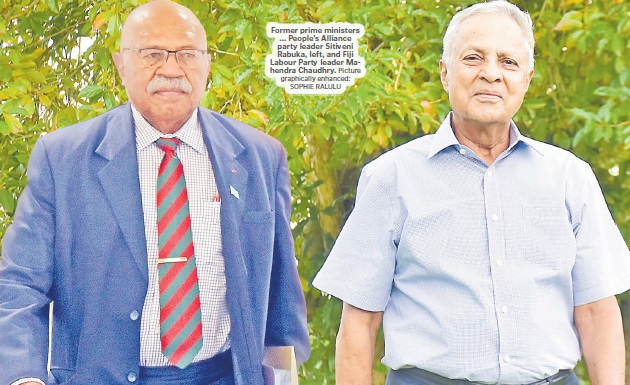
Professor Wadan Narsey claims that I had missed an “historical” opportunity to form a multiracial multiparty government with SVT because I had rejected the services of Sitiveni Rabuka after the general elections in May 1999.
In an opinion column in The Fiji Times last Saturday, November 6, titled “The 2022 elections: choosing between a rock and a softer place”, he says that Rabuka had telephoned from the Vatuwaqa golf course to “humbly offer his services” to me.
“Unfortunately, for reasons that historians can explore till the cows come home, Chaudhry did not accept that humble offer from Rabuka…,” Narsey said.
My response is to set the record straight on what transpired after the Labour Party’s stunning victory in the 1999 general elections and my swearing in as prime minister. If there was such a phone call from Mr Rabuka, I have no recollection of it. It is, however, belied by later events, as I will recount here.
There is in fact no need “for historians to explore till the cows come home” as the events that unfolded following my appointment as prime minister are well recorded and very much in the public domain.
The 1999 elections and the multiparty government
Fiji Labour Party fought the 1999 general elections in coalition with the Fijian Association Party (FAP) and the Party of National Unity(PANU) from the West, under the newly promulgated 1997 Constitution.
Labour swept the polls winning 37 of the 71 parliamentary seats and could have governed in its own right. Our coalition partners brought in another 15 seats with FAP winning 11 and PANU all four indigenous communal seats in the West, giving the Labour-led Coalition an overwhelming majority in Parliament with 52 seats.
Meanwhile, Sitiveni Rabuka’s ruling Soqosoqo ni Vakavulewani Taukei (SVT) party had fought the elections in coalition with the National Federation Party.
SVT came back with seven seats. NFP did not win a single seat. The rest of the seats went to three minority parties and independents: Christian Democratic Alliance (VLV) (3), United General Party (2), Nationalist TakoLavo Party (2) and Independents (5). Both Sitiveni Rabuka and Jai Ram Reddy (NFP leader) immediately and graciously conceded defeat as soon as the election results were declared.
The 1997 Constitution made it mandatory for the Prime Minister to invite all parties with 10 per cent or more seats in Parliament to form a multi-party Cabinet. Under the rules, only two parties – the FAP (11 seats) and SVT with seven seats – qualified to be included in the multi party Cabinet. FAP was already part of the Labour coalition.
After my swearing in as prime minister, I wrote to Mr. Rabuka inviting the SVT to join the People’s Coalition Cabinet. In keeping with the spirit of the multiparty Cabinet provisions in the constitution, invitations were also extended to the others – VLV, UGP and the Independents.
SVT’s outrageous demands
The SVT leader wrote back making a number of demands as conditions for their participation in the Peoples Coalition Government. He demanded four Cabinet portfolios, including that of deputy prime minister for himself.
He wanted the Works portfolio for Ratu Inoke Kubuabola, Finance for Jim Ah Koy and a Cabinet position for Sam Speight (George Speight’s father). He further demanded three additional seats in the Senate from among the PM’s nominees.
Moreover, he demanded that all ambassadors, high commissioners and board members appointed by the previous SVT government be allowed to complete their terms. The demands were unreasonable, unlawful and unconstitutional.
No self-respecting prime minister would have acceded to such absurdity from a minority party that barely made the 10 per cent threshold. It was bargaining in bad faith, to say the least. Not surprisingly, the Daily Post ran the story with banner headlines: “Under Siege! new demands put pressure on Chaudhry” .
I had no choice but to reject the SVT demands. Prof Narsey’s comment, therefore, that an opportunity to form a multiparty, multiracial government with SVT had gone begging, has no basis or justification.
They simply did not want to be a part of the Peoples Coalition Government and chose instead to abort it by making outrageous demands. Having said that, it must be made clear that the Peoples Coalition government led by Labour was in fact an effective multiracial, multiparty government. All parties, minority or otherwise, were given an opportunity to join.
The VLV and the independents chose to do so. We showed the world that, given the will, a multi-party Cabinet could work.
A caring, competent government
The success of the Labour-led government is evident from its outstanding governance record in just a short span of 12 months. Our performance to this day remains unmatched – 9.6 per cent economic growth with all sectors of the economy performing at record levels, astute financial management, good governance, high levels of investor and business confidence and a record number of social reform measures to alleviate poverty and assist families in the lower income groups.
The Chaudhry cabinet was truly multiracial. Of its 18 ministers, 12 were indigenous Fijians holding important portfolios.
The two deputy prime ministers – Adi Kuini and Tupeni Baba – were ethnic Fijians. Mr Baba also had the Foreign Affairs portfolio and Adi Kuini Fijian Affairs. In addition, the important portfolios of Home Affairs, Lands and ALTA, Health, Tourism, Agriculture, Fisheries and Forestry, Multi Ethnic Affairs etc were held by ethnic Fijians.
Regrettably, the opposition was determined right from the very start to view all developments from the prism of race. They deliberately and quite mischievously obstructed all government measures no matter how well intentioned and nationally beneficial.
From day one, a group of ethno nationalists began calling for the removal of the Indian prime minister. This was a purely racial call.
My first week-end in office, saw a spate of small arson attacks in the Nausori/ Nasinu area. The unrest was nipped in the bud, but from all available information, behind the scenes plotting continued to take place from time to time involving people close to SVT, and the Tako Lavo Party.
MAHENDRA CHAUDHRY is the leader of the Fiji Labour Party and a former prime minister of Fiji. The views expressed in this article are his and not of this newspaper

