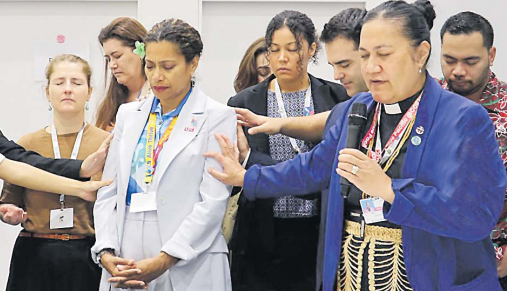
Minister for Foreign Affairs and External Trade Sakiasi Ditoka has defended Fiji’s participation in COP31, saying ministerial representation and sustained diplomatic engagement are essential to ensuring the country’s voice is heard in global climate negotiations. Despite setbacks in Antalya, he says Government efforts have helped secure climate finance, advance Pacific priorities on loss and damage and strengthen the push for greater protection of the ocean ahead of COP32.
Fiji must have a seat at every COP negotiating table
AT a COP, every country and regional bloc fights hard for its position. The major economies, especially those in the Global North, have people covering several negotiations at once. While one room discusses climate finance, another is working on loss and damage, another on emissions and another on the ocean. By the time a decision reaches the closing plenary, much of the wording has already been settled. Fiji cannot afford to leave those rooms to others.
Everyone who attends has a reason to be there and a job to do. Our development partners often sponsor participation, both for members of Fiji’s delegation and for representatives of regional and international organisations attending from Fiji. We appreciate our hosts’ hospitality, and our first responsibility is to do the work we were sent to do.
Why ministerial representation matters
There is also a practical reason ministers attend. With so many countries competing for limited speaking time, the seniority of the office represented affects when Fiji gets the floor, because UN speaking lists follow protocol order. I delivered Fiji’s national statement in the first morning session of the resumed high-level segment.
The same applies beyond the negotiations. At the events held around a COP, ministers are usually given priority when they speak. That is simply how things work.
If a large country is represented by an official and Fiji is represented by a minister, Fiji will usually speak first.
At some of these events there are so many speakers and so little time that those near the end are rushed and may have only a minute or two, while those who speak first may have three to five minutes to make their case.
If Fiji, or any other Pacific island country or small island developing state, wants to be near the top of the speaking order, it is best to send the most senior people we can, so our voices are heard where it counts.
Our officials do the detailed negotiating, and ministers take Fiji’s position directly to their counterparts when the political decisions are being made.
Fiji secures gains despite COP31 setbacks
We wanted more from COP31. Countries could not agree on the main decision, and we still lack a funded plan for tripling adaptation finance by 2035. Even so, countries adopted decisions that strengthen technical assistance for loss and damage, and Fiji helped lead the Pacific’s negotiations on loss and damage, including guidance for the loss and damage fund.
Incremental gains are still gains. Sometimes an issue moves only a little at one COP. That can give us enough to work with in the months that follow, as we sit down with other governments and build support with our Pacific partners for a decision at the next one. That is the nature of negotiated diplomacy.
Climate finance delivering results at home
Look at the Viria water treatment plant. In 2015 the Green Climate Fund approved a $US31million ($F671.20m) grant for the wider Greater Suva water and wastewater programme. It took years of work by Fiji and its partners to get the water flowing. Since April 2024, Viria has supplied 40 million litres a day to Greater Suva. The same fund has since approved $US35.2m ($F80.85) for the Great Sea Reef, about $US29.4m (F$67.53m) for forest and watershed restoration, and $US12.9m ($F29.63) to strengthen Fiji’s disaster warnings. These projects are at different stages, and our job is to see them through.
If the cost of sending delegations is the only yardstick, I can understand the complaint. But judging COP by that measure alone risks missing much of what Fiji has gained, and what it can still gain.
One simple test is to compare what Fiji has been granted with what our delegations have cost. The four Green Climate Fund grants I have just mentioned add up to more than $US100m ($F229.68). I don’t think the cost of all our delegations to all the COPs comes anywhere close to the Viria project alone.
Nabavatu relocation shows the value of climate advocacy
Take Nabavatu Village in Dreketi, Macuata. After Tropical Cyclone Ana in 2021, landslides and ground movement left the old village site unsafe. Fiji approved a $5.9m move to Nadoiviri, funded through our own Climate Relocation of Communities Trust Fund, with support from New Zealand. In my view, years of Pacific advocacy at COP helped draw attention to what it takes to relocate an entire village.
That gave us greater impetus to develop our own response and a stronger basis for working directly with partners.
Fiji also pioneered Standard Operating Procedures for Planned Relocation, which we launched in 2023.
They set out what to do when staying in place is no longer safe, from consulting the community and assessing a new site to supporting families after the move.
Nabavatu is the first relocation guided by those procedures and funded through the trust fund. We have shared Fiji’s approach with our Pacific neighbours, at COP29 and through the UN climate process, so that countries in our region and elsewhere can draw on what we have learnt.
That is how COP helps to shape what we do at home, how we work with partners such as New Zealand, and what we can contribute to the rest of the world.
Pacific leadership in the fight for 1.5°C and loss and damage
Pacific and other small island countries helped put 1.5°C into the Paris Agreement.
It took decades of advocacy to establish the Loss and Damage Fund.
Fiji launched the Ocean Pathway during our COP23 presidency, and the ocean now has its own annual dialogue in the UN climate process.
Fiji pushes for a stronger ocean decision
The ocean is also where Antalya came closest and fell short. Fiji led a group of countries seeking a standalone ocean decision.
When the main decision was rejected, ten agreed ocean paragraphs fell with it, and at the closing plenary Fiji asked for them to be adopted on their own. That did not happen this time, but the text exists and the support behind it is real.
We went to Antalya with a Melanesian mandate. In May, the Prime Minister and I attended the Melanesian Ocean Summit in Port Moresby, where Fiji endorsed the MOCOR Declaration and proposed a Melanesia Blue Shipping Initiative for low-emission sea transport.
At home, our Climate Change Act commits us to manage all of our ocean sustainably and to protect 30 per cent of it. We issued Fiji’s first sovereign blue bond in 2023, and we ratified the High Seas Treaty last year.
COP32 will be held in Addis Ababa in November 2027. Our aim is to secure those ocean paragraphs as a decision of their own, starting at the June talks in Bonn, and to link ocean work to the next Global Stocktake in 2028 and to finance for the ocean measures in national climate plans.
With a host focused on adaptation and food, we will make the case that the ocean is about both: our fisheries, our coastlines and the safety of our communities.
Climate change and trade: New challenges for Fiji
Trade is now part of COP too.
At COP28 in Dubai in 2023, the climate conference gave a whole day to trade for the first time. In Antalya, the COP31 Presidency and Türkiye’s Trade Ministry held a Finance and Trade Day on 13 November, with support from UNCTAD, the WTO and the International Trade Centre.
This matters because producing and distributing goods and services accounts for roughly a quarter of the world’s carbon dioxide emissions, and trade rules increasingly decide who gets clean technology and who pays new carbon costs at the border.
For Fiji, that means two things: our exports must stay competitive as the rules change, and trade should open doors to green investment, not close them.
We can take pride in those gains and still be frank about what fell short in Antalya. Between now and COP32, we will keep working with partners, preparing the projects our communities need and building support for the decisions we want to see.
Acknowledging Team Fiji’s contribution also want to acknowledge and thank my co-lead, the Honourable Lynda Tabuya, permanent secretary Sivendra Michael and the team at the Ministry of Environment and Climate Change for their leadership and painfully hard work in pressing Fiji’s case through the technical negotiations at COP.
I also thank the other ministries that represented Fiji in their own sectors and spaces, including the Minister for Local Government and the Ministry of Local Government, the Ministry of Fisheries and Forestry, the Ministry of Agriculture and others.
Finally, I thank the civil society organisations, NGOs and everyone else in Team Fiji who worked hand in hand to keep moving Fiji’s and the region’s positions forward, as well as our international development partners who generously supported our attendance.