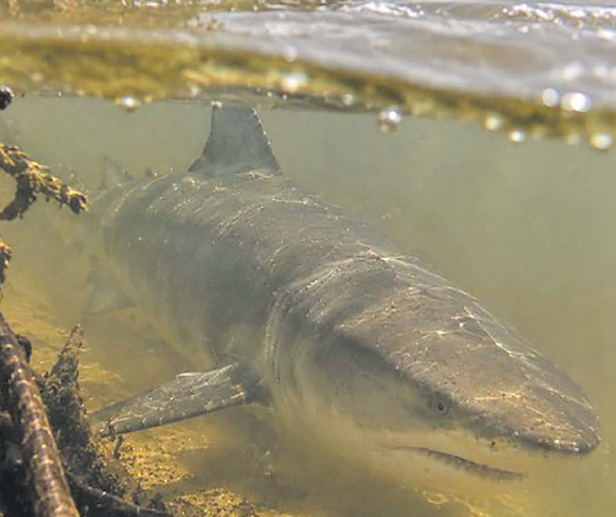
FIJIANS living in communities along rivers are being urged to exercise caution when swimming, fishing or carrying out other activities in waterways, as bull sharks move upstream during their breeding season.
The warning follows an incident last week in which a man from Naitasiri underwent surgery at the Colonial War Memorial (CWM) Hospital after being attacked by a shark in a river.
The Ministry of Fisheries says bull sharks are the primary species known to travel upstream into Naitasiri rivers, including the Wainimala and Waidina.
Ministry of Fisheries Research Division Senior Research Officer Jacqueline Nalomaca said adult female bull sharks migrate from coastal waters into Fiji’s river systems during the austral summer rainy season, between December and February, to give birth.
Communities are advised to exercise heightened caution from November to March, when females enter rivers to pup and newborn sharks become more abundant.
Although unprovoked attacks in Naitasiri and other inland rivers are extremely rare, the ministry has outlined precautions for people using these waterways.
Why sharks enter inland waterways
Bull sharks (Carcharhinus leucas) can survive in both marine and freshwater environments, allowing them to travel upstream.
Ms Nalomaca said they were the primary species known to move into Naitasiri’s rivers.
“Research conducted by University of the South Pacific researchers and published in the journal Ecology and Evolution confirms that bull sharks dominate Fiji’s upper freshwater systems,” she said.
Bull sharks have specialised adaptations that allow them to move between different water environments.
“They are euryhaline, meaning they can tolerate a wide range of salinity levels.
“Their specialised kidneys and rectal glands help regulate salt retention and maintain their internal water balance as they move between seawater, brackish water and freshwater.
“This adaptation allows them to travel dozens of kilometres upstream, even into areas where river water is completely fresh.”
Verified catches have extended far inland into Naitasiri, including the Wainimala River in Vunidawa.
“Their ability to survive in these conditions means their presence is not restricted to coastal areas or river mouths,” she said.
Rivers provide important breeding and nursery grounds
The movement of bull sharks into Fiji’s rivers is linked to their reproductive cycle.
She said adult females migrated from coastal coral reefs into rivers between December and February to give birth.
A survey across the Rewa, Navua and Sigatoka river systems found that more than 74 per cent of 172 sharks captured were newborn pups, identified by their open umbilical scars.
“A joint study by the Fiji Shark Lab and the University of the South Pacific, published in Pacific Conservation Biology, also tracked pregnant female sharks from the Shark Reef Marine Reserve in Beqa Lagoon repeatedly entering the Rewa River during summer to give birth.
“The Rewa River system, stretching from its upper tributaries in Naitasiri to the lower estuary, is recognised internationally as the Lower Rewa River and Delta Important Shark and Rays Area.”
She said the river system provides important nursery habitats for newborn sharks.
Pregnant females move upstream to give birth in shallow, murky waters, where pups measuring between 61 and 95 centimetres are protected from larger marine predators.
“The young sharks can remain in these habitats for their first three years before eventually moving into other environments.”
What communities should know
Although bull sharks in inland waterways are a natural phenomenon, the ministry is advising communities to take precautions, particularly during warmer months when shark activity increases.
People are advised to avoid swimming or standing in murky, waist-deep water where visibility is limited, particularly after heavy rainfall or flooding. They should also avoid wading near river mouths and deep river bends.
Extra caution is recommended between November and March, when adult females enter rivers to give birth and newborn sharks are more abundant.
The ministry warns against swimming near areas where fish are being cleaned, fishing waste or offal is discarded, or active gill nets have been set. Blood and struggling fish can attract sharks.
Parents and caregivers are encouraged to supervise children near river mouths, estuaries and tidal sections of rivers.
Communities are also advised to report unusual shark sightings to authorities to assist monitoring and improve understanding of shark movements.
Alongside public safety, the ministry has highlighted the importance of protecting shark nursery habitats.
“Communities are advised against setting indiscriminate gill nets across river channels because these can entangle and kill newborn sharks.
“We (the Ministry of Fisheries) will continue monitoring reports and working with relevant stakeholders to improve understanding of shark ecology and public awareness.”