
AT Glasgow last month, Pacific Island nations won 10 Commonwealth Games medals.
Six of them came in weightlifting. Two in boxing, one in judo, one in lawn bowls. On the track, not a single Pacific runner got past the first round of the men’s 400 or 800 metres.
Fiji took two of those medals — a weightlifting gold to Taniela Rainibogi and a boxing bronze to Jasmine Daunakamakama, our first female Commonwealth boxing medal. Both deserve every bit of the celebration they received.
But look at the shape of that list rather than the total. We win where a narrow, focused pathway has been built around a small number of athletes. We disappear entirely from the events that need a broad development pipeline underneath them. That is not a statement about our athletes. It is a statement about what sits behind them.
And the usual explanation — that we are a small country and we cannot afford to compete — does not survive contact with the budget.
The money is there
The Ministry of Youth and Sports was allocated $23.4 million for 2025–2026. Inside that figure sit some revealing lines:
n about $5.4m for overseas sporting tours;
n $3.9m for hosting international tournaments;
n $1.9m for engaging coaches; and
n $670,000 for the Fiji Sports Council.
Now consider Jamaica. A country of 2.8 million people — three times our population — grant-funds every one of its national sporting associations through a foundation running on roughly $US4.5m ($F9.9m) a year. And Jamaica is a sprinting superpower.
The two figures are not a perfect comparison. A whole ministry vote is a different instrument from a grant-making foundation. But the orders of magnitude are the point: Fiji’s sports allocation, serving fewer than a million people, is not obviously smaller per head than Jamaica’s, and on some lines it is plainly larger.
A country that can find $5.4m for tours and $3.9m to host tournaments cannot honestly say poverty is the reason its development pipeline runs dry.
So if the money is appropriated, where does it go?
Two answers, both uncomfortable
The first problem is execution. In 2024–25 the Ministry of Youth and Sports had a revised allocation of $23.42m and spent $21.85m. Against a revised capital provision of $1.83m — the money that builds and improves sporting infrastructure — actual capital spending was only $589,500.
Less than a third. The gap between what is budgeted and what reaches the ground is itself a failure of conversion.
The second is leakage, and it is not only governmental. Within the federations and apex bodies that receive the grants, money intended for athletes too often does not reach them. FASANOC itself has said it is unacceptable that some federations, rather than meeting their share of costs, have pushed the burden back onto the athletes they exist to serve.
Read those two facts together and the picture is not scarcity. It is conversion. We are not failing to fund sport. We are failing to turn funding into coaching, competition and pathways.
We already have the hard part
Here is what should make this frustrating rather than depressing: The expensive, difficult thing is already built.
Every year the Fiji Finals fill a stadium. Tens of thousands of Fijians watch schoolchildren compete at a level of intensity that most countries would envy. Jamaica has an equivalent — their inter-school championships, known simply as Champs — and it is the foundation of their sprinting dominance.
The difference is not the schools competition. We match them there.
The difference is what sits above it. Champs feeds a deliberate high-performance pathway: coaching, progression, selection, funding, a route from a school carnival to a world final. Ours largely stops at the spectacle.
We stage a magnificent talent identification exercise every year and then, for most of those children, nothing follows.
What it costs to lose people
In 2018, a young lifter from Levuka won gold at the Commonwealth Games — Fiji’s only gold of those Games. Her name is Eileen Cikamatana. After a falling-out with the sport’s administration here, she transferred her allegiance to Australia in 2019.
She has won Commonwealth gold for Australia ever since. At Birmingham she became the first woman to win individual Commonwealth golds for two different countries. At Glasgow last month she won a third consecutive title.
This is not a story about money. No professional league lured her away; weightlifting has no riches to offer. Rugby players who leave for Australia, New Zealand and France are responding to careers that genuinely do not exist here, and no one can blame them for that. It is a pull, and answering it takes money and professional structures we may not have.
What happened to Cikamatana was a push. And a push costs nothing to prevent. It asks only that our federations govern themselves decently, keep faith with the coaches who develop athletes, and treat the people they exist to serve as human beings rather than assets to be administered.
At Glasgow, Fiji celebrated a weightlifting gold while a woman from Levuka stood on another country’s podium. Both of those achievements began here. Only one of them was still ours.
Even our best story is a warning
We usually answer all of this by pointing to rugby sevens, and we are entitled to. But we should read it honestly.
Sevens did not begin as something we built. It began as something we had — a vast reservoir of informal play, village and provincial tournaments, schools competition, producing exactly the raw material the short game rewards. The professional structure came late and largely harvested an advantage that was already there. It converted the gift; it did not create it.
And that gift is now being closed down. As Argentina, Spain and others professionalise sevens deliberately, the premium on raw Fijian flair compresses. Our endowment has not shrunk. The field has organised around it — and organisation is precisely the thing we have leaned on least.
What would actually change this
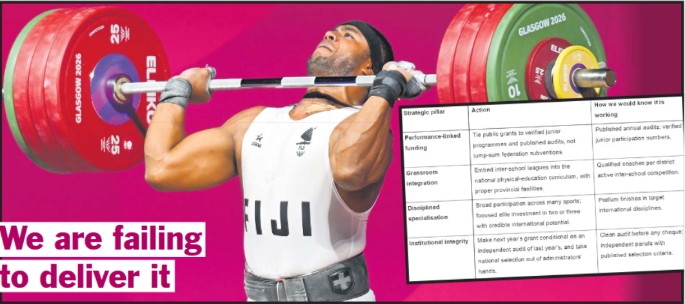
Four things, none of them beyond us (ref to table).
None of this is a criticism of our athletes. The talent has never been the constraint — it is the one thing we have never been short of. Our players succeed the moment they step inside somebody else’s functioning system, which tells you exactly where the problem lies.
Change what stands behind the scoreboard, and the scoreboard will change.
n SHAHEEN ALI served as Fiji’s Permanent Secretary for Trade for fourteen years and as the country’s Chief Trade Negotiator. He writes on trade policy, Pacific agency and state capability, and is based in Suva. The full policy briefing on which this article is based is available on request.
shaheen

