
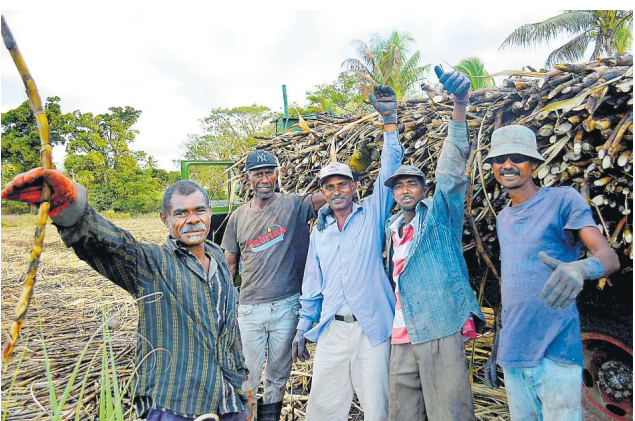
On June 5 2026, the Ministry of Agriculture, Waterways and Sugar Industry placed a paid media release in both dailies (FT, FS, 06/06/26) announcing a guaranteed sugarcane price of $85.00 per tonne for the 2026 crop season. It was presented as an assurance. It was, in every measurable economic sense, a confession. $85 per tonne was introduced by former prime minister Voreqe Bainimarama in June 2018 — eight years ago. In 2026, with rural diesel at its highest recorded price in Fiji’s history, with every farm input cost compounded by the Hormuz crisis, with the rail network FSC was contractually obligated to provide free now facing permanent closure, and with the Sugar Industry Tribunal’s own forecast price standing at $57.40 per tonne — the Government announced the same figure. Not one cent more. The farmer who has grown this nation’s foundational export crop for four generations deserves better than a status quo that has not moved since 2018. This type of betrayal was rife during the Girmitiya days under the British — startling to see it continue in 2026 under the Coalition, unabated under the dictatorial capture of the industry’s institutions by FSC.
When the promise was made and what it now costs
WHEN Bainimarama announced $85 per tonne in June 2018, rural diesel cost about $1.54 per litre. FSC was obligated under the Master Award to provide cane transportation to the mills free of charge. The National Farmers Union noted even then that production costs exceeded $85 when family labour was properly valued. Today rural diesel stands at $4.63 per litre on Viti Levu and $4.65 on Vanua Levu — confirmed by the FCCC effective June 1 2026 (FS, 01/06/26) — a 200 per cent increase since $85 was set. The ministry’s own release confirms the tribunal’s 2026 forecast price at $57.40 per tonne, but should be $85 as there is a price guarantee. This anomaly allows the FSC to pay less on first harvest cane delivery, than if the guaranteed price was used.
The diesel, the queue, and the fermenting cane
Every farm lorry in the cane belt today — the vehicle that replaced the rail FSC was supposed to provide free — runs on $4.63 per litre diesel. When Lautoka Mill suffered boiler failures during the 2025 season, over 70 lorries queued in the mill yard, cane fermenting in the heat, losing sucrose content — every cent of that loss falling on the farmer who had already paid to cut, load, and transport it. With rail now gone from Rarawai and Lautoka, one hundred or more lorries will queue simultaneously. When a mill breaks down — a common occurrence given century-old machinery — trucks sit for days. Drivers have no adequate rest, eating, or toilet facilities. Fields go silent because no truck returns to load the next haul, with cut cane lying in the sun for days. The redundancy that rail provided is permanently gone. That cost falls entirely on the farmer (FS, 08/06/26).
What $85 should actually be
Before the Hormuz conflict drove diesel to historic highs, real production costs — fertiliser, weedicide, harvesting labour, lorry transport, ratoon maintenance, and family labour conservatively valued — had already exceeded $100 per tonne. The NFU formally demanded $102 per tonne before fuel doubled — ignored. At their Ba meeting on June 7 2026, the NFU passed eleven resolutions demanding $110 per tonne — confirmation that our conservative calculation of $115, accounting for doubled diesel, wound-back subsidies, and rail closure costs, is if anything understated (FS, 08/06/26). Consumer Council CEO Seema Shandil confirmed everyday groceries rose by up to 35 per cent between late March and early May 2026 (FT, 19/05/26). Energy Fiji Ltd has placed a fuel price levy and increased its charges. NFP leader Biman Prasad — the man who once demanded, while in opposition, $100 per tonne and $5 lamb chops for Fijian families, now selling at $25 per kilogram — has not issued one public statement on $85, rail closure, or the lorry allowance cut since his FICAC charge in October 2025 (FT, 28/10/25). He attacked Mahendra Chaudhry — who organised the NFU meeting demanding fair prices — as playing political games, while offering no position on $85, rail, or the lorry allowance (FS, 08/06/26). The party born from the farmer’s struggle has chosen coalition silence over the farmer’s survival.
The rail taken, the institution captured
The Master Award required FSC to transport harvested cane to the mills at no cost to the farmer. FSC abandoned that obligation methodically — inducing farmers to shift to lorries through subsidies, starving tramlines of maintenance, then presenting the resulting 6 per cent rail usage figure (FT, December 2025) as justification for permanent closure. A ministerial directive of July 2025 ordered FSC to maintain tramlines. FSC filed for closure before the Sugar Industry Tribunal anyway — the same tribunal that received this author’s formal submission on May 22 2026 documenting precisely this cost transfer. The farmer has no independent body left to fight it. The Sugar Board was abolished under Bainimarama. The Sugar Cane Growers Council, constituted to field 38 elected farmer representatives, has held no growers election since 2004 (FT, 21/03/25) — SCGC CEO Vimal Dutt himself acknowledged the abolishment of grower representation warranted restoration. Elected representatives were terminated in 2009. Election provisions repealed in 2015. FSC is simultaneously miller, price setter, first payment arbiter, and transport decision maker — with no independent institution left to challenge any decision it makes.
The eighteen month wait
The $85 guarantee is not paid in a lump sum. It arrives across four broken payments over eighteen months — the period FSC requires to process the crop, sell sugar on world markets, and distribute proceeds through a payment system that services the corporation’s own costs before the grower sees a cent. Every other participant in the sugar industry economic cycle earns fortnightly throughout — the lorry driver, the cane cutter, the Sardar, the Pani Wala, the Hatmaan, the harvester driver, the mill worker, the FSC extension officer, the sector executive. The farmer whose cane delivery makes every one of those pay cheques possible waits eighteen months — four broken payments — and is treated as the industry’s afterthought, as delayed 2026 payments confirm. He is the first cause of every economic transaction in the Western and Northern divisions. He is paid last, least, and latest.
The reckoning
The ministry’s release advises farmers to diversify into other crops and livestock. That sentence is the most revealing in the document — a government conceding it cannot make cane farming economically viable. It abolished the Sugar Board. It captured the SCGC. It engineered the rail closure. It froze the guaranteed price at 2018 levels. It cut the lorry allowance. It ignored the NFU’s $102 demand and now faces an NFU boycott threat and eleven resolutions demanding $110. The $85 announcement is not merely a policy failure.
It is the latest instalment in a century of extraction that began on the indentured ships and has never fully ended — the Girmitiya farmer always last in line, picking crumbs after FSC executives collect their million-dollar salary packages. A family farming ten acres in Ba, Nadi, or Drasa, where four generations have grown cane since the girmit era — contributing ten to fifteen thousand dollars in unpaid household labour annually, waiting eighteen months for four broken payments that do not cover input costs, is not reading a government assurance this Saturday morning. It is reading eight years of institutional failure dressed in ministry letterhead. The price in 2026 is $115 per tonne. The announced price is $85. The difference is not a policy gap. It is a broken promise compounded annually for eight years — and the farmer, as always, is the one paying the interest.

