
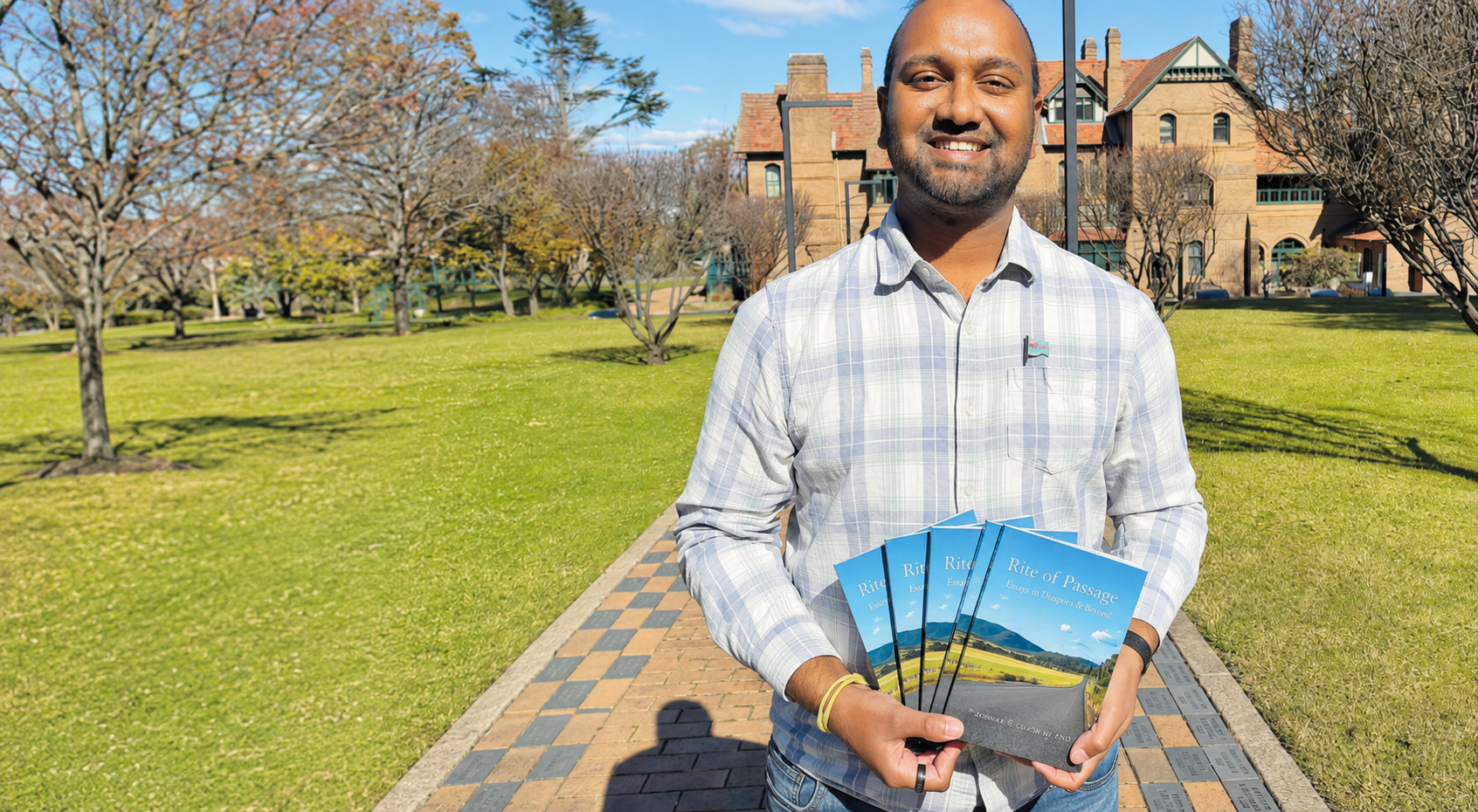
From Fiji to Australia, education to identity, and personal loss to public debate, Dr Prashneel Goundar’s new book Rite of passage: Essays to provoke thought brings together more than a decade of writings that challenge readers to think critically about the world around them. In 2017, he published his first collection of essays, In Simple Words. The book marked the beginning of his public identity as a writer. Since then, he has delivered numerous talks on writing and has published four additional books alongside many peer-reviewed scholarly articles. For Dr Prashneel Goundar, essays serve as a vehicle for critical reflection and public engagement, allowing writers to express ideas freely on issues that matter to society. Over the years, he maintained a personal archive of his writings and speeches. As Professor Sarah Wayland notes in the foreword to Rite of Passage, Goundar’s work reflects a commitment to translating complex academic ideas into accessible forms of community engagement, ensuring that scholarship reaches audiences beyond the university.
IN compiling Rite of Passage, Dr Goundar faced the difficult task of selecting essays capable of stimulating discussion both within Fiji and in broader academic contexts.
From a collection of approximately 50 essays, 27 were selected for inclusion. Some pieces, such as the opening memoir, were inspired by deeply personal experiences and individuals who shaped his life.
Others engage with contemporary social and educational issues in Fiji or emerged from moments when he felt compelled to speak publicly rather than remain a passive observer.
Many of Dr Goundar’s writings have appeared in a variety of publishing outlets and have received strong public engagement, particularly from readers of The Fiji Times. Opinion pieces such as In search of happiness, considerations for Fiji’s education review, and overcoming the loss of a loved one, prompted readers to contact him directly to share feedback and appreciation.
These responses motivated him to continue writing for wider audiences. One company manager reportedly circulated In search of happiness among staff members because of its inspirational message.
Similarly, following the publication of his book Pursuing divinity in Paradise (2020), the Then India Sanmarga Ikya (TISI) Sangam purchased 30 copies for distribution across its school libraries.
Although Dr Goundar relocated to Australia in 2022, his writing has remained closely connected to Fiji’s social and educational concerns.
Essays such as Desperate for titles, co-authored with me, generated significant public discussion by addressing controversial issues surrounding fraudulent doctoral qualifications and bogus institutions in Fiji.
The essay resonated strongly with readers because it confronted a topic often avoided in public discourse.
The writings collected in Rite of passage span more than a decade and reflect the competing pressures of academic life, professional commitments, and personal responsibilities. Dr Goundar notes that some essays took years to complete, often written gradually in small increments.
The memoir Gone with the wind, in particular, proved emotionally difficult to write as it recounts the loss of his mother to cancer. Early readers of the piece reportedly responded with deep emotion, recognising parallels with their own experiences of grief and loss.
Professor Wayland, Central Queensland University, similarly reflects that the anthology captures the often-hidden emotional realities of academic life, especially the personal sacrifices, uncertainty, and resilience that accompany the PhD journey.
The broader intention of the collection is to provoke debate, encourage curiosity, and invite readers to think critically about teaching, learning, society, and personal growth. Dr Goundar argues that academics frequently become constrained by the bureaucratic culture of scholarly publishing, limiting their ability to engage ordinary readers who are directly affected by research outcomes.
The collection includes memoirs and reflective essays on topics ranging from doctoral study in Australia, encounters with prominent South Pacific writers such as Emeritus Professor Satendra Nandan, experiences of academic bullying, and reflections on happiness, grief, identity, and social responsibility.
Several essays challenge conventional assumptions about life and society, while others examine questions of education reform, diaspora contributions, linguistic diversity, and the responsibilities of academics in contemporary society.
In particular, essays such as Stepping into Academia contribute directly to ongoing debates about higher education policy and academic standards in Fiji.
The title Rite of passage carries personal significance for Dr Goundar. Following the completion of his PhD in Linguistics in Australia, he was required to undertake the IELTS examination as part of the skilled migration process.
After successfully completing the test, his doctoral supervisor, Professor Finex Ndhlovu, remarked that he had achieved his “rite of passage” into Australian society, a phrase that later inspired the title of the collection.
For Dr Goundar, the phrase symbolises not only migration, but also the broader academic and personal milestones required to establish credibility across both Fiji and Australia.
Professor Wayland interprets this essay as an important reflection on the “life spine” of the doctoral experience, demonstrating how personal growth, loss, resilience, and transformation are often intertwined with scholarly achievement.
The significance of Rite of passage is further reinforced through the strong endorsements it has received from academics, professionals, and public intellectuals, as well as through the reflective afterword by Emeritus Professor Satendra Nandan.
In the afterword, Nandan describes Dr Goundar as “a questioning and questing writer” whose work engages deeply with educational, literary, and social concerns relevant to Fiji and beyond.
He commends the author’s ability to remember and honour influential figures such as Cliff Benson and Ratu Joni Madraiwiwi with “affection and generosity,” while also recognising the emotional depth of memoirs such as Gone with the Wind.
Nandan regards the anthology as “a gift to younger readers and aspiring writers,” emphasising that Dr Goundar’s writing journey contributes meaningfully to the tradition of “Writing Fiji”.
He further reflects that the collection demonstrates the importance of continuing dialogue “within and without in quest for answers to our problems and possibilities of daily living and loving,” ultimately asserting that “writing is healing” and that these essays reveal the enduring power of words, memory, and reflection.
These sentiments are echoed in the advance praises accompanying the volume.
Dr Sagar Solanki describes the collection as “a compelling and deeply reflective anthology” that bridges academia and everyday life with clarity and sincerity, while Professor Subramani regards the work as both “a persuasive story about becoming a writer” and evidence of Dr Goundar’s emergence as “a commanding resonance” within Fijian literature.
Similarly, Professor Anna du Plessis highlights the authenticity and emotional depth of the essays, particularly praising their capacity to provoke reflection on culture, belonging, and lived experience.
Award-winning journalist Ranbeer Singh characterises the collection as a moving narrative of resilience, identity, and transformation, while Dr Valentine Hazelman positions the anthology as an important contribution that encourages academics, policymakers, and readers to engage meaningfully with pressing societal concerns.
Together, the foreword, afterword, and endorsements underscore the intellectual, emotional, and cultural significance of Rite of passage within contemporary Pacific discourse.
Dr Goundar has been a Senior Lecturer in the University of New England’s Graduate Research School since February 2024. Prior to joining UNE, he served as a Lecturer at Fiji National University from 2015 to 2024.
Published by Carindale Publishing (Brisbane, Australia), Rite of Passage invites readers, writers, scholars, and policymakers to engage critically with the pressing social, educational, and cultural questions shaping contemporary life.
The book is available for purchase by contacting the author directly at prgoundar@gmail.com and at the USP Book Centre in Suva.
RAVNIL NARAYAN is a Senior Lecturer in Applied Linguistics in the School of Communications, Language and Literature at the Fiji National University’s, Lautoka Campus. The views expressed in this article is his own and not of the affiliated institution. For comments: email at ravnilnarayan@gmail.com

