
Part two: What was Fiji trying to tell me?
In part one, I wrote about the conversations that followed me across Fiji. They began in different places and with different people, but somehow they kept arriving at the same destination: Migration.
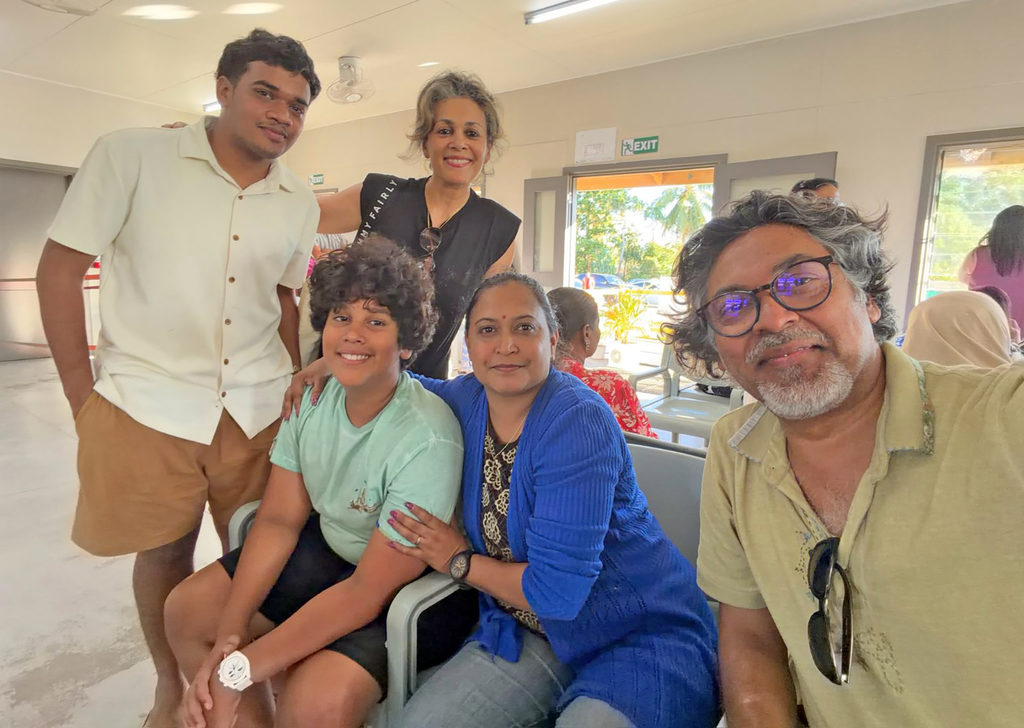
I had not gone looking for these stories. I had come home for a family holiday, to see my mother, spend time with family and friends, and reconnect with the country that shaped me. Yet by the end of the journey, I could no longer dismiss what I had heard as coincidence.
Together, these voices seemed to be telling us something about Fiji. But what? That question took me back to a very different conversation I had only days earlier.
AT the University of the South Pacific (USP), during a public lecture on Fiji’s changing labour market, employers spoke of mounting skills shortages. Government officials acknowledged the growing pressures created by outward migration. The National Skills Assessment pointed to shortages across dozens of occupations, while business leaders described vacancies they struggled to fill.
At the time, they had been statistics, reports and presentations. During my journey home, they acquired names, faces and voices. The statistics spoke of labour shortages; the people spoke of sons and daughters. The reports identified skills gaps; parents spoke of opportunities abroad. The evidence and the stories were no longer separate. They had become one.
And then I looked at the latest numbers. In June 2026 alone, Fiji Bureau of Statistics data show that more than 1,300 residents left Fiji for employment overseas. At the same time, the money flowing in the opposite direction continues to grow. Reserve Bank of Fiji figures put remittances at a record $875 million in in July 2026, while annual personal remittances have already crossed the $1billion mark. More than half now arrive through mobile money.
That last number immediately took me back to the talanoa in Nadi, the kava bowl, the request for a “wash-down”, the phone coming out, and money arriving from a relative overseas through M-PAiSA. What had sounded like an amusing village story was also part of a much bigger economic transformation. Then I read the IMF’s latest assessment of Fiji. It describes the country as a small, migration-prone economy facing “structural constraints on labour supply.” In the language of economists, that sounds technical. But I had already seen what it meant in everyday life: the taxi owner struggling to keep drivers, the teacher considering Australia, employers unable to find workers, and university graduates being welcomed overseas. Therein lies Fiji’s migration paradox. The same movement of people that creates opportunities for Fijians and sends vital income back to their families can also deepen the shortages of skills and workers needed to build the economy at home.
And that leaves Fiji with a much bigger question.
A nation at a crossroads
None of the people I met were making the wrong decision. Parents wanted better futures for their children. Teachers wanted recognition. Young professionals wanted opportunities. Employers wanted skilled workers. Universities wanted their graduates to succeed. These were stories of hope and ambition, not failure.
But collectively, they raised a much larger question: what kind of country does Fiji want to become? Migration has opened opportunities, supported families, reduced poverty and generated remittances that provide valuable foreign exchange. These gains should be celebrated.
But they should not stop us from asking a more fundamental question: Should migration complement Fiji’s development, or gradually become our development strategy?
From a developmental State to an emigration State
There is a bigger question behind these stories: What kind of development model are we building? Development scholar Matt Withers describes this as the risk of becoming an “emigration State”, one increasingly reliant on sending workers abroad and the remittances they send home. A developmental State focuses on building opportunities at home. The danger is not migration itself. It is when migration begins to substitute for development.
Remittances are enormously important to Fiji, but they cannot replace investment in our own productive capacity. That means creating better jobs and careers at home. For my nephew, the teacher, it means recognition and opportunities to progress. For our science graduate, it means research and professional opportunities in Fiji. For farmers and businesses, it means access to technology, finance and markets so they can become more productive and pay better wages. And for government, it means retaining the nurses, teachers, engineers and other professionals the country needs.
The aim is not to stop Fijians from leaving. It is to make migration a choice rather than a necessity, and to make staying or returning attractive choices too. That requires more than a migration policy. It requires a development strategy that creates quality jobs, rewards skills, raises productivity and gives people reasons to build their futures here.
A different conversation
My journey home left me with a few simple messages.
To the people of Fiji: Celebrate the success of our children wherever life takes them, but let us also celebrate those building their futures at home.
To our young people: Dream globally. Study, travel and explore the world, but never underestimate what you can build in Fiji. To our universities and training centers: Continue producing world-class graduates, but let us also help create world-class opportunities for them here.
To employers: Invest in working conditions, in people, in recognition, career progression and workplaces where talent can flourish.
To our leaders: Protect our migrant workers, value our diaspora and recognise the importance of remittances. But never allow labour export to become a substitute for development. Our greatest responsibility is to build opportunities at home.
As my plane lifted above Fiji, I thought again about the people I had met along the way (the taxi driver, the teacher, the children in my village, the proud father, the university academics and my old friends around the kava bowl). I had come home simply to spend time with my mother, family and friends. I left thinking about the future of the country that shaped me.
Perhaps the next time I come home, the conversations will be different, not only about opportunities waiting elsewhere, but about the opportunities we have created here.
Because Fiji’s future will depend on how many of our people can also see a future worth building at home.
DR NAREN PRASAD is a prominent Fijian economist who serves as the Head of Education and Training in the Research and Statistics Department at the International Labour Organization (ILO) in Geneva, Switzerland. The views expressed herein are those of the author and do not necessarily reflect the views of the International Labour Organisation or this newspaper.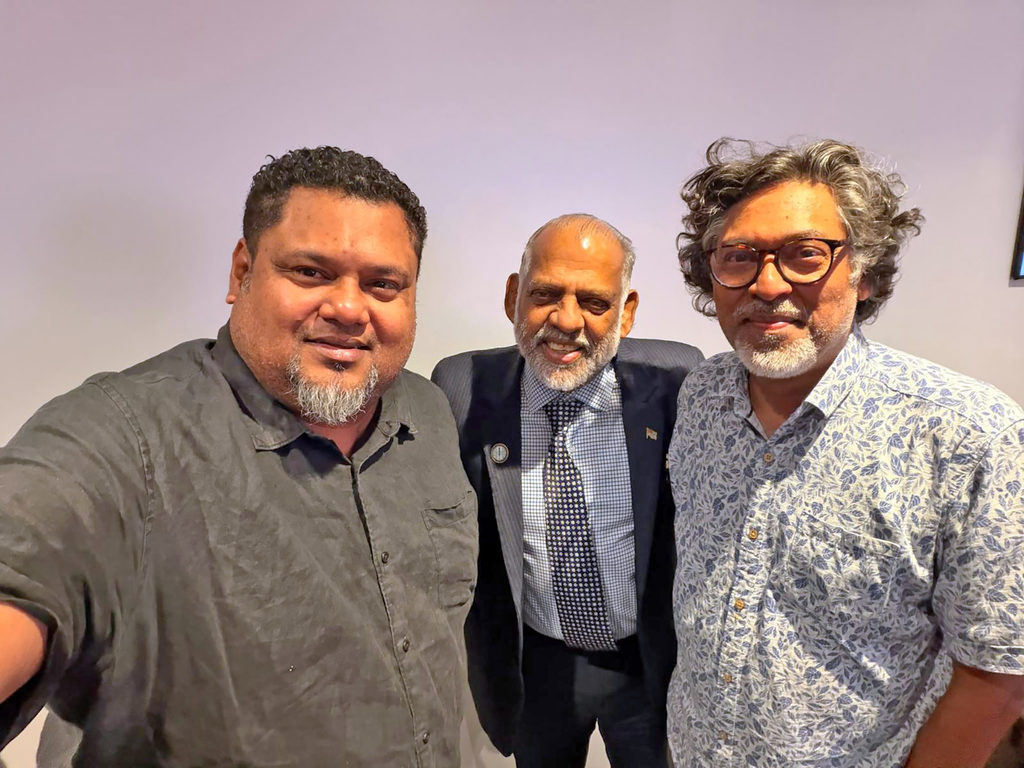
Dr Naren Prasad, right, with Labour Minister Agni Deo Singh and Edward Bernard, CEO of the Fiji Commerce and Employers Federation.
Picture: SUPPLIED
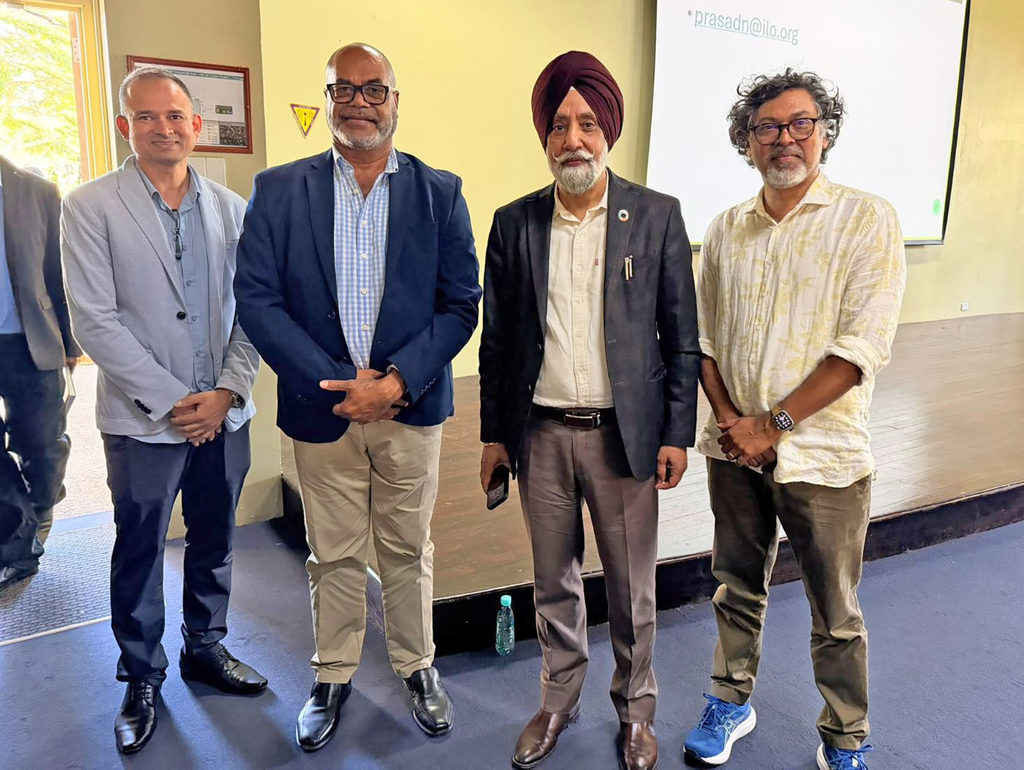
With PS Labour, Maratino Nemani, Associate Professor Baljeet Singh and Professor Gurmeet Singh. Picture: SUPPLIED

