
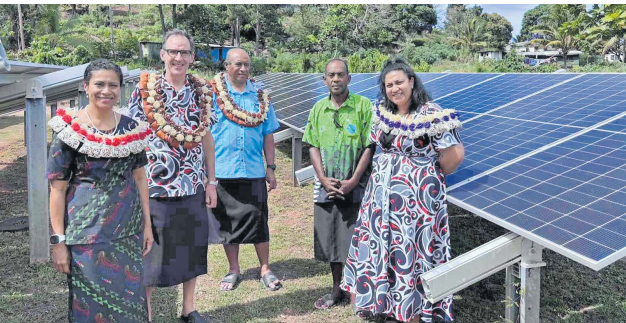
Whether Fiji can make the transition to renewable energy is no longer an open question. Nursing stations in Kadavu and cold storage in Savusavu have already demonstrated that clean energy can deliver reliable, life-changing services in some of the country’s most remote communities.
The challenge now is to scale that success from individual projects to a national investment program. If Fiji can show that hundreds of dispersed renewable energy projects can be bundled into portfolios that lenders will finance, it will do more than achieve its own renewable energy ambitions. It will establish a new model for Small Island Developing States, one that turns geography from a barrier into an opportunity through aggregation, innovation and partnership.
IN July, staff at Dama and Savusavu completed handover training on two solar cold storage and took charge of systems that keep fish, produce and medicine cold without a litre of diesel. In the Kadavu subdivision, nursing stations at Soso and Vacalea came online after the Ministry of Health and the International Solar Alliance relocated and recommissioned systems to reach the facilities that needed them most, bringing 70 per cent of Kadavu’s health facilities onto solar power.
These are small installations, measured in kilowatts rather than megawatts, and none of them will register in a national generation statistic. They matter because they settled a question that has shadowed Fiji’s energy transition for a decade. Can clean power be delivered reliably to the places that are hardest to reach?
Fiji answered it in stages. Under ISA CARES, the country chose solar electrification for two rural health centres at Dakuibeqa on Beqa Island and Daviqele on Kadavu, each fitted with an 8 kWp array and 20 kWh of battery storage sized against a measured daily load of just under 20 kWh, completed in November 2023.
India then under the Quad Climate Working Group signed a project implementation agreement with ISA in November 2024, covering Fiji alongside Comoros, Madagascar and Seychelles, with cold storage, solar pumping and rooftop systems for healthcare at its centre.
Across this body of work ISA designed, supplied, installed and commissioned 73 kWp of solar photovoltaic capacity backed by 68 kWh of storage, at facilities including Wainunu Health Centre in Bua, Yalobi Nursing Station in the Yasawas, and the nursing stations at Nairai and Naqara in Lomaiviti. Engineers built every system for remote island conditions, for redundancy, and for maintenance by people who live nearby.
Reliable power in a nursing station is not an abstraction.
It decides whether a vaccine holds its temperature or gets discarded, whether a midwife works under a lamp or a torch, whether an oxygen concentrator runs through the night.
The Ministry of Health and Medical Services directed where those systems went, and that judgement, rather than any technical breakthrough, is what made them work.
These projects were essential to create trust in solar solution within local context of Fiji.
Solar paired with storage performs in Fiji’s maritime conditions.
Fijian institutions can run the siting, procurement and handover such projects demand. The task now is to move from dozens of kilowatts to hundreds of megawatts, and that requires creating an eco-system of credible project pipeline, local capacity to procure and maintain solar plants, a robust regulatory support and available financing.
Fiji has already done the groundwork. The country has set a target of nearly hundred per cent renewable electricity by 2030 and has identified 75 community-ready solar mini-grid sites, each backed by feasibility assessments, power system designs and business models.
Priority mini-grid projects need an estimated $US60 million ($F132m). Meanwhile, Fiji still imports over US$700 million($F1.55b) in petroleum every year, its largest import category, and roughly 40 per cent of its electricity still comes from diesel and heavy fuel oil. Every megawatt that reaches financial close frees foreign exchange and loosens the grip of a fuel market shaped by decisions taken far from the Pacific.
Because diesel and shipping costs feed straight into food prices and inter-island freight, this is a question of food security and household budgets as much as decarbonisation.
Geography is what makes the financing hard. More than 330 islands, over 110 of them beyond the national grid, mean Fiji’s projects are necessarily small and scattered.
A developer will not mobilise crews and equipment for a single mini-grid on a distant island, and a lender will not underwrite one. Aggregated procurement answers this by bundling many sites into a single tender rather than tendering them one by one.
A developer bidding for a portfolio of twelve or fifteen sites spreads fixed transaction costs across the package, standardises technical specifications and power purchase terms, and diversifies operational and revenue risk. Lenders, in turn, finance a portfolio rather than a single asset exposed to one community’s demand or one island’s weather.
India has run this play before, using demand aggregation for LED lighting, for solar irrigation pumps and later for utility-scale solar parks, each time assembling a package large enough to attract serious bidders and drive prices down through competition. The logic travels.
Tonga, Vanuatu and the Solomon Islands have made real progress through donor-supported, site-by-site work, and each now runs into the same ceiling Fiji does.
Fiji need not build the machinery from first principles. The ISA SIDS Platform already supports harmonised procurement and aggregated tenders, and the Global Solar Facility mobilises blended finance to de-risk investment.
Fiji and ISA signed a Country Partnership Framework in July 2025 and have since developed a country partnership strategy that carries the work into schools, jetties, mini-grids, agriculture, water and transport, alongside a Solar Technology Application and Resource Centre at Fiji National University to train the technicians who will keep all of it running.
The Department of Energy, Energy Fiji Ltd, developers, financiers and technical partners now need to bring these pieces into a single aggregation framework built on the existing pipeline. The health centres and cold storage already running answered the question at the scale where trust is built. What remains is to answer it at the scale where economies change.
Fiji’s journey carries significance far beyond its own shores. Small Island Developing States across the Pacific, the Caribbean and the Indian Ocean contend with the same conditions Fiji does:
n Small and dispersed markets;
n high logistics costs;
n limited fiscal space; and
n vulnerability to external shocks.
If Fiji can demonstrate that dozens of community-scale renewable energy projects can be aggregated into investable portfolios, it will establish a blueprint for island nations everywhere to move from donor-funded pilots to market-driven scale.
In doing so, Fiji will not only advance its own vision of a secure, resilient and renewable energy future, but also help redefine how the world’s island states finance and deliver the clean energy transition.
RO FILIPE TUISAWAU is the Minister for Public Works, Meteorological Services, and Transport, Republic of Fiji and ASHISH KHANNA is the Director General, International Solar Alliance. The views expressed herein are theirs. The views expressed om this article belong to the authors and do not reflect the views of this newspaper.
ro filipe

