
There was a time when I believed Parliament was a place where words carried weight. Perhaps that belief came from childhood, when every debate sounded consequential. Growing up in Kashmir, Lautoka, I did not understand government machinery, but I understood that Parliament was meant to be serious: A place where people stood, spoke, persuaded and were held accountable. Watching Fiji’s parliamentary exchanges today from thousands of kilometres away, I wonder when we became satisfied with noise instead of argument. When did a clever insult become more memorable than a carefully constructed idea, and representation something we discussed at election time rather than demanded every day?
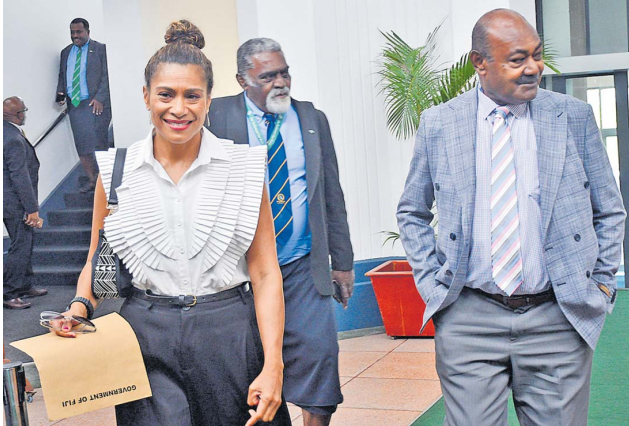
FOR me, the problem is not simply that Fiji needs more women and younger people in Parliament, although it does. The deeper issue is that our Parliament should feel like a reflection of Fiji itself, and too often it does not. Women remain a small minority in the chamber, while the people making national decisions are generally much older than the population they govern. These are not statistics to recite and forget; they tell us whose experiences regularly reach the floor of Parliament and whose do not. When large parts of the country are missing from that room, they are too easily spoken about rather than genuinely heard.
I grew up surrounded by women whose leadership never required a title. They were mothers, aunties, teachers and grandmothers who stretched household budgets, settled disagreements, disciplined children, organised school functions, cared for relatives and somehow kept families moving. Some of the strongest people I knew stood at school gates, in kitchens, classrooms and beside hospital beds. That is why it still feels strange that, at the highest levels of political decision-making, leadership so often looks male. Fiji has never suffered from a shortage of capable women; perhaps what it has suffered from is a shortage of political doors being opened wide enough for them.
The same is true of younger Fijians. At the 2022 election, only a small number of elected MPs were 40 or younger, and just one was 30 or below. Age brings experience, memory and patience, and those qualities matter. But youth brings something equally important: proximity to the future. The generation deciding whether to stay in Fiji, migrate, afford a home, navigate artificial intelligence or raise children in a climate-vulnerable Pacific country deserves more than consultation; it deserves genuine political power.
I feel that absence personally because I belong to a generation Fiji partly lost. My family migrated to Auckland in 2011, before I was old enough to vote in a Fijian general election, so I have never voted in the country of my birth. Yet Fiji has never stopped being part of how I understand myself. Kashmir and Lautoka remain inside me: the schools, the heat, the roads and ordinary routines that become sacred with distance. I carried that childhood into classrooms in New Zealand, the Middle East and now Tokyo. When people speak about Fiji’s “brain drain”, I hear people who still love home even when home is no longer where they sleep.
That is why I want younger people in Parliament. Not because young automatically means progressive or wise, but because somebody in that chamber should understand what it feels like to build a life in the Fiji of now. Somebody should understand why a qualified young person can love their country and still spend evenings searching overseas job advertisements. Somebody should know the heartbreak of leaving with every intention of returning, only to discover that life has slowly rooted itself somewhere else. Parliament needs people old enough to remember where Fiji has been and young enough to feel the urgency of where it is going.
But representation alone will not fix what troubles me when I listen to modern politics. I miss the art of the well-articulated MP. I do not mean polished English, expensive schooling or an imported accent; Fiji has spent enough of its history confusing colonial polish with intelligence. I mean the ability to stand, know your subject, build an argument, anticipate criticism and respond without turning disagreement into humiliation. Fiji’s political history has produced figures such as A.D. Patel, Ratu Sir Kamisese Mara and Jai Ram Reddy whose politics can be debated, but whose command of public argument reminds us that eloquence and substance once mattered enormously.
Maybe part of my frustration comes from being a teacher. My working life revolves around asking children: Why do you think that? How do you know? What evidence can you give? Can you disagree without disrespecting somebody? We teach these habits because shouting an answer does not make it correct. Yet political culture can reward interruption, slogans, cheap laughter and the short clip designed to travel online. If I can expect an eight-year-old to listen before responding, surely it is not unreasonable to expect the same discipline from somebody making laws for an entire country.
I am not pretending Fiji once possessed some golden Parliament where everyone was civil and enlightened. Our political history contains racial division, exclusion and repeated ruptures of democracy. Parliamentary culture is not preserved by a building and a mace; it is a habit generations teach one another. It means learning to scrutinise legislation, question a minister, defend a position, concede a good argument and oppose somebody without treating them as an enemy. Social media makes that harder because careful explanation rarely travels as far as a ten-second insult. But Parliament cannot surrender to the algorithm; its purpose is to examine laws, question power and make decisions that outlive political moments.
None of this requires pushing older people aside for younger people or men aside for women. I want the grandmother and the 28-year-old graduate, the rural woman and the experienced lawyer, the teacher, farmer, entrepreneur and community worker. I want political parties to stop treating diversity as a photograph taken on nomination day and instead cultivate leadership years before an election arrives. Youth parliaments and women’s leadership programs have value, but they mean little if those pathways never lead into the real chamber. Otherwise, we risk teaching people how democracy works while quietly signalling that political power still belongs to somebody else.
Perhaps this matters to me more because I now live away from Fiji. Distance does strange things to belonging: you can become protective of a country while also seeing its weaknesses more clearly. I teach children in Tokyo today, but part of me remains that boy in Lautoka who assumed the adults in Parliament must know more because their responsibilities were so important. Growing older has taught me that a title does not automatically make a person wise, and occupying a parliamentary seat does not automatically make somebody a parliamentarian in the fullest sense. That distinction has to be earned each time an MP rises to speak.
I want a Parliament that makes a young Fijian girl watch and think, “I belong there.” I want a young person considering migration to hear somebody articulate anxieties they thought politicians did not understand. I want Fijians to tune in not merely hoping for a fight or an embarrassing clip, but because a speech might genuinely challenge what they believe. Fiji does not lack intelligent women, passionate young people or articulate thinkers; what we have too often lacked is the political courage to make enough room for them. Parliament should not merely represent power. It should represent us — all of us — and when it speaks, the country should once again feel that it is worth listening.

