In early 2025, the Fiji Government appointed the Fiji Electoral Law Reform Commission (FELRC) chaired by former Chief Justice Daniel Fatiaki and comprising Professor Wadan Narsey, Seini Nabou and Dr Deidre Brookes (a NZ citizen).
The final report of the FELRC (An Electoral System for the People from the People) was handed to the Fiji Government in early July 2025. Prof Narsey conducted a validation and simulation exercise at the FEO and made a presentation to the Prime Minister via Zoom from Melbourne.
The 2026 website of the FLRC recorded that “The Report [An Electoral System for the People from the People] marks a significant milestone in Fiji’s journey toward electoral reform and democratic enhancement.”
But most disappointingly and for reasons unknown, the final report was not tabled in Parliament or made public.
My attempt through a The Fiji Times article (April 15, 2026) to enlighten the Fiji taxpayers who footed the bill for the 2025 FELRC and hoping that the 2026 CRC could save some money by not duplicating our effort, was castigated by the Attorney-General.
I was glad therefore when the 2026 Constitution Review Commission requested a public submission from me, including my take on our recommended electoral reforms.
This article is Part II of my Submission to the 2026 CRC on 6 July 2026.
The 2025 FELRC
THE 2025 FELRC was asked to ensure that its proposed electoral system:
(a) should uphold the principles of democracy and good governance, equality, inclusion, and fairness;
(b) promote the representation of women by the inclusion of special measures which comply with Fiji’s obligations under international law, including CEDAW;
(c) strengthen the accountability of elected representatives to voters;
(d) review the restrictions placed on civil society actors;
(e) review the powers of the Supervisor of Elections, electoral offences and penalties;
(f) carry out community-wide consultations.
The 2026 CRC should confirm that its own TORs are consistent with the TORs for 2025 FELRC.
The public complaints about the current system
Our consultations throughout Fiji found that voters and political candidates complained:
(a) about the confusing Sudoku style ballot paper with hundreds of random numbers with no candidate name or picture, and no party names or symbols;
(b) the absence of an identifiable local MP who would be accountable to the voters in his/her local community;
(c) the gross unfairness of a system which allowed candidates with insignificant number of votes to become MPs under the massive votes going to the “popular leaders”, while others with thousands of votes were excluded;
(d) the unreasonable requirements for registration of political parties; criminalisation and excessive penalties for minor infractions; the excessive powers of some electoral officials;
(e) many other criticisms outlined in the full report of the FELRC.
These weaknesses are still there for the next election.
What the public wanted
The public consultations made clear that voters wanted:
(a) their own local constituencies and MPs accountable to them (including separate maritime constituencies);
(b) simple ballot papers with candidate names, party symbols, and photographs of candidates;
(c) simple voting with ticks (no complicated preferences);
(d) transparent counting of ballot papers at the local constituency centres;
(e) proportionality at the national level, one of the benefits of the 2013 Constitution;
(f) the 2013 Constitution to be dumped if it prevented progressive change.
The 2025 Proportional Open List Constituency System (POLCS)
In response to the public requests, the Proportional Open List Constituency System (POLCS) recommended by the 2025 FELRC would comprise three essential elements:
(a) 25 open constituencies (with five maritime ones), with no ethnic requirement for candidates or voters;
(b) 25 reserved seats for women in the same 25 constituencies, all voters voting and only women standing. This could be a temporary measure until women candidates begin to stand and win in the 25 Open constituencies;
(c) 21 list seats to ensure proportionality.
This would result in 71 MPs, the same size as in the 1997 Constitution, which number was generally accepted by Fiji previously without any great protest about cost inflation.
The current high salaries of ministers, assistant ministers, MPs and their perks would be all independently assessed by a body independent of Parliament (not by the MPs themselves as currently).
The constituency boundaries could be easily demarcated by using already existing information on the voter ID cards, such as polling station the voter was associated with. This exercise has already been conducted by Mr Fatiaki and Ms Nabou with the assistance of technical staff from the FEO. There is no need for a costly and time-consuming re-registration of all voters.
Simple voting and transparent counting
The 2025 POLCS delivers the voters their simple voting and transparent counting.
Each and every voter would get two ballot papers, one for the open constituency, and one for the RSW.
Each ballot paper will have the names, party symbols (including Independents) and photos of all the candidates for that constituency alone. i.e. probably less than 15.
There will therefore be 25 MPs from the 25 open constituencies and 25 women MPs from these same constituencies (no need for different boundaries for the RSW).
The counting for the 50 local MPs can be and should be decided by the FEO at the local constituency centres, in front of party agents, media representatives and voters themselves.
Simple piles associated with each candidate would be clearly observable and the counting visible and verifiable. There will be no preferences to count and recount (causing great confusion in the public mind).
While the First Past the Post system has its weaknesses, the benefits of simplicity far outweigh the small weakness. The eventual proportionality of results for every party will compensate for any weakness of representation at the constituency level.
With 50 local MPs, voters will know exactly who is their local MP (two actually) and who they can go to for their needs.
The list MPs will then be the only results decided at the FEO HQ after all the party votes are aggregated.
All these list MPs will also have significant numbers of votes behind them from their local constituencies.
Note that “closed” lists reflect party choices, not those of the voters.
The List to Ensure Proportionality
For each qualifying party having more than the 5 per cent threshold, “the proportion of their total MPs in Parliament” will be the same as the “proportion of their total party votes in total votes cast for qualifying parties”.
While the 5 per cent threshold currently applies to qualification for the list, note that any small party which has enough local constituency support to win on a First Past the Post mode of counting, could win a seat without getting 5 per cent of the total votes cast in Fiji (the current threshold).
Independents could also be elected in local constituencies without having to satisfy the 5 per cent threshold which requires around 25,000 votes.
In the final report of the 2025 FELRC, we had stated that the losers from the open constituencies would then go on to the open list where they will be ranked according to “standardised votes” based on percentages of votes received in the constituency.
I have since considered that there is no need for standardisation of losers’ votes which the public may have difficulty understanding.
The FEO could simply rank losers by the total votes received. This will also ensure that the MPs selected for Parliament will also have significant numbers of votes behind them, like the Winners.
Guarantee of Opposing Views in Parliament
With there being 21 list MPs comprising constituency losers, there is a virtual guarantee that there will be opposing views conveyed to Parliament, and not just of the winners and their parties. This must surely strengthen democracy and accountability.
Why Reserved Seats for Women?
A few witnesses did state to the FELRC that there should not be any reserved seats for women and that women should compete with men equally as candidates.
The FELRC, however, felt that given the extent of violence against women in Fiji, women were not on the same “level playing field” when it came to taking full part in politics as candidates, even if they in aggregate had roughly the same number of votes nationally as men.
The full report of the FELRC explains why there are urgent economic reasons to strengthen women politically in Parliament, because historically, women have never been more than 15 per cent of Parliament despite all the encouragement by women’s organisations, local and international.
(a) Women have extremely small shares of total wealth, total income, paid formal employment, and even leisure, while doing more than 54 per cent of all work in Fiji (paid and unpaid);
(b) With the 25 Open and 25 RSW boundaries being the same, then male and female candidates for any party should be able to campaign together, giving greater security to campaigning women candidates. There will be no shortage of women candidates as currently;
(c) As never before, every woman voter throughout Fiji will have a woman MP to approach with their problems;
(d) giving women their own reserved seats will also ensure that good male candidates are less likely to be pushed out of the 25 Open Constituencies as good women candidates are more likely to stand for the RSW;
(e) Note that the losers from the RSW seats do not go on to the party lists, only the losers from the 25 open constituencies, more likely to be men;
(f) the PM will have far more women to choose from as ministers and assistant ministers than currently;
(g) For the first time the Fiji Government will be able to tell the world that Fiji satisfies the CEDAW target of at least 30 per cent of Parliament being women – at least 25. Currently there are only five women in Parliament and not likely to be much more after the next election.
It is a terrible pity that some political parties – men dominated of course – still do not support Reserved Seats for Women.
Protecting both major ethnic groups
Fiji has suffered coups in 1987 and 2000 because, in my opinion, indigenous Fijian parties did not control government after elections and they were able to influence the RFMF to conduct coups.
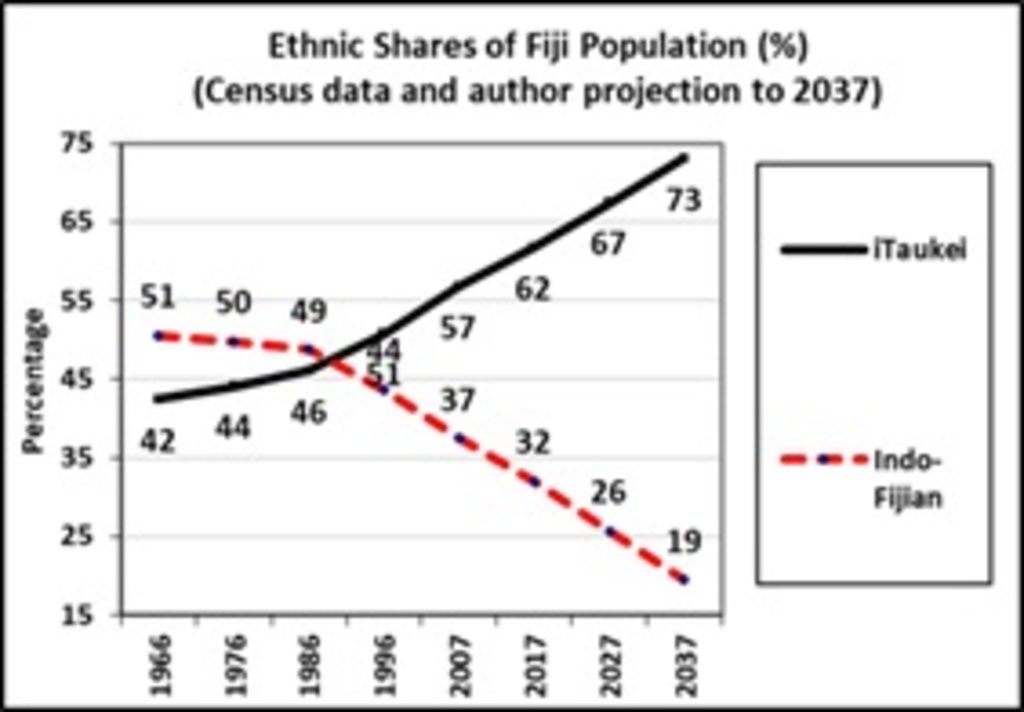
With indigenous Fijians now comprising 65 per cent of the voters and Indo-Fijians comprising around 30 per cent, the element of proportionality through the Open List system will ensure, without fail, if the two major ethnic groups vote as groups, then whoever they vote for
q iTaukei/Indigenous Fijians will elect 63 per cent of the MPs (even more in the future).
q Indo-Fijians will elect 31 per cent of the MPs (decreasing slowly into the future)
The future for ethnic proportions of the population may be seen in the accompanying graph (probably the most important graph in the political history of Fiji). By 2037 Indo-Fijians will be a mere 19 per cent of total population and slightly higher proportion of voters. A mere 12 per cent of class 1 primary school children will be Indo-Fijian.
The political parties representing iTaukei voters will almost certainly form Government either on their own or in partnership with other parties which will include those voted for by Indo-Fijians as currently.
The skewed electoral results and marginalisation of iTaukei parties that encouraged coups in 1970 and 2000 will not occur again.
That proportionality element is central to the 2025 POLCS outlined in the final report of the FELRC.
No need for conflict at the Boundaries Commission
In all the electoral systems from 1970 to the 2013 Constitution, the Boundaries Commission saw intense political bickering as political parties tried to move boundaries this way and that to suit their perceived interests.
But with total proportionality ensured by the 2025 POLCS, there will be absolutely no advantage to be gained by “gerrymandering” or moving boundaries.
At the FEO HQ after allowance is made for the independents who win in local constituencies, then each party who gets past the 5 per cent threshold will be allocated the same proportion of seats in Parliament as their share of national party votes (say T).
If C is the number of constituency seats that party has won, then the number of list seats it is entitled to will be L = (T-C).
Once T is fixed, then C going up by 1 MP (through gerrymandering of boundary change) will mean that L must go down by 1 MP, since T is fixed. And vice versa.
Constituency boundaries can be set purely according to the logistical needs of the candidates, voters and FEO officials in implementing the elections.
Other advantages of the recommended 2025 POLCS
For the first time since 2006 there may be independents winning.
For the first time since 2014, there may be small parties winning in local constituencies even if they do not get the threshold nationally.
Warning: if the next election is held under the same 2013 system (as it currently seems), the current small parties may not make the 5 per cent threshold.
Reduce the Threshold to 2%
It would be considered utterly scandalous if it was discovered that the Fiji Elections Office had quietly thrown away thousands of votes into a dustbin after the elections.
Yet at every election – including the next one – the current 5 per cent threshold throws more than 25,000 votes into the dustbin because their parties did not achieve the 5 per cent threshold.
With 1 MP in a 71 seat Parliament representing just 1.4 per cent of voters (and 1 MP in a 55 seat Parliament representing just 1.8 per cent of total votes), I suggest that the threshold for parties to qualify for the list could be sensibly reduced to 2 per cent to be fair to small parties.
Remember that the winners in the local constituencies will not require any threshold to be exceeded – they just need to win First Past the Post relative to the other candidates.
Other Changes to the Electoral Laws
The 2025 FELRC Report and its annexes have detailed recommendations for fundamental changes to the electoral laws to remove the climate of fear etc.
Sadly, Fiji will not see the benefits described above, from the next election, because I suspect that the 2025 POLCS does not suit the personal priorities of Fiji’s current political leaders who think that the current system suits them, regardless of what the voters think.
Will Fiji get the results they deserve?
WADAN NARSEY is a former Professor of Economics at The University of the South Pacific. The views expressed are his and do not necessarily reflect the views of this newspaper.