THE Ministry of Environment and Climate Change and WWF-Pacific this week welcomed a landmark $US42.6million ($F95.43) investment to protect and restore Fiji’s Great Sea Reef – bringing new hope for coastal communities, marine wildlife and one of the country’s most valuable natural assets.
The Green Climate Fund has approved $US35.2m ($F78.85m) for the 10-year Fiji Coral Reef Resilience Project. A further $US7.4m ($F16.58m) in co-financing from the Government of Fiji, the Government of Australia and WWF brings the total investment to $US42.6m ($F95.43m) — the country’s largest investment to date in nature-based approaches to strengthen the climate resilience of vulnerable coastal communities.
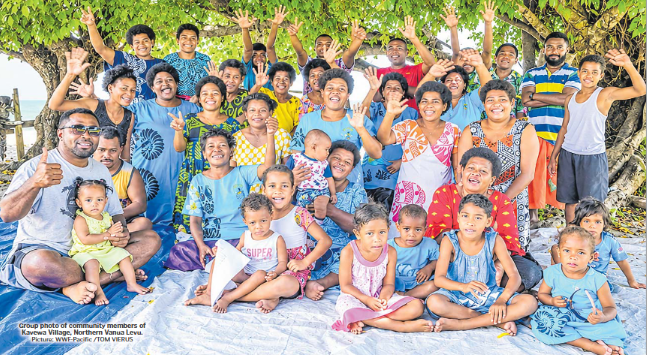
The project will bring government, communities and partners together across the provinces of Ba, Ra, Bua and Macuata to restore mangroves and riparian forests, strengthen management of the Great Sea Reef, support locally-led adaptation and grow reef-positive enterprises. It is expected to directly benefit 121,358 people.
A natural defence under threat
More than 75 per cent of Fijians live along the coast, where fisheries support food, income and deep cultural connections to the Great Sea Reef. The reef underpins an estimated 65 per cent of Fiji’s export earnings and 20 per cent of national GDP, making its health inseparable from the country’s future prosperity.
Yet tropical cyclones and floods cost Fiji more than $US500m ($F1.12billion) each year, while coral bleaching, overfishing, unsustainable coastal development and sediment runoff are placing the reef under mounting pressure. The new project offers a timely opportunity to keep this natural defence from reaching a tipping point and to build a safer, more resilient future.
From ridge to reef
The Great Sea Reef stretches more than 275 miles along the western coasts of Vanua Levu and Viti Levu. The world’s third-largest continuous barrier reef system, it is home to 55 per cent of Fiji’s fish species and 74 per cent of its coral species. It can reduce wave energy by up to 97 per cent and wave height by 84 per cent, helping shield coastal communities from erosion and storms. As one of a small number of climate-resilient “super-reefs”, it is also expected to play a critical role in the survival and recovery of coral reefs globally.
The project will apply an integrated ridge-to-reef approach that recognises the close connection between healthy land, rivers, coasts, and ocean ecosystems.
Planned activities include:
n restoring 835 hectares of mangroves and 2524 hectares of riparian forests;
n building nature-based coastal protection, including living shorelines, expected to reduce flooded land area by 11 per cent and lower flood exposure for more than 74,000 people;
n establishing a Great Sea Reef management plan across four provinces and 20 customary fishing grounds, or qoliqoli, supported by a dedicated Management Unit within the Ministry of Environment and Climate Change;
n creating a $US1.5m ($F3.36b) fund providing direct grants to at least 12 community-designed adaptation initiatives; and
n supporting 50 reef-positive enterprises, including women-led businesses, with development and growth assistance, helping at least 25 access commercial capital and mobilising an estimated $US500,000 ($F1.12m) in finance.
Over the next decade, the project aims to increase fish biomass by 20 per cent, avoid $US9m ($F20.16m) in economic losses from coastal flooding, and create stronger, more diverse livelihoods. It is expected to directly benefit 121,358 people — equivalent to 13 per cent of Fiji’s population — while helping communities turn local knowledge and nature-based solutions into lasting resilience.
WWF-Pacific will lead implementation in close partnership with the Ministry of Environment and Climate Change, divisional forest offices, provincial authorities, iTaukei institutions, communities and other partners.
Partner and community voices
Dr Sivendra Michael, permanent secretary, Fiji Ministry for Environment and Climate Change, said the Great Sea Reef is central to Fiji’s identity, food security, economy and resilience.
“The approval of this programme follows seven years of effort to get to this point,” he said.
“MECC continues to advocate for financial reforms that enable these types of interventions to be financed at scale. This program serves to connect national leadership with the knowledge and determination of communities. Through its ‘ridge to reef’ approach to local ecosystem restoration and a core focus on strengthening local stewardship, this program offers the opportunity to take further significant step forward in our national effort to protect Fiji’s natural assets and build a safer, more prosperous future for our people.”
WWF-Fiji’s Great Sea Reef program manager, Margaret Tabunakawai-Vakalalabure, said the event was a landmark investment in hope and practical action.
“It recognises that thriving reefs, forests and mangroves are vital systems protecting Fiji,” she said.
“WWF is proud to stand with the Government of Fiji and communities to deliver locally led solutions that strengthen livelihoods, unlock new opportunities and give the Great Sea Reef the best possible chance to thrive for generations.
“WWF-Fiji pays tribute to the many individuals, communities and organisations whose dedication and contributions helped shape the vision and final proposal.
“This achievement is the culmination of a seven-year journey built on collaboration, dialogue and shared commitment.
“We extend our sincere appreciation to key partners, including the Fiji Crop and Livestock Council, the Fiji Sugar Council, farmer and fisher groups across Fiji, the Soqosoqo Vakamarama iTaukei, our civil society and NGO partners, and members of the private sector. Each played an important role in informing and strengthening this initiative, which reflects the aspirations, expertise and collective efforts of a broad coalition committed to Fiji’s sustainable and resilient future. We also sincerely thank the Ministry of Environment and Climate Change for its leadership and commitment in helping make this important initiative possible.”
Ratu Semi Ramatai, the chief of Nabouwalu Village, Bua, said the reef was “our food source, our protection and part of who we are”.
“We are excited that this project will support communities to lead decisions, restore our mangroves and fishing grounds, and pass on a healthier ocean to our children.”
Mere Colavatu, the Mali District Women’s Representative from Nakawaga Village, Macuata, said climate change was already affecting their shores and livelihoods, but “our communities also hold knowledge and solutions”.
“With the right support, we can combine that knowledge with science, strengthen local enterprises and build a future in which both people and nature prosper,” she said.
Emosi Rotokala, the head of the environment committee in the district of Sasa in Macuata, said, their qoliqoli (traditional fishing grounds) served as the primary source of income and livelihood for the people of Sasa.
“The community has limited dependence on agricultural activities, as the local environment and available resources make marine-based livelihoods more sustainable and reliable. As a result, most households depend on fishing and the harvesting of marine resources from the qoliqoli to meet their daily needs, support family welfare, fund education, and contribute to community development. Our qoliqoli is, therefore, not only an important economic asset but also a vital cultural and social resource that sustains the well-being of our communities.”
The Fiji Coral Reef Resilience Project builds on almost two decades of WWF collaboration with communities along the Great Sea Reef and complements other climate and conservation investments in Fiji.
WWF Fiji also gratefully acknowledged the support of WWF-US in its role as the Accredited Entity, whose guidance and partnership have been instrumental throughout the nine-year journey to bring the proposal forward.