
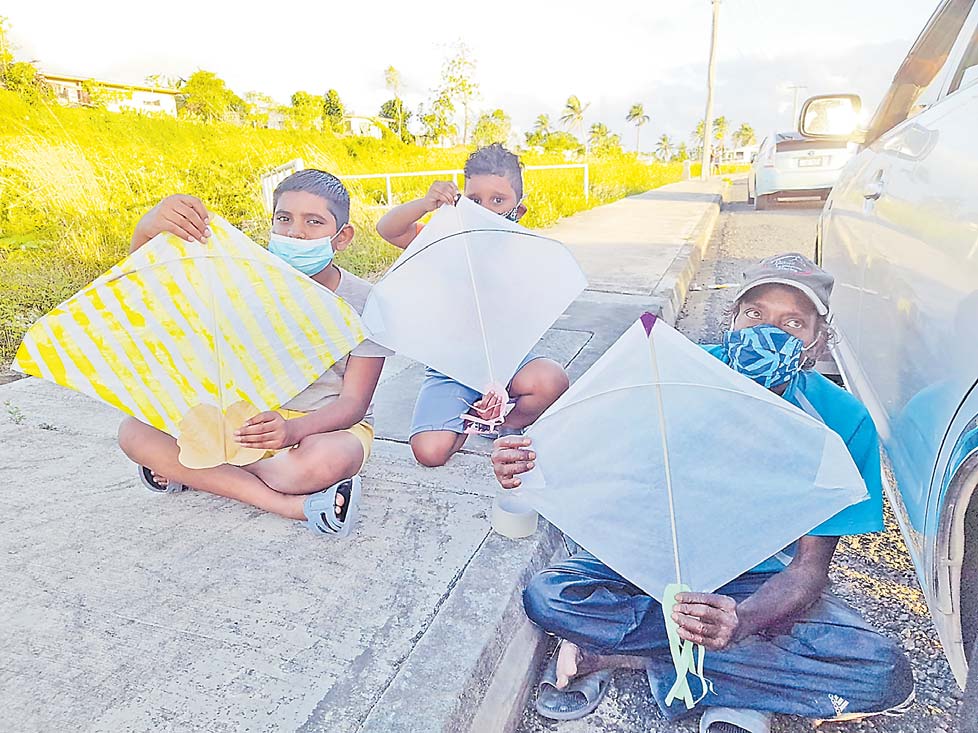
Residents of Lautoka and across Fiji recently showed their kite flying skills and displayed their flamboyant flying toys to mark the Hindu auspicious festival of makar sankranti, celebrated a day after lohri festival.
This day acknowledges the arrival of spring and the end of the winter season.
The ancestral craft of kite flying was tested by many modern kite lovers who maneuvered their kites to cut their opponents’ kite strings.
They performed crafty handling tricks.
Their kites were usually diamond-shaped — made of paper, bamboo sticks and attached to a string.
In contemporary times, kites were generally flown for sports and recreational activities.
Lautoka kite lovers were extremely thrilled with the experience.
Kite flying in the clear blue sky was witnessed in many parts of Fiji, colouring the sky with kites of different sizes and shapes.
Although kite flying history is ambiguous and speculated, the available evidence of its invention and its use is worth noting.
Thus, this opinion article attempts to put together the history of kite flying and its significance.
History
Kites have been used to drive away evil, convey messages, symbolise gods, hoist flags, propel craft, drop propaganda leaflets, catch fish, spy on adversaries, gauge the weather, photograph the earth, relay radio signals, and carry people into the air as website www.Britannica.Com reports.
Countries such as Indonesia, Malaysia and the South Pacific recognised kites as fishing equipment.
They were composed of natural materials.
However, other evidence claim that it was invented and developed in other countries.
Earlier evidences of kite flying can be found in China.
Han dynasty Chinese general Han Hsin flew a kite over the city’s walls to determine the distance of the army and his soldiers were able to sneak into the city, surprise the enemy, and win the battle according to website www.Nationalkitemonth.Org.
Chinese kites were often rectangular, and some had musical instruments attached such as whistles, while others had designs inspired by mythology and folklore.
Indonesia also boasts one of the first countries to depict kites and over time it spread across India, Japan, Korea, Myanmar, North Africa, Malay peninsula, Indonesia and the islands of Oceania, according to website www.Britannica.Com.
There are many stories about how the people of Micronesia used leaf kites to carry bait far out over the water where the gar fish fed.
The polynesians have myths about two brothers, who were deities that introduced kites to man when they had a duel.
The winning brother flew his kite the highest.
There were contests in the Pacific islands where the highest flying kite was dedicated to the gods, as website www.Nationalkitemonth.Org reports.
Website www.Kite.Org states kite flying spread throughout Europe in the 14th and 15th centuries, and later it was used for various craft of meteorological and scientific uses in 18th century, in early aerodromes and airplane; military usage and applications; in the space age; and in large display and sports.
The website said kites were also used for wireless communication, photography and its skills was adapted in paragliding and parachuting.
Man-lifting kites were used in the past and later, it became a part of the entertainment.
Earlier mentioned sources pointing to the 18th and 19th centuries state kites were utilised as vehicles and instrument of science — as in understanding the wind and weather.
It is said they helped in the research and development of aircrafts, used by the military for enemy observation, delivery of ammunition and signalling.
Kite flying was also used for the radio purposes of carrying antennas and light beacons.
With the development of aeroplanes and scientific research instruments, kite flying was mainly left for sports and recreational hobbies.
Cultural significance
Kites are very popular across Asia and these are flown to mark various cultural activities, ceremonies and festival celebrations.
Adults, teenagers and children thoroughly enjoy this popular leisure activity.
In sports the objective of kite flying is to maneuver the kites skillfully to cut the string of another person’s kite.
However, there have been some incidences where the sharp string led to injuries to commoners and motorcyclists, thus, precaution is advised.
In this now digital age, kite flying is not as popular as what it was before.
Fewer people fly kites nowadays.
Other than symbolising festive occasions — they also help in allowing people to take part in physical activities.
Hopefully, kite flying will be revived and practised with precaution.
- Dr SAKUL KUNDRA, associate dean (research) and assistant professor, college of humanities and education, fiji national university. The views expressed are his and not of this newspaper or his employers.

