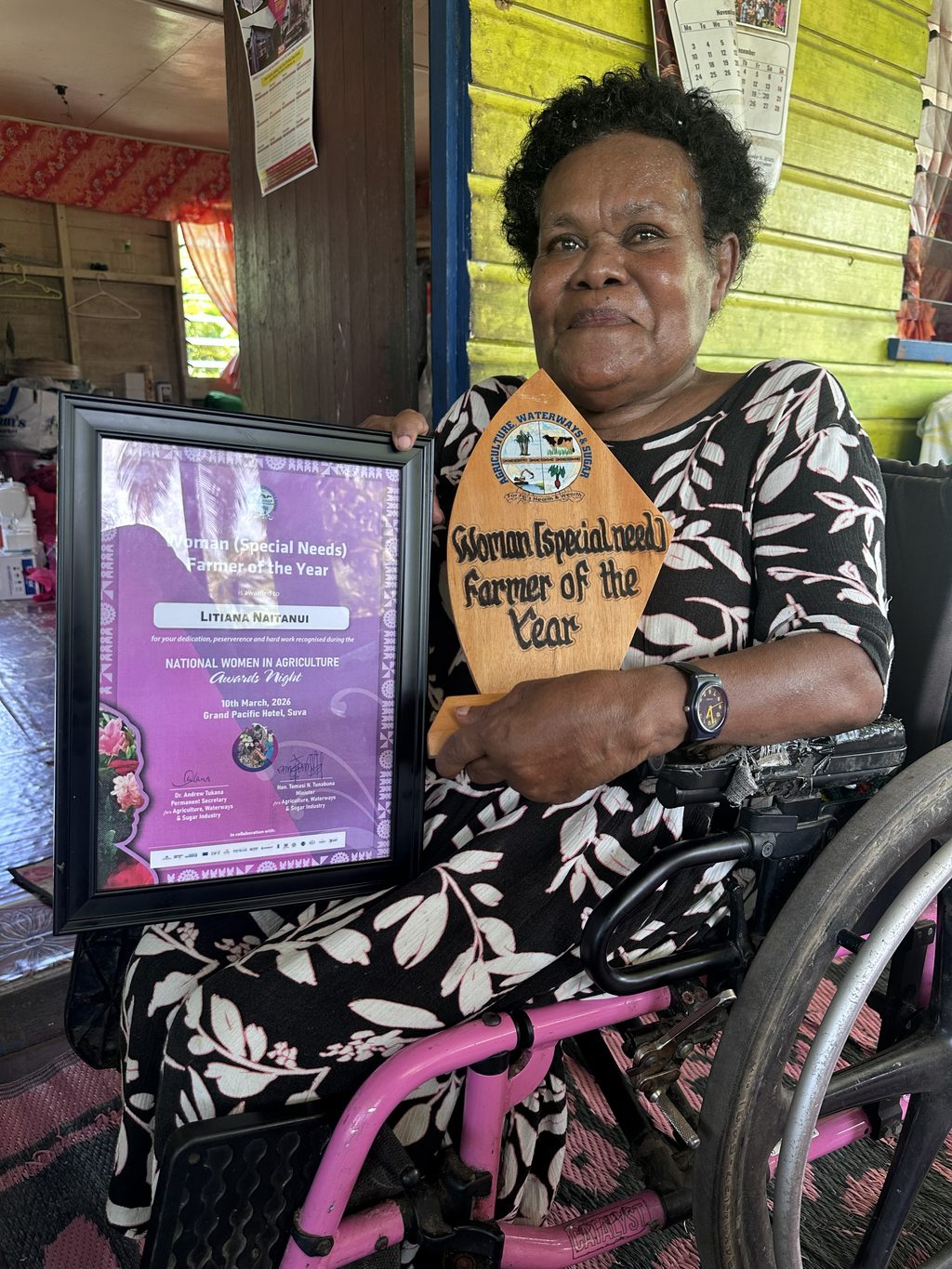
At the edge of a quiet compound in Burebasaga village in Rewa, 67-year-old Litiana Naitanui moves slowly across the soil, guiding herself through rows of plants she has carefully nurtured.
Sometimes she wheels across the yard. Sometimes she crawls. But she always plants.
Bananas stretch skyward beside fruit trees. Medicinal herbs grow in small clusters. Lemongrass, vegetables and flowers fill every available space. From the front yard to the back fence, Ms Naitanui’s compound is proof that agriculture can flourish anywhere, even in the smallest spaces.
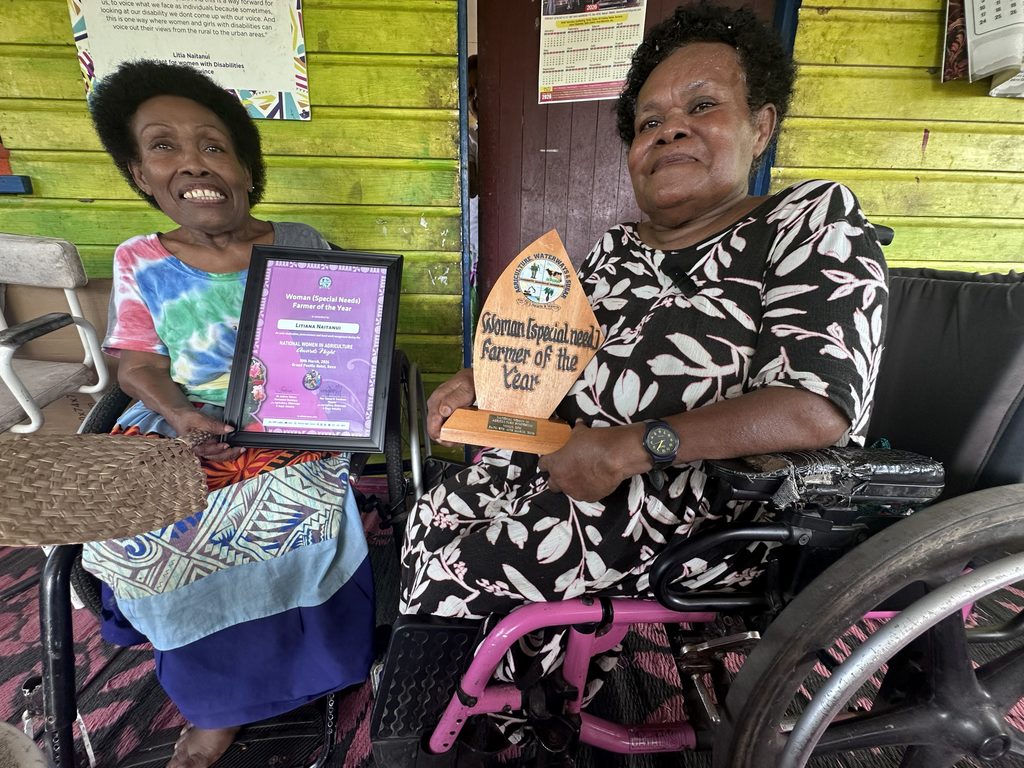
This year, her determination was recognised nationally when she was named the Woman Special Needs Farmer of the Year at the 2026 National Women in Agriculture Symposium, jointly coordinated by the Ministry of Agriculture, Waterways and Sugar Industry, the Ministry of Fisheries and Forests, and the Ministry of Women. The Symposium was supported by the Australian Government, the World Bank EnABLE Program, and partners. The Symposium was held from March 9-11 in Suva.
For Ms Naitanui, the award is not just a personal milestone; it is a message.
“My message today is simple,” she says firmly. “Don’t look at my disability. Look at my ability.”
A life changed by accident
Ms Naitanui has been wheelchair-bound for eight years. A road accident shattered the bone in her foot, leaving doctors warning her never to put weight on it again. But the accident changed only how she moved, not how she lived.
Even before the accident, walking had never been easy.
“I had deformed legs,” she explains. “I could walk, but not very well.”
Yet throughout her life, she refused to allow physical limitations to define her.
Before turning to farming, Ms Naitanui spent 16 years as a kindergarten teacher and later a community-based development officer, working with people living with disabilities across Rewa, Tailevu and Naitasiri.
Her mission was clear: to give people with disabilities a voice.
“Most of the time, disabled persons are locked in a room or placed in one corner,” she says.
“They have no voice.”
Ms Naitanui refused to accept that reality.
Giving others a voice
As President of the Rewa Women with Disabilities, she travelled widely advocating for inclusion and opportunity.
She helped establish disability associations across Tailevu South, Tailevu North and Naitasiri, creating networks where people with disabilities could organise, support each other and engage with government services.
Within just three years, those networks connected hundreds of people to support.
At one stage, Ms Naitanui even operated from a small desk at the Commissioner Central’s Office, helping link disabled communities with ministries responsible for welfare and social protection.
Many people she worked with had never accessed government assistance before.
“So, we helped them fill in forms and access welfare allowances and bus fare assistance; some received improved washroom facilities,” she recalls.
At the time, she estimates that around 250 people in Rewa and Beqa were living with disabilities caused by road accidents, non-communicable diseases and congenital conditions.
“Before that work started, there was little visibility,” she says. “But things have changed.”
Farming without limits
Ms Naitanui lives in her parents’ Lui and Amali Naimoso’s home in Burebasaga village with her younger sister Lusiana Buli, 64.
It is here that she created her thriving compound garden.
“I call it compound gardening,” she explains. “From the back, front, left and right, don’t leave any space empty.”
Bananas anchor the yard. Fruit trees provide shade and food. Medicinal herbs grow in clusters while vegetables fill the spaces between flowers.
“If you plant flowers, you can plant vegetables in between and turn it into a multi-crop space,” she says.
When the terrain becomes difficult for her wheelchair, Ms Naitanui simply crawls across the soil to reach her plants.
For her, the garden is both livelihood and therapy.
Capacity, not disability
Ms Naitanui’s philosophy is rooted in Asset-Based Community Development (ABCD), the belief that every person has talents that can be nurtured.
“Asset means the talent you have,” she explains. “Build and develop that capacity.”
She often tells people with disabilities not to focus on what they cannot do.
“At meetings I tell them, show what your hands can do.
“As long as part of your body works, you can achieve something.”
Her faith strengthens that belief.
“I believe our condition may be genetic, but it is our destiny,” she says. God is using our lives as testimonies.”
A garden of possibility
Winning the Woman Special Needs Farmer of the Year 2026 award has filled Ms Naitanui with pride.
“This award shows we can do the same things as other women in agriculture.
“It shows our capacity and potential.”
But more than anything, she hopes the recognition inspires others.
“If we can achieve awards in agriculture, any woman can.
Her garden in Burebasaga is small. Yet between the herbs, fruit trees, and flowers grows a powerful reminder:
Ability, not disability, is what truly takes root and grows.