
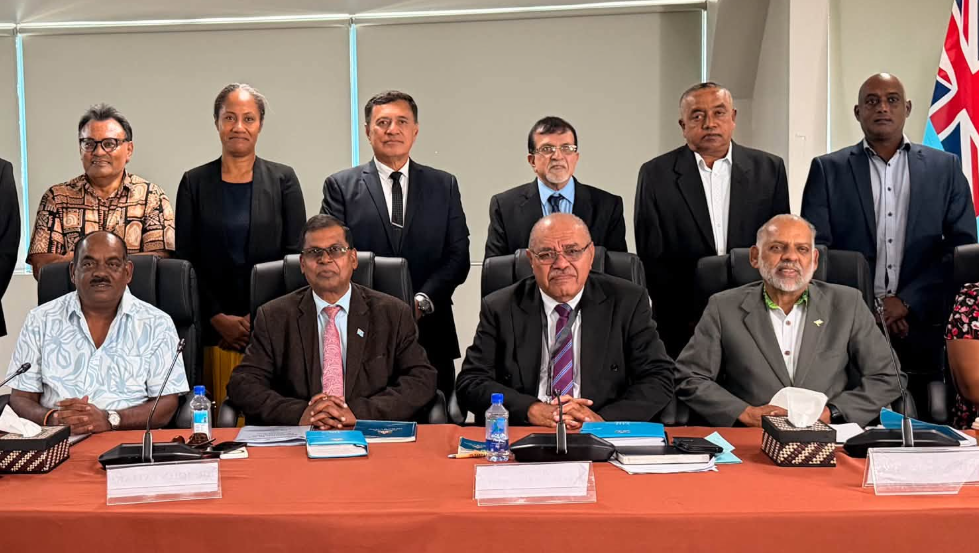
The National Federation Party (NFP) has proposed expanding Fiji’s Parliament from 55 to 70 seats, arguing the increase is essential to improve representation, strengthen democracy and better reflect the country’s changing population under a new Mixed Member Proportional (MMP) electoral system.
In its submission to the Constitution Review Commission (CRC), the party says the current parliamentary structure and electoral system no longer provide fair and proportional representation.
The NFP has recommended that the new Constitution provide for a 70-member Parliament, comprising 25 constituency MPs elected under the First Past the Post system and 45 list MPs elected under a closed party list system based strictly on each political party’s share of the national vote.
The party said Fiji has experimented with several electoral systems since Independence, including First Past the Post under the 1970 and 1990 Constitutions, the Alternative Vote system under the 1997 Constitution, and the D’Hondt proportional representation model under the 2013 Constitution.
According to the NFP, the D’Hondt system has failed to deliver true proportional representation despite constitutional requirements.
The submission points to the 2018 General Election, saying FijiFirst’s share of the national vote mathematically equated to 26.2 seats while the NFP’s vote share equated to 3.95 seats.
The party argues that under a genuinely proportional system, FijiFirst should have received 26 seats and the NFP four seats. Instead, the D’Hondt formula awarded FijiFirst 27 seats while reducing the NFP to three.
“The principle of proportionality became meaningless,” the submission states.
The NFP also criticised the current voting process, saying the A3-sized ballot paper required voters to select only a candidate number, with no names or party symbols displayed, likening the system to solving “Sudoku.”
To address these concerns, the party is proposing an MMP model similar to those used in countries such as New Zealand and Germany.
Under the proposal, Fiji would be divided into 25 geographically based, non-racial constituencies, with one MP elected from each electorate through First Past the Post.
An additional 45 MPs would be elected from closed party lists, with seats allocated according to each party’s share of the nationwide party vote to ensure overall proportionality.
Voters would cast two votes—one for their preferred local constituency candidate and another for the political party of their choice.
The NFP is also proposing that the 5 percent threshold for parliamentary representation remain unchanged.
Candidates would be allowed to contest both a constituency seat and appear on their party’s closed list. If a candidate wins a constituency and also qualifies through the party list, the next-ranked person on the party list would take that list seat.
The party says increasing Parliament to 70 members is necessary to make the MMP system work effectively and ensure every vote carries equal value.
It argues the model would eliminate communal voting while guaranteeing minority representation through either constituency victories or proportional party list seats.
The NFP also believes the expanded Parliament would improve the representation of women and young people without imposing quotas.
It says political parties would have a strong incentive to rank women, youth and minority candidates highly on their closed lists, with voters able to scrutinise those rankings before election day.
The party says its proposal builds on recommendations made nearly 30 years ago by the Sir Paul Reeves-led Constitution Review Commission, but updates them to reflect Fiji’s changing demographics and modern democratic expectations.
According to the NFP, a 70-seat Mixed Member Proportional Parliament would produce governments that more accurately reflect the will of voters while ensuring broader and more inclusive representation across Fiji.

