
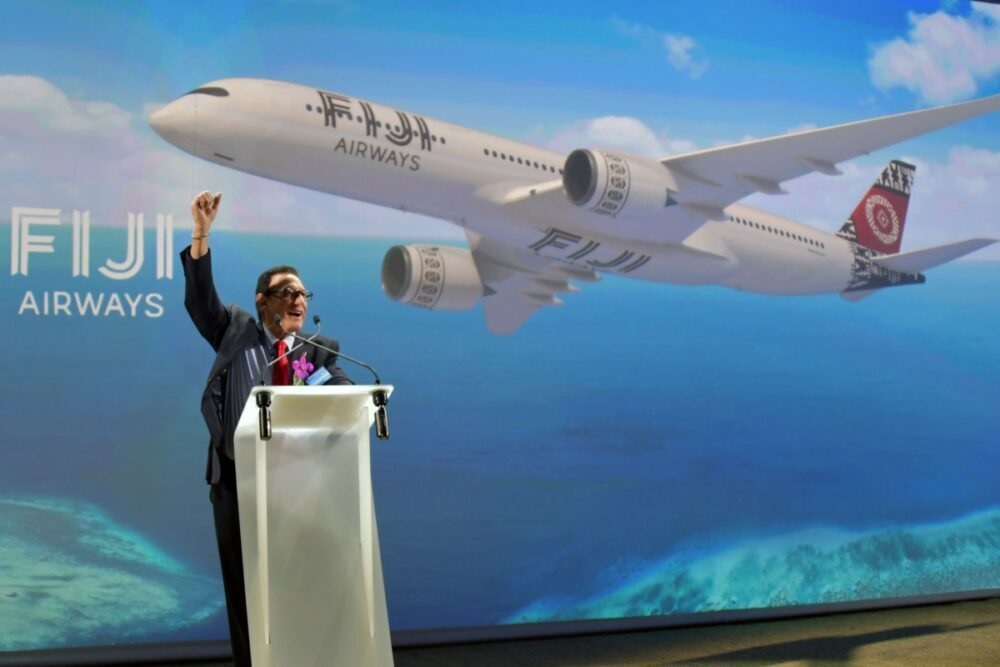
Since Independence in 1970, Fiji Airways (aka Air Pacific) has been one of the few success stories among its public enterprises, a David battling the Goliaths of the international aviation industry
It has succeeded largely because of the gritty commitment and proficiency of its pilots and cabin crews, and despite interferences by meddling ministers, the occasional hoopla of cosmetic rebranding exercises and the premature departure of a few adventurous CEOs.
But today, taxpayers of Fiji, who have been exposed to a $455 million loan guarantee, as well $200m from FNPF and $75m from Reserve Bank of Fiji, ought to be having nightmares about the bottomless pit that is Fiji Airways and how much it is swallowing up every month.
This is somewhere between $20m (according to CEO Andre Viljoen two days ago) to $38m (according to Mr Viljoen two weeks ago), with absolutely no idea when its passenger planes will fly again or when it will return to profitability.
Minister for Economy Aiyaz Sayed-Khaiyum disparagingly labelled as “irresponsible” the dire, but sensible warnings from political leaders such as Prof Prasad, Sitiveni Rabuka, Savenaca Narube and Mahendra Chaudhry.
Mr Sayed-Khaiyum also disparagingly labeled (shooting the messenger) the media (aka The Fiji Times) and other commentators as “unprofessional”.
He alleged that they “have suddenly become aviation experts, with absolutely no understanding of the aviation sector itself, absolutely no understanding of how financing is done in the aviation sector” — with the unspoken sentiment that he is such an expert.
But the Minister for Economy, once a lawyer but long a politician by trade, can hardly make the same criticisms of Mr Viljoen.
It was he who warned the Business Forum of the Nadi Chamber of Commerce and Industry that the lease agreements that Fiji had signed for the three Airbus A350 aircraft were like a “noose and there is no way you can wriggle out of it” (The Fiji Times, 11 August 2020).
He pointed out that $1 billion of revenue had suddenly become zero and with the bulk of the staff already laid off he asked “how long can we survive” given that “one of the major problems was to fix our recurring costs of $38m a month”.
A few days ago he claimed that the leakage was now only $20m per month, and I comment below on his change of numbers.
He has also revealed one positive (FT 26 Aug. 2020) that Fiji Airways had built up some $150m in cash reserves of which $60m was from profits in 2019.
He said this gives them a cash buffer of about seven months, but thereafter they will be calling on Fiji taxpayers, with no end in sight.
Simple arithmetic suggests that this latter figure gives them a cash buffer of about seven months, but thereafter they will be calling on Fiji taxpayers, with no end in sight.
Despite Mr Viljoen’s valiant attempt to reassure the public (what else can he do if he wants to keep his job and pay?), the numbers are still a nightmare for Fiji taxpayers.
The arithmetic of the hangman’s noose
If the monthly leakage is indeed $20m (and not $38m as earlier revealed by Mr Viljoen), then any secondary school student can estimate that by the end of this year, Fiji Airways will have used up its own $150m in cash.
Thereafter, it will be calling on the $450m sovereign guarantee of taxpayers’ money that the Bainimarama Government passed through Parliament in the last budget.
If it still does not start flying passengers by the end of December 2021, the Minister for Economy will come cap in hand for yet more from taxpayers, at least $240m (at $20m per month) or $456m (at $38m per month).
What all these will add up to is anyone’s guess. But it will be way over the $200 million that the National Bank of Fiji disaster cost, even if that cost is increased for today’s prices.
And then, even if international tourism gets going, Fiji Airways will struggle to return to adequate profitability, given that all competing airlines and especially Qantas (more on that below) and Air New Zealand will be desperately fighting for the same customers.
Cutting wages paid to laid-off Fiji Airways workers may help a little bit, even if callously done.
In the worst case scenario, Fiji Airways may still go bankrupt, wasting all the taxpayer funds committed to it.
It is not just Fiji Airways that has the noose around its head, but (courtesy of the Minister for Economy) so also does FNPF, the Reserve Bank and ultimately, all the taxpayers of Fiji.
Loans from FNPF and RBF
Note that FNPF, currently struggling under COVID-19 withdrawals, has also given a massive $200m loan to Fiji Airways which has apparently returned some $70m in interest, (although the public has not been told how much of the principal has been repaid).
Continuing its recent questionable trend of assisting state enterprises in dire straits (like FSC), the Reserve Bank of Fiji, the sacred regulator of Fiji’s money and money-lenders, has also lent an additional $75m to Fiji Airways, through the Fiji Development Bank, thereby also becoming a money lender (regulating itself?
Apparently not a problem in the Fiji of today)).
None of these loans are at “arm’s length” because they are all authorized (or rubber-stamped?) By boards which are all appointed by the Minister for Economy.
In the last few days, the Minister of Economy has appointed the CEO of Fiji Airways as the chairman of Fiji Development Bank. But Fiji Development Bank is the channel through which the Reserve Bank of Fiji is lending $75m of Fiji’s money to FDB which will then lend it on to Fiji Airways at 3 per cent interest.
As pointed out by others, how on earth could the borrower’s man suddenly become the lender’s man also?
Is this part of the smoke and mirrors and mumbo jumbo that partly explains why Fiji Airways’ monthly cash leakage had been reported by Mr Viljoen to have reduced from $38m (a few weeks ago) to $20m (a few days ago)?
One can only wonder why Mr Viljoen accepted this onerous appointment in the first place given that his airline is struggling to survive?
But is this all part of a pattern where the Minister for Economy – apparently – is not able to find capable Fiji citizens to be the Chairman of critical boards like FDB and FNPF
A last tango with Qantas?
The crisis at Fiji Airways becomes even more ominous when Mr Viljoen revealed that, despite having a 46 per cent stake in Fiji Airways, Qantas from July 2019 to July 2020, took away 95,000 passengers and $65m in revenue from it.
While he had expected that Qantas, as a major strategic partner, would help Fiji Airways “with procurement… acquire aircraft… help train our pilots [etc.], Mr Viljoen complained that “on the contrary they became a major competitor”.
Then Mr Viljoen gave a fantastic “applied economics” lesson to Fiji’s secondary school and university students.
He talked about the concepts of “economies of scale” and “economies of scope” which fundamentally disadvantaged Fiji Airways.
He lamented (FT 26/8/2020) that Fiji Airways was operating under a severe technical operational disadvantage relative to large airlines.
This was because they had only 20 aircraft but “in five types, which means five engineers, five lots of spares, five lots of everything”.
But a much larger airline [like Qantas] not only has “deeper pockets” but also can spread its costs over “200 aircraft … and they typically have [only] one, two or three types which makes them have a size and scale advantage”.
This all makes sense to this simple economist (a simpleton, says my legal adviser).
But that only begs the question: who made the decision to purchase five different types of aircraft in the first place?
Who was it, out of all the great leaders in the Air Pacific/Fiji Airways boards, or revolving-door CEOs? Or was it the Minister for Economy or Prime Minister?
Fiji Times readers might remember a former Fiji Airways CEO who used to profusely praise the great leadership of the Prime Minister, the Minister for Economy and the Board chairman for their vision in helping in the purchase of a new aircraft type.
He resigned and left before the new aircraft had even flown one flight.
Why expect Qantas to help?
But there are even more awkward questions that simple economists (not aviation experts) can ask Mr Viljoen about the expected role of Qantas.
First, if Fiji taxpayers who own 51 per cent of Fiji Airways are forking out $450m of loan guarantees (and other effective subsidies from FNPF and RBF) to try and save the enterprise, what is Qantas (with 46 per cent shareholding) forking out, if anything?
Second, any good economics student would remind Mr Viljoen that if Qantas shareholders get 100 per cent of every dollar of profit from a passenger on Qantas but only 46 per cent of every dollar of profit from the same passenger on Fiji Airways, Qantas must surely want that passenger to fly on a Qantas seat, not on a Fiji Airways seat.
If this logic held between July 2019 to July 2020, then it would be even more powerful given that Qantas today is itself struggling to survive, letting go another 2400 of its staff members a few days ago.
Even though many international airlines have collapsed, experts expect that when international travel begins in the future (whenever) fares will be higher, services trimmed back, and small airlines which totally depend on international travel (like Fiji Airways) will still be struggling.
Qantas will have a sizeable domestic Australian market and perhaps the New Zealand market and the trans-Tasman Bubble to fall back on.
Consider this scenario: if Fiji Airways goes bankrupt, despite having a 46 per cent stake in Fiji Airways, might Qantas gain financially in the long run by not just taking over the Fiji Airways market for travel, but even pick up cheap Fiji Airways planes and other assets for a song?
Where does the buck stop?
Fiji taxpayers need to ask who is really responsible for major policy decisions at Fiji Airways and who should be accountable to Parliament and taxpayers for their money.
The Minister for Economy has a pervasive media presence (with lovely pictures taken) when cash grants or bonuses are being distributed to staff.
But why is the Fiji Airways Board chairman ( Rajesh Punja) not making any statements whatsoever to the public whose interests he is legally bound to protect?
Why are Fiji’s taxpayers not demanding that the annual reports for Fiji Airways must be presented to Parliament and posted on the website, which is singularly lacking even basic information such as who is on the Fiji Airways board?
Note that Opposition Parties have tried their best to demand accountability. For instance, in a parliamentary debate in 2017, NFP’s Prof Prasad had requested that the annual reports of Fiji Airways be tabled in Parliament given that $18m of taxpayers money was being given to them to fly new routes that would be otherwise unprofitable.
The Minister for Economy is reported by FBC’s Rachael Nath to have said that the Fiji Airways annual report “does not need” to be tabled in Parliament.
He scornfully advised the Opposition MPs and any member of the public in the gallery to go to the Registrar of Companies Office “like any Tom, Dick and Harry and get the accounts”
Fiji’s taxpayers should note that ever since the Bainimarama Government took over, large sections of the Civil Service which used to be audited by the Auditor-General (such as PWD) were corporatised (eg. Fiji Roads Authority).
So hundreds of millions in taxpayers’ money annually became out of bounds to the Auditor-General with only the Minister for Economy presumably having access to their finances.
One sad result of the Bainimarama Government’s “Clean Up” coup has been a massive “Cover-Up” of what happens to large proportions of taxpayers’ money.
It is therefore utterly scandalous that Fiji Airways does not have any annual report on its webpage.
Interestingly it does not even have any information on who are the board members who supposedly have oversight on the management of Fiji Airways.
Whose responsibility are these glaring omissions?
But a board exists
A Fiji Airways news item on December 14, 2015 informed that previous chairman (Nalin Patel) had been replaced by Rajesh Punja (a director of the Punja Group of Companies).
Also continuing were Shaheen Ali (permanent secretary for Industry, Trade and Tourism), Aslam Khan (former CEO of Vodafone), Sharvada Sharma (Solicitor General) and Mr Viljoen himself.
Rajesh Punja and Aslam Khan would have some general business knowledge and experience, but apart from the CEO himself, intelligent taxpayers can ask what expertise these other board members have in aviation and the financing of aviation.
These are the criteria that Mr Sayed-Khaiyum himself demanded of the Opposition MPs.
Two of them (Shaheen Ali and Sharvada Sharma) are civil servants. Neither of them is known to be an aviation expert, but they are totally beholden to Mr Sayed-Khaiyum, their line Minister (in more ways than one, if the blog Grubsheet Feejee is to be believed).
Despite the frequent assertion by the Minister for Economy that Fiji Airways was critical to Fiji’s tourism industry, there are no independent representatives of the tourism industry on the Fiji Airways board. Why not?
It is no surprise that the current Fiji Airways CEO, like previous CEOs, when announcing the good financial results for 2016 made the by now obligatory statement “We are grateful in particular for the consistent support of our Prime Minister, the Honourable Voreqe Bainimarama, and our Line Minister, the Hon. Aiyaz Sayed-Khaiyum”.
So if there is a financial disaster at Fiji Airways, for whatever reason, will the buck stop with the Prime Minister – or will he blame someone else?
How will this sad saga end?
If Fiji Airways is still afloat when passengers start flying again, you can be sure that it will take more than a decade for profits (if any) to return to their pre-COVID levels.
It will probably take more than 20 years for all the loans to be repaid to FNPF, RBF and taxpayers.
If Fiji Airways still goes bankrupt, it may have swallowed up more than a billion (or two) of taxpayers’ money, with that amount added to the already massively inflated public debt which is 80 per cent of GDP and may reach in excess of 100 per cent of GDP, leaving Fiji to join the ranks of bankrupt nations like Greece.
Mr Viljoen has revealed that of the $38m (today magically $20m) recurrent expenditure per month, some $7.5m is going to employees who remain.
Perhaps the media can ask the Fiji Airways Board chairman to reveal how much of that $7.5m is going to the top management and whether any of them have taken any pay cuts during this crisis -— just as hundreds of thousands of ordinary taxpayers have had to — and while the Fiji Airways cabin crew lost their pay altogether.
But whatever the outcome, one must not forget that Fiji’s tiny national airline has had a fascinating record of withstanding competition from much larger airlines and overcoming other challenges – including interfering ministers.
Hopefully, it will overcome this last global COVID-19 pandemic as well, or Fiji’s tourism industry will have to depend completely on global airlines for tourist arrivals.
This may not be a bad thing for the tourism industry (is that why there are no tourism representatives on the Fiji Airways board?).
The Never-Ending Story (so far) of Fiji Airways should be a good topic for a PhD in political economy.
* Prof Wadan Narsey is an Adjunct Professor at James Cook University and a former Professor of Economics at the University of the South Pacific where he worked for more than 40 years. The views expressed are the author’s and not necessarily of this newspaper.

