
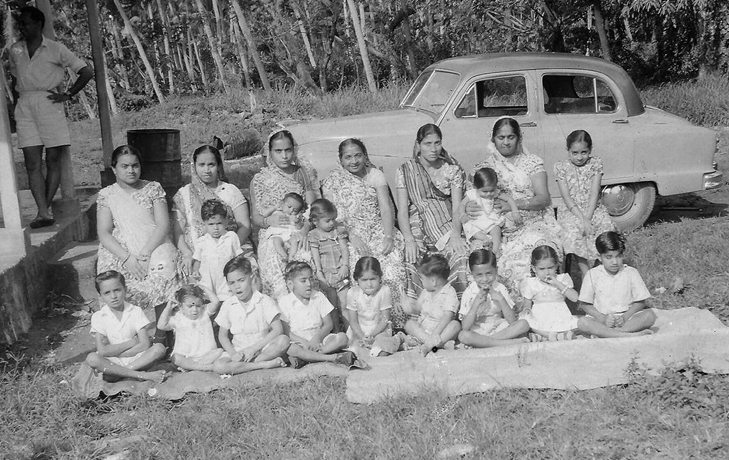
FOR decades, thousands of photographs sat quietly inside drawers, briefcases and old boxes in a family home on Taveuni, waiting for someone to discover the stories they held.
Today, those images are breathing life into the island’s past, prompting calls for Meridian Store managing director Champak Lal Dayaram to establish a small museum or an art gallery so future generations can experience Taveuni’s rich history through the lens of one man.
The photographs were taken by his late father, Ambaram Dayaram, whose passion for photography documented everyday life on the Garden Island long before smartphones and digital cameras existed.
His collection captures a changing Taveuni, its people, villages, schools, chiefs, sporting events, businesses and celebrations, creating what many now regard as one of the island’s most valuable historical records.
During an interview, Mr Dayaram was asked whether there were any plans to do so, he said he have received a lot of requests to do so.
“I have a large collection. They include community events, chiefly installations, sporting events and many other moments from Taveuni’s history,” he said.
Photography, he said, was never his father’s profession.
Instead, it was a lifelong hobby driven by genuine passion.
“Photography was his hobby, but he was very passionate about it. He was the first person here to take passport photographs.
“He photographed people from all walks of life for passport applications, driver’s licences and government documents.
“Back then everything was done in black and white, and passport photographs did not require a plain white background.”
His camera became a familiar sight across the island.
Teachers, police officers, traditional leaders, business owners and ordinary villagers all found themselves standing before his lens.
“He also photographed schoolteachers, police officers, chiefs and ordinary members of the community.
“Those photographs have become an important historical record.”
Among the treasured images is one that holds special significance.
“The earliest photograph I have is of our first shop. There was nothing around it at the time.
The collection, however, almost remained hidden forever.
He said it was only while renovating a section of a store that he stumbled upon boxes containing decades-old photographic negatives.
“I found boxes of my grandfather’s negatives when we were renovating and moving things around.
“They were scattered in drawers and briefcases. I realised they needed to be preserved.”
Recognising their historical value, he purchased specialised equipment to convert the fragile negatives into digital images before time could destroy them.
“I bought a scanner that converts negatives into digital images.
“Every time I scan one, another piece of Taveuni’s history comes back to life.”
The restoration project has produced emotional moments for many island families.
“Many families have seen photographs of their grandparents for the very first time because of this collection.”
The archive continues to grow with every scanned negative.
Together, the photographs tell the story of an island evolving through the decades.
“These photographs document schools, villages, community events, chiefs, festivals, early businesses, airports and many other parts of Taveuni’s history.
“They are more than family photographs; they are part of the island’s history.”
While the collection has attracted considerable interest online, it has yet to be formally recognised by national institutions.
Asked whether the Fiji Museum had expressed interest in preserving the archive, he said discussions had not yet taken place.
“Not yet.
“They have their own collections, but perhaps one day these photographs could also become part of Fiji’s wider historical record.
“They tell the story not just of our family, but of Taveuni and its people over many decades.”
For many who have viewed the collection, the next chapter seems obvious.
For a permanent gallery where visitors can walk through Taveuni’s history one photograph at a time.
Such a space would not simply preserve old images.
It would preserve memories, celebrate the people who shaped the island and ensure future generations understand how Taveuni grew from a quiet rural community into the vibrant island it is today.
As more negatives are scanned and more forgotten faces emerge from fading film, each photograph serves as a reminder that history is not only found in books.
Sometimes, it survives in a dusty box, waiting for someone to bring it back into the light.

