
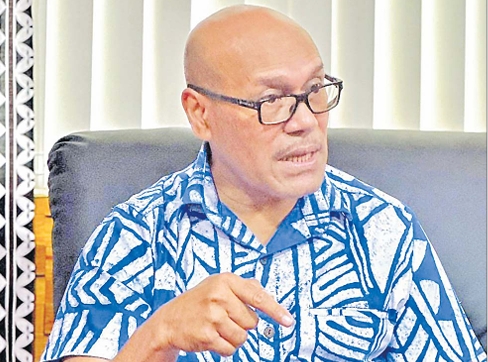
Glowing light
WHILE Fiji and its people continue to face political struggles, leadership battles, rising social issues, and the alarming spread of drugs within our communities, it is also important that we acknowledge the quiet achievers among us — those who are creating hope instead of headlines. ONE person who deserves recognition is Semi Tukana of Sole Fintech. In a time when many complain about the lack of opportunities for ordinary people, especially for the underprivileged iTaukei communities, Mr Tukana continues to work tirelessly behind the scenes to create pathways through financial inclusiveness, local innovation, and home-grown software solutions. What stands out most about this man is his determination. He does not quit easily. His leadership and vision continue to motivate not only his Sole team, but also many others, like me, who are watching his journey closely. Recently, we witnessed Sole Fintech invest close to half a million dollars to send one of its staff members to America for further exposure and development. That alone speaks volumes about the company’s belief in investing in people and building local talent for the future. At a time when Fiji desperately needs more action and less politics, people like Mr Tukana are quietly proving that real nation-building can happen through innovation, empowerment, and opportunity. He is truly a glowing light for Fiji. JOELI TUI Lumuni, Sabeto
Divorce rates
AS a young lawyer who frequently deals with family matters before the courts in Fiji, it is deeply saddening to witness the growing number of marriages ending in divorce. Marriage was once regarded as a sacred, lifelong commitment built on love, trust, sacrifice, and mutual respect. Today, however, many relationships appear to be collapsing under pressure, leading to broken homes and emotional suffering for entire families. In recent years, divorce cases in Fiji have increased significantly, particularly following the COVID-19 pandemic. Statistics reveal that approximately 9700 divorce cases were filed between 2020 and mid-2024. This alarming rise reflects the challenges many couples face in maintaining healthy and stable relationships. Financial hardship, emotional stress, poor communication, domestic conflict, and the influence of social media have all contributed to the breakdown of marriages. One of the most common reasons seen in court, however, is infidelity or cheating, which is especially heartbreaking because it destroys trust, loyalty, and the very foundation of a marriage. The impact of divorce extends far beyond the husband and wife. Children are often the silent victims in these situations. Many grow up with only one parent or develop limited relationships with the other parent. This can affect their emotional wellbeing, education, confidence, and future understanding of relationships and family life. As young people who are yet to marry and start families of our own, these situations also affect us deeply because they shape how we view commitment, love, and marriage itself. Sadly, marriage today sometimes appears to be treated as a trend, a social display, or a means of gaining money, status, or fame, rather than a lifelong promise between two people. People should only marry when they are truly ready to commit for life and willing to endure both the good and difficult moments together. It is my sincere hope that more couples learn the importance of forgiveness, patience, understanding, and growing together through hardship instead of abandoning one another midway through marriage. Strong families create strong communities, and preserving the sanctity of marriage is something that benefits society as a whole. RAYNAV CHAND Nakasi, Nausori
Girmit Day
GIRMIT Day was commemorated last week to honour the sacrifices, resilience, and contributions of the girmitiya forefathers who were brought from India as indentured labourers to work on cotton and sugar cane plantations in Fiji. This observance led me to reflect on two significant questions. Firstly, what might Fiji be like today had the British colonial administration never brought Indian labourers to these shores? Secondly, what course might Fiji’s history have taken if all the girmitiya ancestors had chosen to return to their villages in India upon the completion of their indenture contracts? These are not questions intended to divide, but rather to encourage thoughtful reflection on the historical journey that shaped modern Fiji into the diverse and multicultural nation it is today. DINESH KUMAR Ba
Electricity bills
THE 5.91 cents surcharge approved by the government on Thursday evening has increased the residential electricity tariff from 34.01 cents to 39.92 cents per kilowatt hour. While the government has announced that the increase in bus fares and subsidies for customers earning below $30,000 annually will be fully absorbed, this seemingly suggests that those earning $30,001 and above are expected to shoulder the burden without consideration. Interestingly, there has been no clear mention of any corresponding surcharge on business customer tariffs. This raises an important question; are ordinary residential consumers once again being treated as the easiest source of revenue collection while larger entities remain comparatively untouched? One cannot help but conclude that, in the eyes of policymakers, financial hardship appears to end rather conveniently at the $30,000 income mark; a truly remarkable achievement in economic reasoning. DINESH KUMAR Ba
Penetrating letter
LUCY Blackmore’s penetrating letter which cuts through the spurious claims of the TNT Vuda waste to energy proposed project (FT 23/5/26 ) is a solid reminder of Abraham Lincoln’s famous statement: “You can fool all the people some of the time and some of the people all the time, but you cannot fool all the people all the time”. Lucy Blackmore eloquently articulates the views of the thousands of people who are not fooled by the picture the developers are trying to paint about the Vuda industrial incinerator project. RAJEND NAIDU Sydney, Australia
Disappointing view
Unity Fiji Deputy Leader Seremaia Tuiteci has repeated his view that women are not meant to be leaders. Really? In this day and age, such views are simply pathetic and deeply disappointing. It is frustrating to know that there are people in leadership roles who still hold such shallow and outdated beliefs. Fiji is trying to move forward with gender equality, recognising the importance of women and the valuable contributions they have made toward nation-building. It is disturbing that, even in modern times, some people continue to believe that “a woman’s place is in the kitchen and to look after the family.” Today, both men and women share responsibilities at home and in society. We should be encouraging and empowering women, not holding them back with outdated stereotypes. Such comments are offensive to women and undermine the progress made toward equality and inclusion. These attitudes belong in the past, not in a modern and progressive society. Simply pathetic. KIRTI PATEL Lautoka
Vuda project
After reading two full page paid advertisements and an Opinion piece in the FT of 19/05, two things struck me :
1) The Gold Coast proposal mentioned in it, was for incinerating 660,000 tonnes of waste annually and generating approximately 65 megawatts of electricity — plainly , the Vuda project can be down-sized and still remain profitable. In other words, we don’t need a facility that processes 900,000 tonnes of local (and imported) waste annually as proposed ;
2) I am also reliably informed that Singapore has been successfully and safely operating a W2E program since the 1990s and its “bottom ash” after incineration, is being used as land fill after being treated. Maybe some thought could be given to that possibility and Singapore officially requested for assistance
Unfortunately, even if the W2E project is scientifically and environmentally safe and economically viable, the proposed location on the coastal stretch between Vuda and Saweni, is ill thought out and highly problematic. The lack of a feasible alternative site or any explanation for its absence from the W2E project promoters who would have been aware of the historical significance and tourism potential of the selected site, is unfortunate and a bad look. It is disconcerting. While on the topic of renewable energy sources, maybe this is an appropriate time to ask why isn’t EFL there. Why isn’t Government sponsored solar farms already in existence in Vanua Levu and the Western Division which averages 6 to 8 hours of sunshine daily for most of the year. Tonga has it, Samoa has it, Tuvalu has it, Solomons and Vanuatu have it and Nauru is looking at going completely solar. Why not us? What’s the holdup? Where’s the Government incentives? Nothing has been said either by the promoters or FRA about the estimated numbers and weight of the trucks that will be carting tonnes of household and industrial waste daily from collection centres to the incinerator(s) along the Queens and Kings highways and the serious detrimental effects that can have on the condition, usability, and longevity of these main arterial roads. Who will bear the cost of repairing the roads? Plainly, much thought needs to be given to how best to deal with our long-term waste disposal and renewable energy options. We need a five-year plan and a Government that is fully committed to its complete implementation. Our seas, towns, and cities are becoming more polluted by single-use plastic bags and bottles. Maybe it’s time for a consumer waste and energy tax! DANIEL FATIAKI Suva
Climate reality
WHILE Pacific Island countries are strongly advocating for increased access to climate finances to support priority adaptation efforts, there is an important reality that is often overlooked. Most climate funding is delivered through projects with fixed timelines, within which objectives must be achieved and funds fully utilised. However, for these resources to be effective, it is equally critical that our national systems, particularly procurement, human resources, and financial management policies are fit for purpose. These systems must be flexible and accommodating to enable the timely use of external climate finance in accordance with funding agreements. Without such alignment, we risk facing situations where funds remain underutilised, or worse, must be returned to donors due to implementation delays and administrative bottlenecks. In summary, while the urgent need for increased climate finance in the Pacific is undeniable, it is just as important for us to strengthen and streamline our internal policies and procedures. Doing so will ensure timely approvals, efficient implementation and full utilization of funds within the agreed timeline. Ultimately, this will maximise the impact of climate investments for our vulnerable communities. FLOYD ROBINSON Micronesia

