Massacre of democracy?
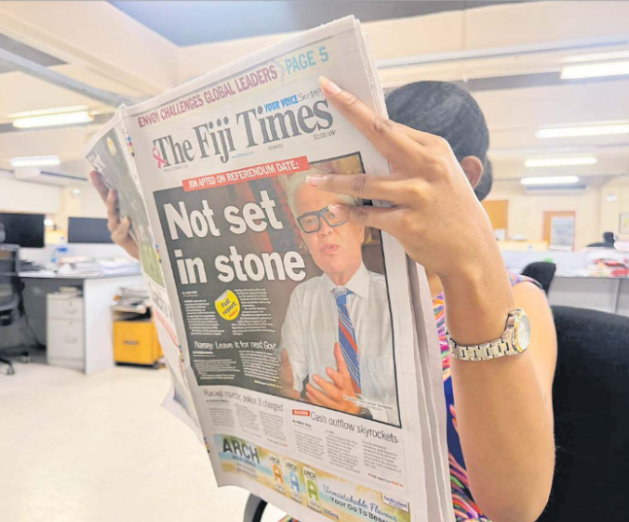
This articulation by Prof Narsey in the FT (09/10/26) is the most honest, scathing and comprehensive treatise of the 2022-2026 Rabuka period, and will go down in the annals of history as a summary of the systematic manner that the massacre of democracy has occurred in our nation under PM Rabuka.
I applaud The Fiji Times and the editorial team for carrying this great 2-page piece by Prof Wadan Narsey, which will hopefully not only alarm, but also open the eyes of Fijians.
This is the fourth estate fully doing its job by informing the nation with such critical commentary and investigative reporting.
Dr Sushil K Sharma Lautoka
What are we gonna do with it?
McCafe coffee is just as good as any expensive coffee shop’s brew.
Flipping through the priceless pages of this paper yesterday (Friday), it occurred to me that tomorrow (Saturday) will be exactly 56 years since we became independent.
The radio station on the Nakasi outlet speakers was blaring the “Now that we found love what are we gonna do with it” as I went through the pages. It was around 8.10am.
Then the song made sense to me. We found independence over half a century ago but never figured out what to do with it.
The FM96 gang, vinaka.
Donald Singh Nausori
Governed by a BLV Senate
I read Ro Naulu Mataitini’s excellent column in Monday’s newspaper (FS 5/10) and was struck by one particular paragraph on a Pasifika democracy, where he wrote that “customary authority can have constitutional space while remaining accountable. It would allow Parliament to govern the nation while giving the vanua a meaningful constitutional voice”.
Sashi Karan was quoted in The Fiji Times on Tuesday (6/10) as saying that the BLV Act “restores a customary authority that has historically served as a unifying pillar of social cohesion and peace for all communities in Fiji”.
It is true that the newly-drafted Constitution gives the ultimate authority in the country to the BLV-controlled Senate (14 of the 23 members would be BLV).
Thus, Ro Naulu is not correct in saying “Parliament would govern the nation” and Sashi is correct in saying that the BLV will have real authority.
As for BLV being a “unifying pillar”, I believe that was definitely not true when the BLV supported Rabuka in 1987 — he appeared from the Civic Centre triumphantly waving the appropriate paper agreement. BLV history began with Governor Gordon and has had its ups and downs, with confederacies often struggling to remain united.
Fergus Garrett Vatuwaqa, Suva
Last minute decision
What does a last minute government decision cost?
Today gives us a very practical example.
For more than a year, Fiji’s published 2026 public-holiday calendar showed Fiji Day as Saturday, October 10.
One day before Fiji Day — Government gazetted a change declaring Monday, October 12, the public holiday instead.
Whatever one’s view on whether Monday should have been the holiday in the first place, the bigger question is: Why was this decision made at the last minute?
Businesses plan ahead. Workers are rostered.
Events are organised. Travel and accommodation are booked. Deliveries are scheduled. Families make plans.
Some businesses may now have to close on Monday or reorganise staff.
Others may face additional employment costs.
Bookings and deliveries may have to be changed.
People who arranged travel or holidays around the previously announced dates may have little opportunity to adjust.
And businesses that planned Fiji Day activities around the original arrangements may already have spent money. These are real costs.
Government decisions do not cost only what appears in the national Budget.
There is also the cost of uncertainty, lost business, disrupted plans, wasted preparation, additional administration and people’s time.
The question is not whether Fiji Day deserves to be properly celebrated.
Of course it does.
The question is why a matter that could have been decided months ago was changed only the day before.
Good governance is also about foresight, certainty and giving people enough notice to plan their lives and businesses.
When Government changes course at the last minute, who carries the cost? Usually, it is the people!
Noleen Billings Savusavu
Public holiday
I thought Mr T was the only one chasing things around town. Now, it seems even public holidays can change direction!
On Monday, October 5, Defence Minister Pio Tikoduadua announced there would be no additional public holiday on Friday or Monday because Fiji Day falls on Saturday, October 10.
He explained that it was the usual arrangement.
Then, noting from Fijivillage news on Friday, October 9, the Government gazetted Monday, October 12, as the Fiji Day public holiday after all, since Fiji Day falls on the Sabbath of our Creator.
Well, well! What happened between Monday and Friday?
Did someone discover a missing page in the calendar, or did the Government simply change its mind?
To be fair, governments can reconsider decisions, and there is nothing wrong with responding to public concerns.
A weekday holiday may also give more people an opportunity to enjoy the occasion with their families.
But when a clear announcement is followed by a different decision just four days later, the public is entitled to ask what changed.
Mr T, you have been chasing missing cocaine, flour and suspicious characters.
Perhaps you should now investigate this disappearing-and-reappearing public holiday!
If it’s not a norm. I am not complaining about an extra day off.
Who would refuse a Monday holiday?
But public announcements should be clear, and when decisions change, the reasons should be explained and well in advance.
After all, Fiji Day is about our independence, our unity and our national pride.
Surely, the arrangements surrounding it should inspire confidence too.
I’m not gonna be surprised come Monday morning, Mr Ching Chow Wah from Downtown Hot Chilli Restaurant, will be waiting at the bus stop to catch a bus for his normal day kitchen routine, because he doesn’t have a clue of how the Fijian calendar is running, since he’s on the Lunar calendar.
Unlucky Mr Wah!
Anyway, Mr T, put down the magnifying glass for a moment.
This time, the mystery is not who took the flour away, but who brought a day back!
Peceli Alistir Waitolu, Naitasiri
Current drama
With current “dramas” within the nation.
- Missing bars of cocaine from High Court exhibit room;
- Replacement of cocaine with flour;
- High Court officials implicated in missing cocaine; and
- Policemen charged for murder of colleague.
I remember well the famous quote: “Every saint has a past and every sinner has a future.”
I believe sinners having a “field day” indeed.
All hidden things will come to light.
God bless Fiji.
Paul Seforana Ba
Road humps
Why the road humps were removed adjacent to a school in Mead Road, Nabua? Can Fiji Roads Authority explain?
Asish Vinay Prasad
Park Road, Raiwasa, Suva
Fiji Day coincidence
It seems a lot of court proceedings are coinciding with the Fiji Day celebrations. Happy Fiji Day people.
Juki Fong Chew Nadawa, Nasinu
Back up plans
As the El Nino continues to cast its spell in the form of ongoing dry weather, this will test the resolve of our education systems, especially our children, especially those attending schools on isolated islands and rural areas.
The availability of water for drinking and sanitation purposes is likely to decrease.
All in all, let’s hope that we are prepared to ensure that classes endure the dry spells but our decision makers are also prepared to make tough decisions in timely manners should the water availability situation deteriorate further.
Mother nature may be beyond our control but let’s have back up plans for the education of our children in these changing times.
Floyd Robinson Micronesia
Step up
Apart from the People’s Alliance Party, will any of the political party contesting the upcoming general election have the courage and fearlessness to take the Government to court for constitutional redress?
Or are they all timid? Sobo!
Wise Muavono Balawa, Lautoka
Our voice since 1869
The Fiji Times, being Fiji’s oldest newspaper, has survived 56 years of independence, both good and rainy days.
The rich history of the people’s newspaper enables us to appreciate the journalists who toiled sweat, blood and tears to build a newspaper which we are presently enjoying.
I vividly remember that in the past the journalists and staff of The Fiji Times being targeted by certain politicians.
The Fiji Times, which was established on September 4, 1869, in the Old Capital by George Littleton Griffiths, has braved ordeals, coups, extreme turbulences, the Media Industry Development Act 2010, criticism and scolding by politicians and leaders, continues to exist, providing Fijians a platform to raise their opinions and voices.
The Fiji Times is an archive, full of information. The library has newspapers dating back to the 1800s when it was established.
One day the next generation will look back at time and appreciate the existence of the newspaper, which is a tank full of information.
The Fiji Times, which lifts the spirits of readers with credible news, is worth buying and reading. The Fiji Times informs, inspires, educates, encourages and motivates. On today’s 56th independence anniversary, I thank The Fiji Times for being part of our beloved nation!
Rajnesh Ishwar Lingam Nadawa, Nasinu
Cannibalistic tendencies?
Fijian Teachers Association general secretary Paula Manumanunitoga’s deeply disturbing outburst on social media is not only appalling, it is utterly disgraceful and completely unbecoming of a person holding such a senior position.
What is perhaps even more disturbing is the deafening silence from many on the government side, including the so-called chiefs, who have seemingly failed to condemn Mr Manumanunitoga’s provocative and inflammatory remarks about roasting people in earth ovens.
I had expected our Prime Minister to issue a strong and uncompromising statement on such a serious matter. Instead, it appears that Rambo’s attention is firmly occupied with political referendums and polling dates.
Yes, the indigenous people of Fiji practised cannibalism centuries ago, particularly during tribal wars, when human flesh was reportedly consumed as part of warfare and cultural practices.
Mr Manumanunitoga needs to understand that this is the 21st century, and not the 1800s. Threatening or speaking casually about roasting fellow citizens in earth ovens is not humour, culture or leadership. It is repugnant, irresponsible and deeply offensive.
If Mr Manumanunitoga genuinely harbours such cannibalistic tendencies as expressed in his remarks, then I suggest he seek professional help to curb such “fetishes”.
Public figures, particularly those entrusted with representing teachers and influencing the next generation, have a responsibility to demonstrate restraint, maturity and respect, not incite hatred or evoke the darkest chapters of our history.
More importantly, Paula needs to be reminded that the people he so casually threatened to cook in earth ovens have contributed immensely to Fiji’s development. They have established successful businesses, created employment, paid taxes, invested in communities and helped propel the national economy. They are fellow citizens who deserve dignity and respect, not cheap and hollow threats implied in references to cannibalistic practices.
For someone occupying the position of general secretary of the Fijian Teachers Association, Mr Manumanunitoga’s conduct is unacceptable. Teachers are expected to shape young minds and uphold standards of responsibility and decency. A senior representative of the teaching profession should be setting an example, not making statements that bring shame and embarrassment to the organisation he represents.
He should be removed from his position without delay. There must be consequences when someone in a position of influence makes statements this reckless and disgraceful.
And perhaps Mr Manumanunitoga should turn his attention towards his own chiefs and, in particular, the Great Council of Chiefs. After a century of existence, he should be asking what tangible achievements have been delivered for the indigenous community and whether the institution has truly addressed the challenges facing ordinary iTaukei people. 75 per cent of those in poverty are iTaukei.
Fiji cannot afford leaders who drag us backwards by resurrecting the language and mentality of an individual like Paula Manumanunitoga.
We should be building bridges, not threatening to make a meal out of people in earth ovens.
Nishant Singh Lautoka
Pension lifeline
As Fiji and South Pacific’s reportedly biggest financial institution, the Fiji National Provident Fund today celebrates its founding 60 years ago, please have a heart.
Remember, the surviving betrayed pensioners as you celebrate your successes. Your primary role is to also care for your founding members. Their pensions remain unrevocable till our final breaths.
The then FijiFirst government colluded heartlessly with FNPF and continues to deny us our just dues — 14 long painful years, and counting.
By the cruellest twist of fate, hate and heartlessness through an ill-founded decree, hatched by the then FijiFirst government headed by Voreqe Bainimarama and his right-hand man, Aiyaz Sayed-Khaiyum, 6000 senior pensions from 2012 were denied their irrevocable pensions through unscrupulous reports of unproven liquidity.
There are about 1400 survivors today. We continue our daily struggles, pain and suffering — some bordering on poverty. We are well into our ’70s and ’80s.
There is no end in sight. This repressive festering cruelty needs to end expeditiously.
Two wrongs do not make one right.
Good sense, empathy and compassion must prevail. Fiji must do better for older betrayed pensioners.
The Coalition Government, the FNPF must find a way forward. A Fiji First government’s decree stops us from seeking legal redress. This is truly absurd.
We beg life-lines to live and die happily. Nothing less.
Ronnie Chang Nadi
An Indo-Fijian’s 44- year journey
As Fiji celebrates Fiji Day today, I thought of penning an article on how this beautiful nation has moulded and nurtured a passionate and patriotic son in me. Forty-four years on my beloved Fiji has taught me valuable lessons of resilience, love and care, and the need to live peacefully in a multiracial country like Fiji. Born and bred in Savusavu to parents who were teachers, expectations were always high. We were brought up traditionally in an extended family in Savusavu where family values ruled the entire household. We were taught to love each other and respect our teachers and elders. I carry that legacy with me today.
Happy Fiji Day
Today, Fijians commemorate 56 years of independence. Memories from October 10, 1970, when our beloved nation gained her independence after being a British colony for 96 years, come to the fore. Today’s independence celebration reminds Fijians how far we have come as a strong and united nation. I am a proud and patriotic Fijian, and I feel very fortunate and blessed that I was born in Fiji, which has seen both good and bad days. As we celebrate independence, let us reflect on our past and try to make it better. The principles of love, togetherness and unity, tolerance and the inclusiveness approach must be used to bind Fijians and keep us united despite the trying times we face. Fiji Day reminds us that in unity we can achieve so much. Fijians from all walks of life will converge on to celebrate Fiji Day and I pay tribute to Fijians who played a significant role in gaining our independence. To my fellow Fijians, let us put politics and hatred aside and live as brothers and sisters. If we are united just as the way we join hands to support our sporting teams, no one will be able to divide us, and we will be able to build a bigger and better Fiji!
A love for The Fiji Times
The Fiji Times has played an influential role in my success, both as a teacher, a school administrator and writer. My love for The Fiji Times started in Savusavu when I was a primary school student. Back then, the newspaper was sold for 50 cents at the iconic Hot Bread Kitchen shop. I would read every day, starting of course with the sports pages. That’s where I developed a huge interest in sports, especially football and rugby. From Savusavu to Labasa, and the love intensified. The cost of the newspaper went up, but it did not hinder my interest. Even at Nadogo Secondary School, where I pursued my secondary school education, I’d wait for the afternoon bus to bring a copy of the newspaper. I would ask the owner, the late Krishna Reddy, to keep a copy for me, and the old man used to call me ‘The Fiji Times boy’! As my love unfolded, I sent my first letter to the editor, posting it from the Labasa Post Office. It was based on the Fiji 7s team. I wrote a few letters and then backed off. However, in 2014, I started writing once again and that has not ceased. From letters to opinions and sports pages, I’m glad The Fiji Times gave me space. The icing on the cake was when my wife and I were invited to be part of The Fiji Times 150th birthday celebration at the Grand Pacific Hotel. What a night it was, as I rubbed shoulders with so many great and distinguished personalities, including the staff and management of The Fiji Times. That night brought me very close to the people’s newspaper, and I respect the work done by our journalists in getting us news.
An educator turned unionist
Having taught at Savusavu Secondary in 2003, I became a member of the Fiji Teachers Union. At that time, all other things aside, I looked forward to the annual conference and sports meet. We came all the way from Savusavu by boat to take part in the FTU annual conference on the mainland, paying our own boat fare and arranging our own accommodation and transportation, while the bigger branches had the luxury of travelling together and being billeted together. In 2008, I was appointed the interim chairman of the FTU Suva branch. What a moment it was! A simple unionist from Savusavu being asked to lead one of the biggest branches. I took the offer and continued serving Suva as chairman from 2008 to 2023, having won two football titles (2011 beating hosts Rewa 1-0 at Ratu Cakobau Park and 2023 beating hosts Labasa 1-0 at Subrail Park). Under my leadership the Suva women’s volleyball team won the women’s volleyball title for the first time in 2023 at Subrail Park. The men’s volleyball team won the most titles, while the netball team made me proud. Suva made a clean sweep in the annual Southern zone sports meet. Apart from FTU, I served as an executive committee member of the Fiji Trades Union Congress Youth Wing and then the vice president. Being appointed the president of the Youth Wing was memorable as I organised membership, got members together and attended conferences in Geneva, Hong Kong, Bangkok and Bali. Today, I serve as the assistant general secretary of FTU and secretary of FTU-CTCL – a staunch unionist!
Sports in my blood
I love sports. I’m so thankful that I was born here, and I have been part of some momentous journeys for the national 7s and 15s side. My love began when the national 7s team started taking part in the iconic Hong Kong 7s tournament. I saw Fiji make a hat-trick from 1990 to 1992 and I was part of the 1997 RWC 7s win. It was hard to hold tears when Fiji beat South Africa 24-21. The 2005 Melrose Cup win can neither be forgotten, nor the 2016 and 2020 Olympic Games gold medal wins, plus the disappointment of finishing second in France in 2024. Who can forget Jerry Tuwai and the boys lifting the prestigious Melrose Cup in South Africa, ending a 17-year-old drought. I salute the great Tuwai for giving me the opportunity to take pictures with the 2016 and 2020 Olympic gold medals and the Melrose Cup. Football is in my blood too, having been a great supporter of Labasa. The Stallions have my tick when it comes to provincial rugby.
Life as an educator
I started teaching in 2003 at Savusavu Secondary School (SSS). The five glorious years that I spent at SSS Since then, times have changed. After SSS, I taught at John Wesley College, Assemblies of God High School and at Dreketi Central College where I was confirmed Head of Department Languages. From there to Ballantine Memorial School and then Nabua Secondary School where I was confirmed vice principal. At Nabua, I was exposed to the Matua program, which changed my perception towards school dropouts. As a team, we created history in 2023 when we achieved 100 per cent pass rate in English. Last year, the Year 13 English result was 99 per cent. Only one student failed English. The behaviour of children has changed and so has their attitude towards schools and teachers, and we need to continue counselling and talking to our children. I thank God for blessing me with energy, the spirit, vigour and enthusiasm to teach students in schools like John Wesley College, Assemblies of God High School and now Nabua Secondary School.
Life as a single parent
After the death of my wife Madhu Krishna, life took a challenge as I became a father and mother to my only daughter Mahika Lingam, a Year 6 student at Rishikul Primary School. Having to balance school and union work alongside my social, sports and religious commitments take a toll, but if one possesses the right attitude then the journey becomes smooth and pleasant. To single parents, keep the fight going!
In conclusion, I wish every reader of The Fiji Times a happy, blessed and eventful Fiji Day! God bless Fiji!
Rajnesh Ishwar Lingam Nadawa, Nasinu
Crowning Night
This evening, curtains will be drawn at the 2026 Vodafone Nasinu Festival, and the most outstanding contestant will be crowned the queen.
The festival was blessed with beautiful weather.
A good crowd made it to the festival every night.
While food prices and prices of rides are skyrocketing, that did not stop kids and their parents from enjoying the week-long festival which went well.
Acting chief executive officer Felix Magnus urged the contestants to use the platform to advocate for young people and inspire them to rise above all the odds and the challenges that they face.
It is time that municipalities join hands to encourage young people to choose better options in life and move away from drugs, theft, bullying and inciting violence.
Above all, young contestants must be motivated to take up the challenge of becoming a contestant so they can expose their talents, improve communication skills and build confidence.
Wishing the contestants all the best as the crowning takes place tonight. To Felix Magnus and his team, keep striving!
Rajnesh Ishwar Lingam Nadawa, Nasinu
Crime Stoppers
The Crime Stoppers episode is aired on Fiji TV every Sunday before the six o’clock news.
This segment shows the names and faces of criminals that the police are looking for.
The police ask the public for help, which is why they share this information on TV.
These wanted offenders are dangerous and should not be accepted by society.
They commit serious crimes like fraud, assault, theft, and armed robbery. Some have also broken their bail conditions or have bench warrants against them.
The problem is that the number of wanted criminals is not getting smaller each week.
We need faster action to catch and bring this dangerous group to court as quickly as possible.
Only the criminals hiding know how close the law enforcers are to finding them, even though police work day and night to bring them to justice.
If family members or friends of these criminals know anything, that could help the police, they should speak up without delay.
We all know that hiding a criminal is a serious offence. We cannot allow these offenders to stay free for long. It is important that everyone works hard to capture these wanted people as soon as possible.
Our country is not large enough for anyone to hide in.
Let us all help the police catch these lawbreakers.
Suresh Chand Nadi
Pride at stake
There is more than pride at stake when the Wallabies clash with the All Blacks this weekend at Eden Park.
After being humiliated and wounded recently by the Springboks, the All Blacks are out to restore pride and confidence at a venue where they have a very distinctive winning record.
The Wallabies are out to prove their recent victory against the Springboks is no fluke but represents determination and self-belief.
Dave Rennie has an abundance of talented players to choose from and a home game advantage, but it will be a different home without the presence of inspirational captain Ardie Savea.
For now, I am tipping the Wallabies to land a surprise in the Land of the Long White Clouds.
Floyd Robinson Micronesia
Democratic breakdown
Thank you Professor Wadan Narsey for an in-depth analysis of the present Constitution Amendment Bill/Referendum exercise.
It now appears that we will be continuously shifting the goal post in future if our PM Rabuka has his way.
My expectation is we will continuously be engaged in amending our constitution, holding referendums, Australia providing budgetary supplements, India and other countries building hospitals, health centres etc.
While we are engaged with the above, the HIV crisis, drug abuse, crime, falling educational standards, housing issues, inflation and poverty etc will continue to increase.
PM Rabuka needs to understand that by shifting the goal post, he can win an election once only. But the long-term detrimental effects of his actions will leave an unstable Fiji and possibly divided communities.
Singapore’s first President, Yusof Ishak, emphasised that a multiracial society can only achieve enduring peace and prosperity when citizens of all religions and backgrounds enjoy absolute equality without institutional advantages.
Rakesh Chand Sharma Nadi
Day of reckoning
When Fiji looks back a year from now (believing that the national election has been held and a new Government is in place), the fall of the Rabuka-led ruling coalition will be down to its failure to strip immunity provisions for coupmakers.
For once, public consensus is one with the Opposition, civil society groups and the military in criticising government’s draft constitution.
I believe December 9, 2026 will be a day of reckoning for the current Government because the people will reject the draft, serving as a precursor to the national election in early 2027 when Fiji heralds a new leadership — a government which is genuine, trustworthy and listens to the people.
Samu Railoa Nadi
Arabic podcast
SAMU Silatolu informs us that an Iraqi man said he “applauded Netanyahu all the time” (FT 9/10/26).
That is not surprising. We have people popping up to say they applaud Hitler, notwithstanding the fact that his Nazi regime exterminated six million Jews.
Netanyahu has an arrest warrant on him by the International Criminal Court for war crimes and crimes against humanity but that is not important in so far as Samu Silatolu is concerned.
That says a whole lot about Samu Silatolu’s mentality.
Rajend Naidu Sydney, Australia
Gender equality
I’m writing to express my views on the issue of gender inequality, as this is something that we cannot just ignore. We have come a long way in recent decades, but women still face unequal access to education, jobs and leadership roles compared with men.
In many workplaces, gaps are clearly seen in pays, responsibilities and promotions, while outdated stereotypes continue to limit people based on their gender. This has a massive effect that limits people from reaching their potential which affects their families, colleagues and communities.
Gender inequality isn’t just a “women issue”, rather it’s about creating an environment where everyone gets a fair shot, no matter their gender. This means that men and boys also have to be part of the solution as well. Sharing responsibilities at home, challenging outdated cultural norms and backing inclusive policies in schools and workplace are all steps towards achieving equality.
We cannot just rely on the Government to fix these issues. It takes us all – community leaders, families, students, and ordinary citizens, all have a role to play. When everyone is treated equally, everyone benefits: stronger families, healthier communities and a fairer society overall.
I believe it’s time that we stop framing gender equality as a niche concern and start treating it as a matter of human rights and social progress. If we commit together to give everyone the same opportunity, we can build a fairer society for us and for our future generations.
Thank you for the chance to share this.
Antriksh Lal Ba
Youth participation
Young people are an important part of Fiji’s future and they should have more opportunities to participate in decisions that affect their lives. Young people have valuable ideas and different perspectives that can contribute to better decisions.
I encourage leaders and decision-makers to create more youth forums, consultations and opportunities for young people to express their opinions.
Giving young people a stronger voice will contribute to the development of a more responsible and inclusive Fiji.
Litiana Kolinivala Samabula, Suva
Please resign
I agree with Sashi Kiran’s calls for Mr Manumanunitoga to resign or FTA to remove him. As if the push for corporal punishment wasn’t enough, that he has to utter such a statement.
I agree that “our innocent young ones need care, love, values, and strong mentorship to navigate through life — not the beating and violence”.
Ms Kiran is right to state that “every citizen, regardless of their background, race, or ancestry, belongs in Fiji, every individual has an equal right to participate in our nation’s political and civic life, express peaceful opinions, and live completely free from fear and harassment”.
Serious concerns are being raised after discriminatory comments and swear words used in a recent Facebook post by Mr Manumanunitoga.
“While telling people not to discredit the chiefs of the country, Manumanunitoga asks didn’t anyone tell you how and why you are here in this country instead of your original country.
He says “you and your kind are here because of the decision our chiefs made to cede Fiji to Queen Victoria of Great Britain in October 1874”.
Mr Manumanunitoga goes on to use swear words and tells people to just mind their own business before “we catch you and roast you in earth ovens”.
Now that is unacceptable.
Showing respect to the chiefs which of course should be the case, should not come at the cost of losing one’s integrity where lack of respect for other groups of people or our nation becomes evident.
That is not what the chiefs are advocating. You have not done the chiefs any justice or made them proud by stating those comments which showed your mindset and hatred.
Respect should be given to everyone and disagreements can be settled with proper debate and solutions.
This matter has to be settled at its earliest.
We cannot have such people in the education fraternity who lack respect for others.
Kirti Patel Lautoka
An open celebration
An invitation can say everyone is welcome while the venue quietly says otherwise. A step at the entrance, an announcement that cannot be understood or a viewing area that cannot be reached can settle who gets to join.
Fiji Day gives this question a fitting public setting. National celebrations speak about belonging. The practical arrangements should allow people with disabilities to experience that belonging alongside friends, neighbours and family.
Section 42 of Fiji’s Constitution recognises rights to reasonable access to places, public transport and information, alongside appropriate means of communication and adaptations. Those rights provide a useful foundation for asking how a public event is planned.
The question begins before anybody arrives. Can a person find dependable information about the entrance, the ground surface, seating, facilities and transport arrangements?
A poster that says accessible is less useful than a clear description of what is available.
Someone deciding whether to attend may need to plan more than the time of departure. If that person cannot establish whether the route is usable, the uncertainty can be enough to stay home. Missing information becomes a barrier even before a physical obstacle is encountered.
Organisers should work with people with different disabilities while there is still time to change the plan. Consultation after the stage is built and the crowd barriers are fixed leaves fewer choices. An invitation to a planning meeting is useful when the advice can affect decisions.
The route through the event deserves particular attention. An accessible entrance helps only if people can continue to the program, refreshments and appropriate facilities. Temporary cables, parked vehicles or a narrow gap between barriers can interrupt an otherwise usable path.
A designated viewing area should allow people to enjoy the event with companions. Separating a disabled visitor from the people they came with can turn an access arrangement into an isolating experience. Seating choices should account for that ordinary wish to share a celebration.
Communication needs the same planning. Important information can be offered in more than one form, with clear signs and suitable support for announcements. Organisers should establish which communication arrangements are needed rather than assume one feature will meet every person’s needs.
Staff and volunteers need practical guidance. They should know where assistance is available and how to respond respectfully. Helping begins with asking what a person wants. Grabbing a mobility aid or making a decision on someone’s behalf can create discomfort or danger.
Some visitors may also need a quieter place to pause. A busy celebration can include loud music, crowd movement and long periods of standing. Information about a suitable resting area can help people decide how to participate without being expected to explain a private condition.
Transport and departure need a place in the plan too. An event can be easy to enter and difficult to leave when crowds gather. Organisers should check the complete journey with relevant providers, explain available arrangements and keep agreed routes usable until visitors have left. The end of the programme should not mean the end of access.
Safety arrangements must include everyone. Emergency routes, communication and evacuation procedures need appropriate professional planning. An organiser should not assume that friends or relatives will improvise the assistance a venue failed to consider.
There are limits to what a temporary event can provide. Budgets, terrain and existing buildings may restrict choices. Honest information about a limitation is better than a promise that the site cannot keep. Organisers should explain the available alternatives and look for changes that have a real effect.
Some improvements are inexpensive. Moving an obstruction, adjusting seating or publishing accurate access information can help. Other changes require investment. Access should be considered while the budget is being agreed so that it does not survive only on money left over afterwards.
Public bodies can encourage consistent practice by asking about access when approving or supporting an event. The request should seek meaningful arrangements, with responsibility assigned, rather than a box ticked on an application.
There should also be a way to report a problem and receive a response during the event. A concern that reaches an organiser only after the crowd has gone may help next year, but it cannot improve this year’s experience.
Afterwards, organisers can ask people what worked and what prevented participation. That feedback should inform the next event. Repeating a celebration should mean carrying useful learning forward.
This is about enjoying ordinary public life with a reasonable degree of choice. A person should be able to attend for the music, the company or the occasion, without becoming a special project for everybody nearby.
The photographs of a national celebration show who was present. Good planning asks who was able to come in the first place. A welcome becomes convincing when people can enter, take part and leave with dignity.
Swaansh Mahat, Nepal
Comments gone viral
The Fijian Teachers’ Association general secretary, Paula Manumanunitoga’s FB post has gone viral and has drawn strong criticism from right-thinking people.
Mr Manumanunitoga writes, “so shut the f*** up and just mind your business before we catch you and roast you in earth oven!”
What is the so-called learned GS implying? We go back to the dark ages?
He goes on to write: “Do you know how come you’re here in Fiji? You and your kind are here because of the decision our chiefs made to cede Fiji to Queen Victoria of Great Britain in October 1874.”
Yes, we know that and also know that our forefathers were brought in from India to make Fiji what it is today.
We also know Fiji is our home and our rights are enshrined in the Constitution.
I find the general secretary’s post highly repulsive, totally discriminatory and sickening to the core.
It is unbelievable that a general secretary of the teachers’ union would stoop so low and use vulgar and unpalatable language.
I urge the authorities concerned to take appropriate steps to see if Mr Manumanunitoga has breached any laws.
What message is the GS sending to the students, parents and teachers?
Thank God I worked with late Maika Namudu (FTA GS).
I call upon the FTA national executive to act decisively and call for the resignation of Mr Manumanunitoga. This will be in the best interest of FTA.
Remember, FTA is affiliated to Council of Pacific Education (COPE) and Education International (EI), the world body.
I believe they do not condone such comments.
I believe the Fiji Teachers Union will find it very difficult to work with Mr Manumanunitoga, knowing his gut feelings for other races.
FTU should write to COPE and EI and inform them of the current scenario.
Arun Prasad Dilkusha, Nausori