SOMEWHERE in Fiji today, a child who was never supposed to see is reading. Not with their eyes, but with their fingers tracing raised dots across a page that Barbara Farouk and her team translated.
Barbara spent 12 years as treasurer at the Tavua Town Council. When her husband was transferred to Suva she followed and started looking for work.
“I needed a job and couldn’t just stay home,” she said.
She applied to other municipalities and had other offers, but her family encouraged her to take up an offer to work at the Fiji Society for the Blind.
“Mum, you take this job because you’ll like it,” they told her.
She started at the Fiji Society for the Blind in 2000 and within months, was promoted to executive director and has remained there since.
“In the beginning it was very challenging for me because I was never used to special needs children.
“But I changed my mindset and developed a passion for it. The experience gave me courage to overcome all this.”
Twenty-five years on, she runs the country’s only organisation for blind and visually impaired Fijians.
She oversees a school, a hostel and rehabilitation programs that have reached close to 20,000 people.
She goes to villages and health centres and sits with parents who are hesitant to send their children away.
“Parents don’t come to us — we go to them. We sit with them and counsel them and convince them to send the child to the school.”
She shared that some parents resisted and that stigma was a bigger problem when she started.
“Stigma was an issue when I first joined, but after awareness in the villages and settlements, they are coming out now.”
Around 500 students have come through the school, most going on to tertiary education.
“Sisi finished primary school at the Society, went to St Joseph’s for secondary, earned her degree and studied further in Australia. She is now a project manager at the Pacific Disability Forum.
“Ranjesh Prakash’s vision worsened over time, but he learned Braille and is now at SPC (Pacific Community).
“Veronica came back to the Society as its Braillist after finishing school here and is one of the most qualified in Fiji.
“They can have a new lease of life. They can ‘see’ now,” she said.
Keeping the organisation running is a constant fight, she shared.
Braille machines cost $1800 each and must be ordered from the United States. Text-to-speech software costs $3500 per user licence per year. These are costs that Government grants don’t cover.
“We have to purchase it ourselves, with funding from high commissions, corporate agencies and other sponsors and donors.
“If they’re not around to assist, we would find it extremely challenging to operate.”
Mrs Farouk has contributed to national disability policy and pushed for teacher aides in mainstream classrooms, a standard in Australia and New Zealand that has not reached Fiji’s secondary and tertiary schools.
“Instead of focusing on their disability, they should focus on their ability, what they can do, and all schools should take special needs children on.”
When Mrs Farouk took on the job, her daughter was studying business management.
Realising the great need in special needs development, she changed her course of study and retrained as a special needs teacher. Today, she is the assistant headteacher at the Nausori Special School.
“I have seen a lot of changes,” Mrs Farouk said. “But there’s still room for improvement.”
She is urging parents with children who have vision impairment who are not in school, or people who know of students struggling in school because of vision difficulties to contact the Fiji Society for the Blind on 338 2966.
“They have the right to education.”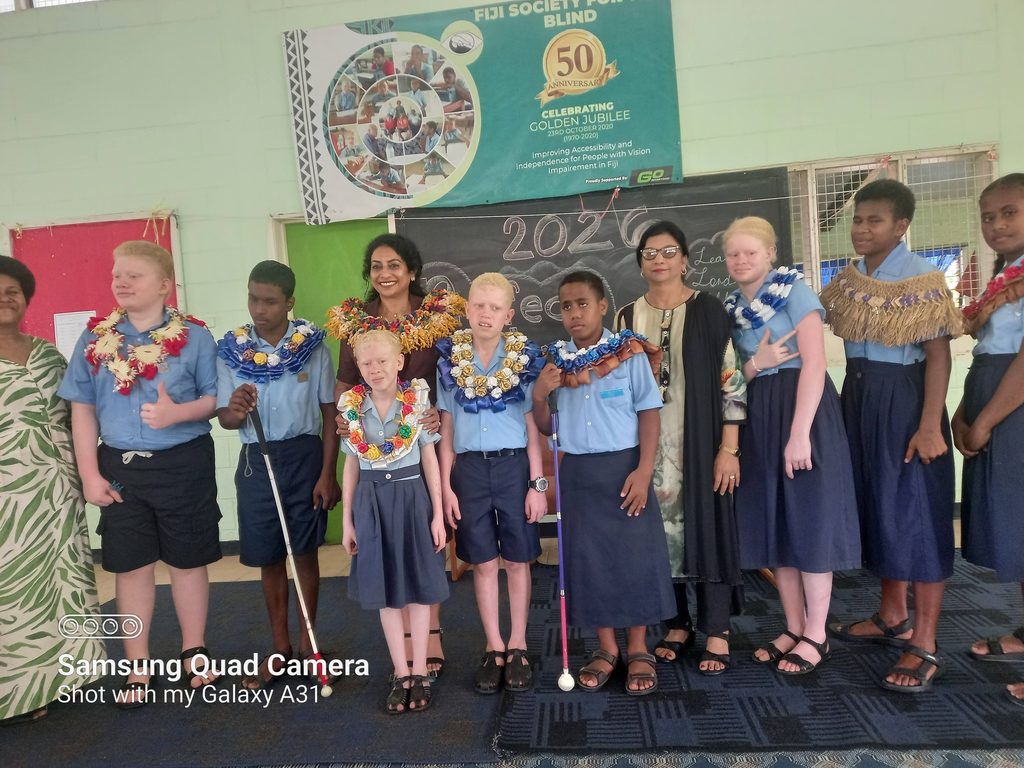
Barbara Farouk, fourth from right, with students and guests of the Fiji School for the Blind’s
prefects’ induction in February.
Picture: FIJI SOCIETY FOR THE BLIND/FACEBOOK