
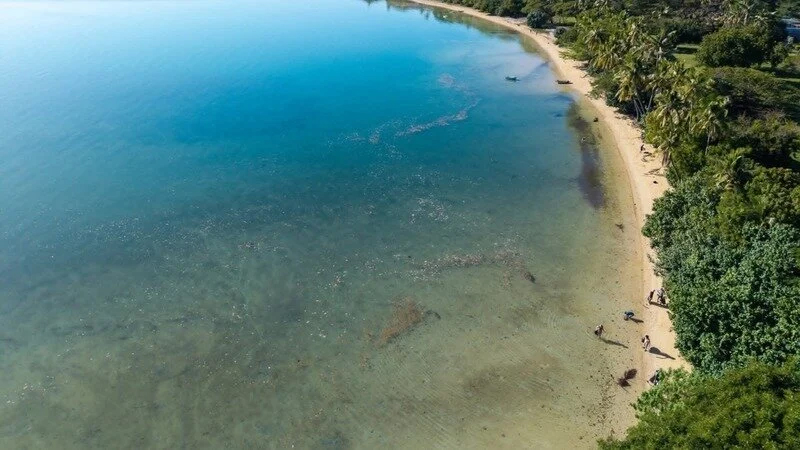
ALONG the sun-drenched coast of Vuda in Lautoka lies a highly contentious site that up until January 2026, was well known for its historic significance.
It is not far from where the first natives landed on Viti Levu, turning the location into one of cultural and national prominence.
But lately, Vuda or more specifically Naikorokoro Point in Saweni has become synonymous for another potentially national transformation that has sparked global debate before any final decision has been made.
Government’s decision is what every person on either side of the coin is eagerly awaiting as a scrutinisation process begins of the Environment Impact Assessment (EIA) report submitted by The Next Generation (TNG) Fiji.
Spearheaded by the Environment Department’s Technical Review Committee, the analysis will sift through the 1500-page report along with 875 public submissions and opposing petitions with more than 8800 online and paper-based signatures.
The proposed Vuda waste-to-energy project
Ever since The Next Generation (TNG) Fiji published an advertisement in The Fiji Times for a three-day consultation on the proposed $1.4billion power plant project in January, opinions have piled up over the past four months with many taking a definitive stand.
On one side are the developers led by Fiji-born Lyndhurst Group’s Robert Cromb and Australian billionaire, Dial a Dump owner Ian Malouf.
During my first interactions with Mr Malouf, the message was clear; the proposed power plant was going to solve Fiji’s waste problem — landfills would be a thing of the past and recyclables, waste materials and any household waste thrown away would feed this power plant to generate 80 megawatts of electricity.
As someone who has covered numerous fires at the Vunato dump and witnessed how thick smoke from the landfill would pollute Lautoka City’s air quality for days, the idea of landfills being non existent was almost a welcome relief.
It sounded too good to be true until each layer was peeled back by opposers who questioned why 700,000 tonnes of the 900,000 tonnes of waste needed to fuel the power plant would be imported from Australia, New Zealand and neighbouring Pacific Island countries.
And why a location of national significance and a potential tourism mecca is being touted as a prime location for more than two dozen trucks to deliver — on a daily basis — waste from every corner of the country.
However, despite the mounting criticism, Mr Cromb has been defiant and steadfast in his belief the power plant would not only solve Fiji’s waste disposal dilemma, but it provides a solution to our growing demand for electricity.
During the Viseisei Village consultation on April 18, a pre-recorded presentation by TNG explained the project is expected to significantly reduce Fiji’s greenhouse emissions, reduce methane and fossil emissions, contribute to long-term energy security and a new port facility may further enhance trade and economic activity.
But the main reason was pointed out by Mr Cromb while responding to Viseisei villager Akili Masi whose concern was the future of his children who could be subjected to breathing in toxic fumes from the plant.
“If we don’t do something about it, they are going to have to live with 10 or 20 years of at least 200,000 tonnes of open waste dumps burning, leaking gases into the atmosphere and that is going to be a bigger problem,” said the Bua native.
“That is the only mad reason I am doing this.”
TNG v the majority
The other side is led by one of the most influential sectors in the country — the tourism industry.
Responsible for $2.81billion of Fiji’s 2025 earnings, the industry is up in arms against a project that could threaten opportunities to bring in more visitors.
In late March, Tourism Minister Viliame Gavoka appealed to the developers to take the project somewhere else saying the Vuda-Saweni corridor is earmarked for tourism developments.
“The industry is pleading to the Government or to the ministry dealing with this project not to have that in Vuda because the Vuda corridor is earmarked for tourism developments,” said Mr Gavoka.
“And it is not a new thing. We have known about it for quite some time, and a lot of the plans are quite advanced.
“The tourism projects that are earmarked for that area are quite big, so we do not want to jeopardise those plans.”
Echoing Mr Gavoka’s opinion was former Opposition leader Mick Beddoes who attended one of the consultations in Naikorokoro Point where he suggested the power plant be moved close to the Vunato dump site.
“The fact is what should come first is our people and how the impact is going to be felt by them,” said Mr Beddoes.
“If the resistance is about the location of the power plant, then my recommendation is why not look closer to the Lautoka rubbish dump and look at the surrounding area. It is a far better option for (TNG) to look at.”
Joining the fight from offshore, Fiji’s Ambassador to the United Nations Filipo Tarakinikini questioned the environmental credibility of the project, rejecting claims it offers a clean energy solution.
“Incinerators emit more carbon dioxide per unit of electricity than coal-fired power plants. This is not a renewable energy solution. It is a fossil fuel substitute wearing a green label,” he said.
Mr Tarakinikini raised particular concern about the scale of waste processing and the resulting toxic by-products.
“Burning 900,000 tonnes of waste annually produces between 225,000 and 300,000 tonnes of highly toxic residue, fly ash and bottom ash laden with persistent organic pollutants, heavy metals, and dioxins,” Mr Tarakinikini said.
“This ash does not disappear. It must be stored, managed, and contained permanently, on Fijian soil.
“Australia’s waste becomes Fiji’s permanent toxic legacy.”
Landowners
Waste colonialism is a term that was brought up on social media by former The Fiji Times journalist Charlie Charters when he joined this heated debate earlier this year.
The term, loosely defined, is an accusation towards developers who shift their environmental burden to other lesser developed countries which, according to Mr Charters and many other opposers of the project, is what TNG is leading.
But for Fijians, specifically the iTaukei, the word “colonialism” is a reality deeply entrenched in their history.
It is the reason many resource owners have had to fight, and at one point, to the death for what is rightfully theirs. They disagreed sometimes with developers and in other times with their very own.
Sadly, in Vuda, the latter is what has transpired over the past few months.
The Tokatoka o Nakelo of Viseisei Village have been public with their endorsement of the project with Taukei Nakelo Josaia Natakele not mincing his words when he said members of the landowning unit fully supported Mr Cromb and TNG.
He said the project would mean a stable future for their people.
Ratu Meli Tavaiqia also joined the supporters adding the power plant would make use of idle land.
“My people are still here (living) under the poverty line. This is an opportunity with all the benefits … and if I do not support the idea something must be wrong with me.”
Meanwhile, Tokatoka o Wadigi of Lauwaki Village led a petition collecting signatures from landowners between Lautoka and Sabeto opposing the project.
Wadigi headman Apimeleki Nasalo said they were disappointed when they learned the proposed site was close to their land.
“None of them came to us or to our tokatoka members about this project,” he said in late March.
“We don’t want this affecting our children and our future generations.”
As the debate between resource owners rages on, the project site, however, is owned by the State and leased to Mr Cromb as a special tourism development lease.
And according to the Lands Department, it could be up for consideration for conversion to an industrial lease if all of the requirements of various government agencies were met.
Government
Which brings us to the State, the Crown, the Government.
Through all of this, Government has been the constant right from the earliest conversations about this proposed project.
Mr Malouf said he met Prime Minister Sitiveni Rabuka on one of his visits to Australia where they first talked about the concept.
As time progressed, it was revealed the Lands Ministry had leased a part of Naikorokoro Point to Mr Cromb for a tourism development, the Local Government Ministry had an application from Mr Cromb for the conversion of the tourism lease to industrial while the Environment Ministry leads an assessment process that will determine whether this project gets off the ground or not.
State entities Energy Fiji Ltd and Fiji Airports leaders have publicly endorsed the project pointing out it would address a forecasted increase of waste brought in by more visitors and the growing demand for electricity that is rising by five per cent annually.
And for opposers, the last line of defence is the Technical Review Committee that Environment permanent secretary Dr Sivendra Michael reaffirmed would scrutinise every page of the EIA report.
“All submissions received have been forwarded to the EIA consultant and will be formally assessed by the Technical Review Committee, which brings together expertise from government agencies, academia, and environmental organisations,” he said in a statement last Friday.
“This stage ensures that all issues raised are rigorously evaluated against the requirements of the law.”
He reiterated that no decision has been made to date while calling on the public to respect the process.
“The ministry calls on the public to respect the process and allow the ministry the space to complete its work in accordance with the law.”
Whether the decision by Government goes the developer’s way or to the protestors — one thing is clear and that only time will tell.

