AN analysis of the structural and statutory frameworks governing Fiji’s legal apparatus reveals critical vulnerabilities where the machinery designed to uphold the rule of law intersects with political and administrative execution.
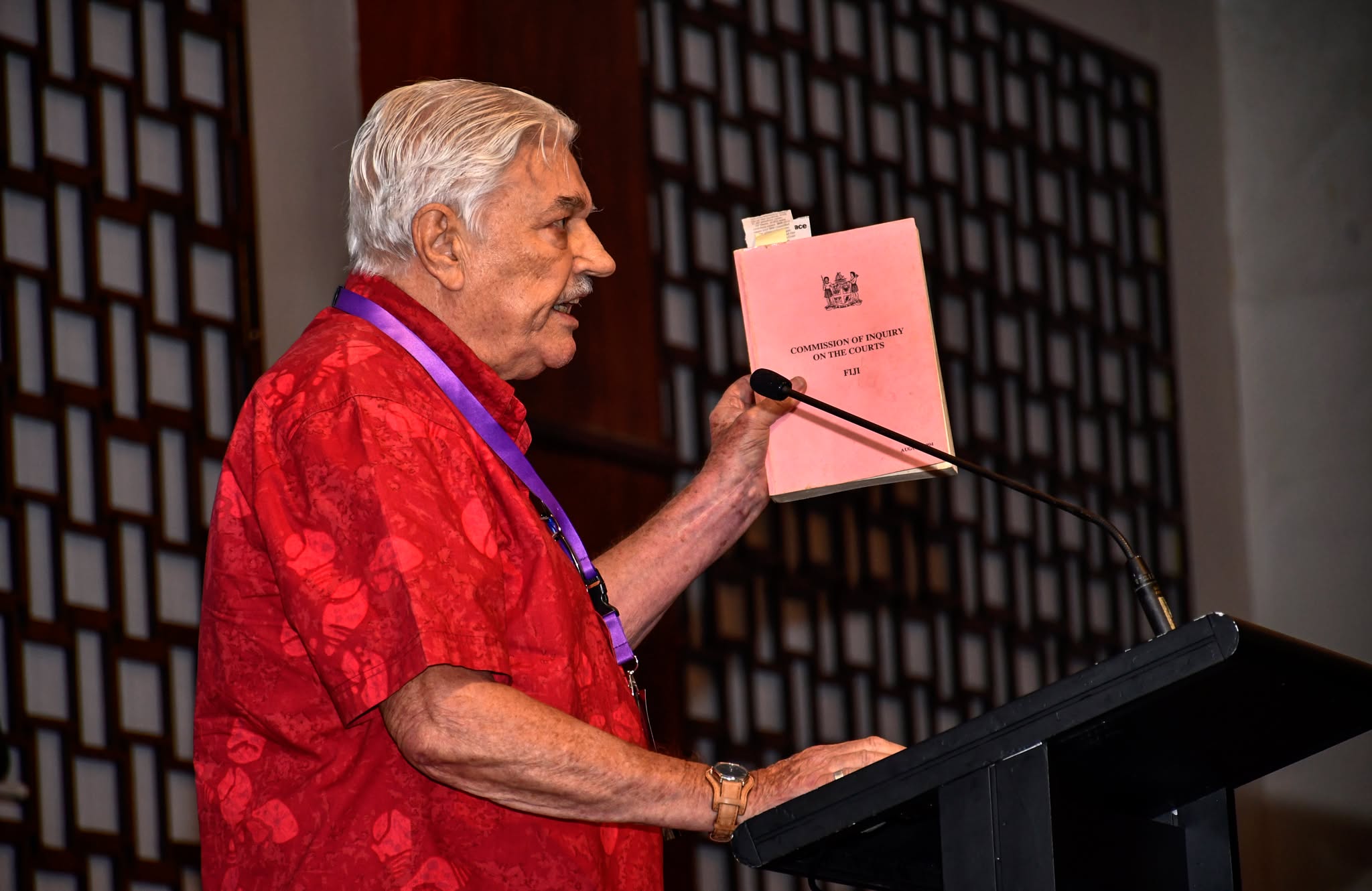
At the Fiji Law Society Annual Convention in Nadi, former Tonga Chief Justice and Fiji High Court and Court of Appeal judge Michael Scott presented a systematic evaluation of these systemic fractures.
Rather than focusing on transient administrative issues, Mr Scott’s analysis isolated a deeper institutional crisis: an operational collapse within the court registry network, severe statutory ambiguities in the execution of public inquiries, and a breakdown in constitutional accountability that directly challenges fundamental human rights frameworks.
The 20,000-case backlog and constitutional rights
Mr Scott identified a staggering backlog of over 20,000 unresolved cases across all tiers of the Fijian court system.
According to the data he presented, more than 17,000 cases remain stalled in the Magistrates’ courts, over 3000 cases are pending in the High Court, and 763 cases are awaiting disposition in the Fiji Court of Appeal.
He characterised this registry logjam as a “shameful national scandal” that leaves thousands of citizens trapped in legal limbo.
These chronic delays, Mr Scott stated, amount to a systematic and endemic breach of the fundamental human right to access justice and to be tried without unreasonable delay.
He noted that these rights are explicitly protected under Fiji’s Constitution and the International Covenant on Civil and Political Rights (ICCPR).
He attributed the longevity of the crisis to the failure of successive administrations to implement the 262 recommendations of the 1994 Beattie Commission of Inquiry into the courts, which was originally established to restore a court system once considered the finest in the Pacific region.
Institutional accountability and the Beattie blueprint
To resolve the gridlock, Mr Scott called on the Judicial Service Commission (JSC) to fulfil its explicit mandate under section 104 and section 105 of the Constitution.
These provisions assign responsibility to the Commission for the “efficient functioning of the judiciary” and mandate it to advise the Attorney-General on administrative matters.
Mr Scott argued that these constitutional duties are currently being neglected as case files pile up unaddressed, and he reminded delegates that these exact obligations are reflected in ongoing constitutional reform proposals.
As an immediate solution, Mr Scott proposed establishing a new commission whether formal or informal to look into court efficiency.
He noted that this inquiry would not need to take long or conduct lengthy preliminary interviews because it could utilise the foundational work contained within the 1994 Beattie report to achieve a “flying start”. He suggested that Sir Terence Arnold KC, a Judge of the Supreme Court of Fiji, serve as its chairman.
The strategic and political use of inquiries
Mr Scott also provided a critical evaluation of how governments utilise public inquiries. While stating that properly structured inquiries historically addressed major issues of national importance, he observed that governments frequently use them as tactical instruments to manage political furore.
According to Mr Scott, when political heat builds up, administrations often announce an inquiry to “kick it down the road,” relying on the expectation that public interest will wane by the time the commission reports.
He argued that formal inquiries should be reserved strictly for genuine priorities that impact the general public welfare, rather than routine administrative matters.
Furthermore, he noted that overly long, highly detailed, and academic inquiry reports such as the UK’s Hallett inquiry into the COVID-19 pandemic or Fiji’s own Beattie report can inadvertently crush the political and public energy required to implement reforms, leaving recommendations forgotten on government shelves.
Statutory contradictions and executive advice
Mr Scott highlighted a glaring statutory contradiction within Fiji’s current legislation regarding the qualifications of inquiry personnel.
While the law enforces strict minimum professional qualifications for the counsel appointed to assist an inquiry, it prescribes no qualification requirements at all for the commissioner leading it.
This legislative oversight allows the executive to appoint virtually anyone to lead a commission regardless of background or expertise, a practice he contrasted with recent draft constitutional amendment bills that establish explicit qualification criteria for independent bodies.
Additionally, Mr Scott scrutinised the legal ambiguities between the Commission of Inquiry Act and Section 82 of the Constitution.
While the law permits the President to establish an inquiry when he deems it advisable for the public welfare, the statutory framework fails to specify who is authorised to give that foundational advice.
Under standard constitutional conventions and Sections 81 and 82 of the Constitution, executive authority is exercised on the advice of the Cabinet or Prime Minister. Applying standard principles of executive governance ensures that the President formally acts on government advice while upholding the statutory purpose of public inquiries.
Institutional overlap and judicial review
Finally, Mr Scott raised serious concerns regarding the disregard for the foundational legal principal nemo iudex in causa sua (no one is a judge in his own case).
He pointed directly to the architecture of the Ashton-Lewis Commission of Inquiry where a serving judicial officer was appointed.
Because the actions and findings of any commission of inquiry are subject to judicial review in the High Court, Mr Scott explained that any subsequent appeal could theoretically land before the Supreme Court.
This means the case could come before the very judge, who served as the commissioner, raising a distinct and embarrassing question of apparent possible bias.
He concluded that executive appointments must scrupulously avoid overlapping judicial roles to safeguard public confidence and ensure that commissioners are entirely detached from the subject matter under review.