
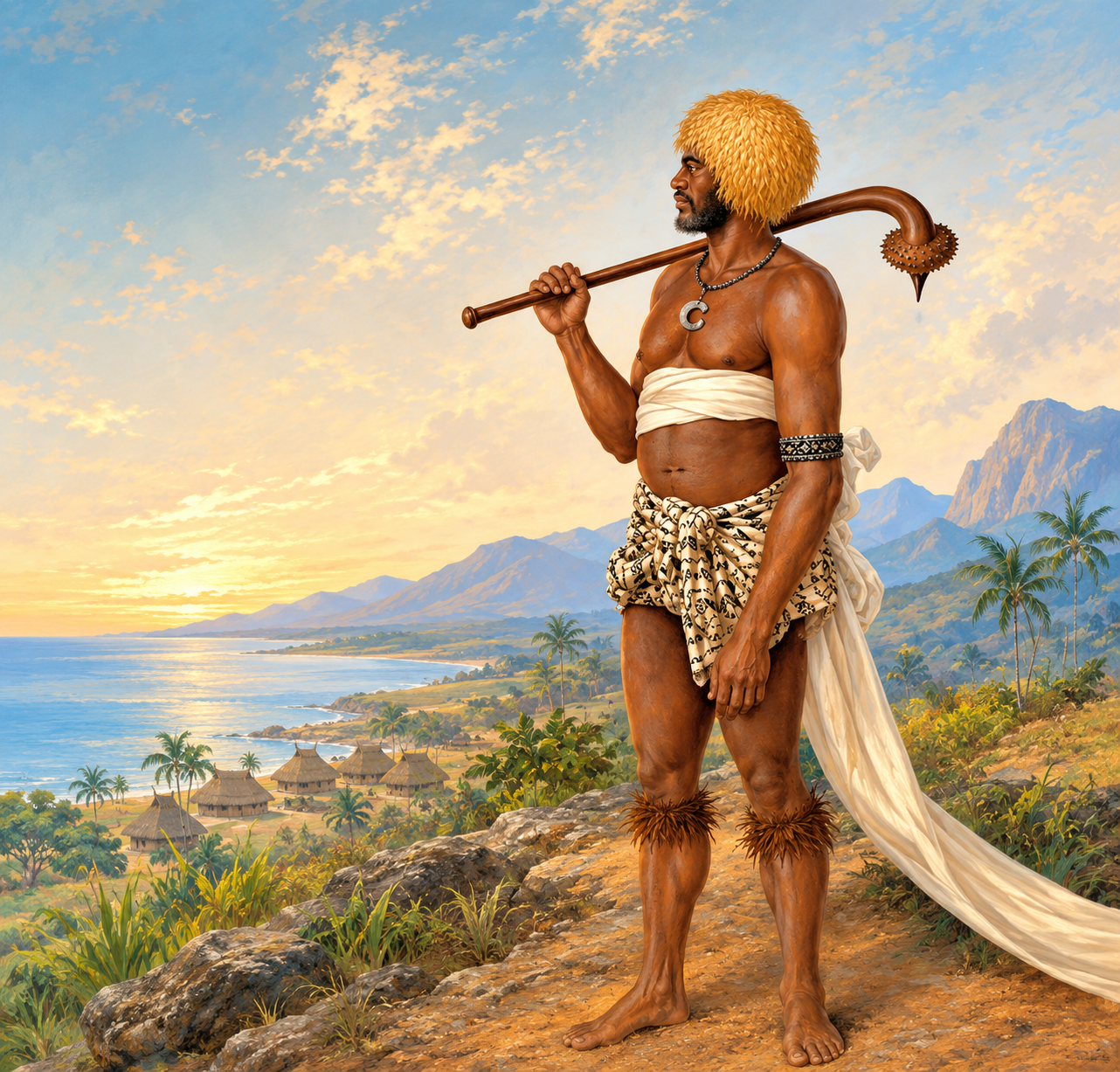
DEEP within himself, the Swede Charles Savage —the descendant of the Vikings—felt a quiet satisfaction as he watched the Bau warriors who had been glaring angrily at him gradually avert their eyes.
He did not look only around those aboard the sacred canoe. He also cast his gaze towards the occupants of all the other canoes, yet not a single man dared meet his eyes.
Then he thought quietly to himself:
“Let them boast as much as they wish. Let them tell everyone how many men they killed. Had it not been for my help, they would all have died at Nakelo, or at best have fled back to Bau in defeat.”
Once again Savage reflected that, so long as the Vunivalu continued to recognise him and appreciate the value of his firearm, what—or who—did he really have to fear?
A lonely homecoming
While these thoughts occupied his mind and the Bau warriors remained silent, the fleet entered the river mouth before setting course for Bau.
The islands gradually came into view, and with them came the sound of celebration.
The sight of their homeland delighted the warriors, for this was the first occasion on which they could celebrate a victory over a territory belonging to Rewa.
Conversation soon resumed, but it was no longer about boasting as it had been earlier.
Now they spoke only of the festivities that awaited them: the women who would welcome them home, the victory dances that would be performed in honour of the returning warriors, the great feasts that would be prepared, and the days of celebration and rejoicing that would follow.
Stories of individual exploits in battle would be told later, separately, within each clan gathering.
When Savage observed the happiness of the Bau warriors and saw that the expressions of jealousy and suspicion had disappeared from their faces, a feeling of loneliness suddenly overcame him.
He realised that once the celebrations began, he too would once again be forgotten.
When they reached Bau, there would be no one to greet him or recognise him, for he was merely a stranger with neither family nor relatives there.
Searching for Lui
Then, quite suddenly, his face brightened as he remembered that he did in fact have someone in Bau whom he regarded as family—Lui, the Chinese cook from the ship Elisa.
Savage had almost forgotten Lui amidst the many demands of the previous weeks, after sailing first to Nairai with Daulakeba and then onward to Oneata in search of the new weapon—the European firearm.
Yet ever since the foreign ship had arrived at Nairai, Lui had remained constantly at Savage’s side, looking up to him as his protector and guardian among these formidable people, the Fijians.
During their time in Bau they had become especially close.
As he thought of Lui, Savage said to himself:
“I have been a useless protector, for I have scarcely thought about Lui despite his loyalty to me. When I return to Bau, I shall make every effort to strengthen our friendship, for in this place he truly is my only relative.”
Thus, as they entered Bau amid loud cheers of triumph, the beating of the lali drums and preparations for the victory celebrations, Savage clearly saw how little notice was taken of him.
The people of Bau were greeting only those whom they knew personally, embracing relatives and welcoming one another home.
Savage immediately began searching the crowd for Lui.
He examined every face, looking for the short, dark-complexioned Chinese man.
But he could not find him.
When they finally disembarked, Savage went straight to the Vunivalu and asked where Lui was.
Ratu Naulivou turned to one of the chiefs who had remained behind to guard the settlement and asked him about the Chinese man.
The chief replied that Lui had been sent, together with several others, to work in the plantations at Tai ko Bau.
A surge of anger came over Savage, and he could no longer restrain himself. He spoke firmly to Ratu Naulivou, insisting that Lui be summoned back immediately.
Because the Vunivalu was in such high spirits after the victory, he did not take offence at Savage’s forceful request. Instead, he immediately gave orders for Savage’s companion, Lui, to be brought back.
The entire island and the settlement buzzed with activity as the Bau warriors dispersed to reunite with their own families.
Money was brought out, ovens were prepared, and everywhere people hurried about making arrangements.
There was scarcely a person whose heart was not filled with peace, celebration and rejoicing.
Those responsible for organising the festivities rushed busily from one task to another.
Meanwhile, the greatest warrior among them all—the Swedish Viking, Charles Savage (Jale Seveti)—went quietly to his own house, where he sat alone cleaning and reloading his firearm while waiting for Lui to return.
The historical insights above were compiled with information from series of articles written by Viliame Ravai, senior reporter for the Nai Lalakai publication.

