
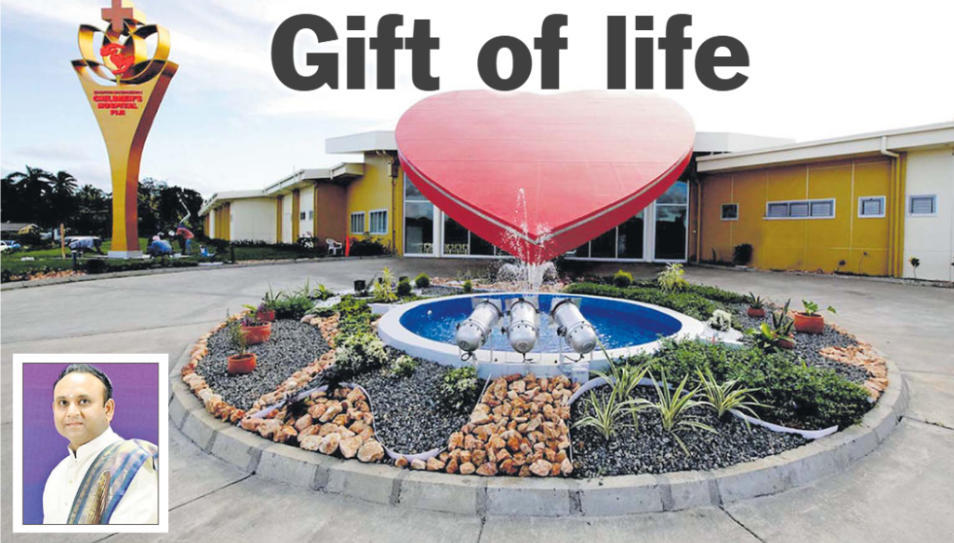
A MONTH from now, Fiji will establish the South Pacific’s first free dedicated heart surgery facility, bringing “the gift of life” to millions across the region.
Founder of the Sri Madhusudan Sai Global Humanitarian Mission and the Sai Prema foundation in Fiji, Sadguru Sri Madhusudan Sai confirmed this development saying this could fundamentally change how the nation treats one of its deadliest health burdens.
For decades, Fiji’s cardiac care system has been defined by absence.
There has been no permanent, fully-localised heart surgery service. Instead, patients have depended on visiting overseas specialist teams who arrive for short missions, perform a limited number of procedures, and leave.
Even basic diagnostic pathways have been unreliable. The country’s only cardiac catheterisation (cath) lab and angiogram machines at the Colonial War Memorial Hospital have, at times, been non-operational — effectively cutting off access to early diagnosis and timely treatment.
For many, the only alternative has been to travel abroad, to Australia, New Zealand, India or the United States, at enormous personal cost.
Sri Madhusudan Sai said the idea for the hospital was sparked a decade ago after reading about Fijian children needing to leave the country for heart surgery.
“That triggered the first thought,” he said, describing how the absence of services revealed a deeper systemic gap.
What began as a response to paediatric need has since evolved into a broader intervention, one that recognises the scale of cardiovascular disease across the population.
The economic turning point
For many Fijians, a heart condition meant boarding a plane.
Every year, patients travel abroad for surgery, often to India, because local options are either unavailable, limited, or unaffordable.
Sri Madhusudan Sai said these journeys come at a heavy cost.
In the United States, procedures can reach the equivalent of hundreds of thousands of Fijian dollars.
Even in India, where costs are lower, surgeries can still run into tens of thousands, far beyond what most families earn in a year.
“Not every Fijian earns $50,000 a year.
“So it’s just out of question for them to access these very high-end surgeries.
“We are trying to see if we can bring all that facility over here so that they don’t have to travel, they don’t have to pay by borrowing money because once they do, they get into that debt trap.
“You might have saved the person but then you have pushed the entire family into poverty. Generational cycles of poverty, not even one generation.
“I think that’s a big disservice and that shouldn’t happen.
“And we are trying to see what best we can and at no cost to the patient.”
The new facility aims to break that cycle. By offering cardiac care at no cost, it is expected to save Fijians millions collectively while eliminating the need for most overseas travel.
At the same time, the economic benefit extends beyond savings.
Patients who recover locally can return to work sooner, maintain income, and continue supporting their families, strengthening productivity at a national level.
Asian Development Bank’s recently published Asian Development Outlook 2026, revealed that productivity in Fiji is low because of NCD cases.
The facility is targeting up to 1000 cardiac interventions within its first year, a scale that could significantly reduce the backlog of untreated cases.
The psychological battle behind NCDs
While infrastructure is one part of the solution, Sri Madhusudan Sai pointed to a deeper, more complex challenge human behaviour.
Cardiovascular diseases in Fiji, as in much of the Pacific, are closely linked to non-communicable diseases (NCDs), which are driven by lifestyle and changing habits.
He described behavioural change as one of the hardest barriers to overcome.
“Old habits die hard,
“But awareness alone is often not enough to shift long-term patterns.”
Heart disease, he warned, is increasingly affecting younger people, with cases now common among those in their late 30s and early 40s.
“So it’s no more the old people who are prone to it. It’s the young ones who are very stressed, their lifestyles, their discipline in terms of their food and other habits.
“All these add up, plus the genetics that works, the metabolism and things like that.
“So traditionally, these communities and societies like Sri Lankans, like Indians, like Fijians, we were working very hard. We were either gathering our food or we were growing our food.
“So there was a lot of movement. And we are meant to move as human beings.”
Lifestyle shifts, from physically active livelihoods to more sedentary routines, have played a major role.
His message, however, was deliberately simple: movement.
Encouraging people to “get up and move” regularly, he said, is a practical first step toward reducing risk in a population facing rising NCD rates.
Built from scratch
The facility will begin with the commissioning of a new cath lab a critical piece of infrastructure that allows doctors to diagnose and treat heart conditions without open surgery.
Paediatric procedures will be prioritised initially, with adult interventions expected to follow within months. The program will operate as an extension of the existing Sai Prema Foundation services, which already provide free healthcare and humanitarian support in Fiji.
Discussions are ongoing with the Government regarding further expansion, including how the service can be integrated into the broader health system.
For the first time, for many Fijians facing cardiovascular issues, the journey to treatment may no longer begin with a flight overseas but with a hospital at home.
“It’s great for this region. Our thought is, we call ourselves the One World One Family Mission.
“All our family. We must look after our family.”

