
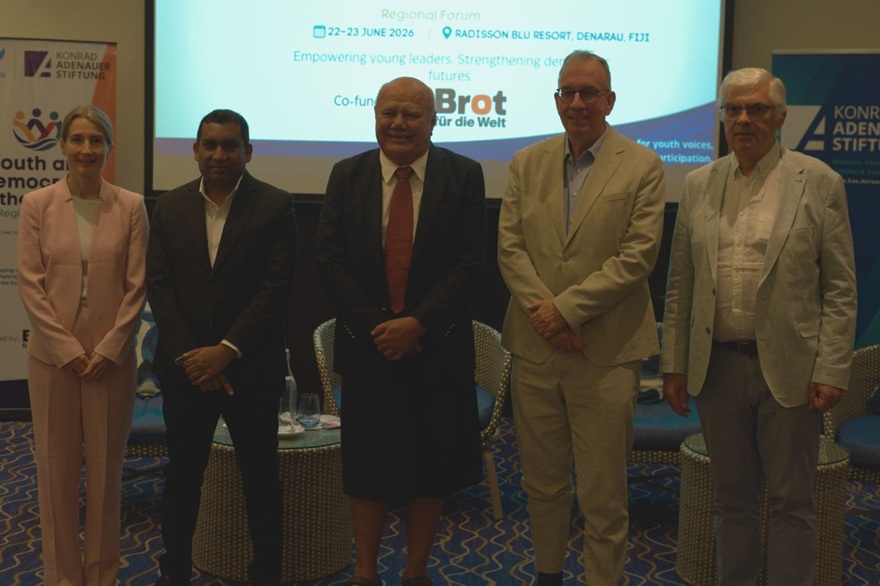
Young leaders from across the Pacific gathered in Nadi yesterday for the Youth and Democracy in the Pacific Regional Forum, a two-day regional program jointly organised by Dialogue Fiji and the Konrad Adenauer Stiftung (KAS).
The forum brought together participants from Fiji, Kiribati, Samoa, Tonga, the Solomon Islands, the Marshall Islands, and other Pacific countries to explore the challenges and opportunities facing youth participation in democracy, governance, and public leadership.
Officiating at the forum Deputy Prime Minister and Minister for Tourism and Civil Aviation, Viliame Gavoka, challenged young people to take a more active role in shaping the future of democracy in the Pacific.
“The conversations you have over the next two days matter,” he said.
” Because the future of democracy in the Pacific will depend not only on governments and institutions. It will depend on you.”
In his welcome address, Dialogue Fiji executive director Nilesh Lal highlighted the importance of strengthening democratic participation among the region’s rapidly growing youth population.
“The Pacific is home to one of the youngest populations in the world,” Mr Lal said.
“In many of our countries, more than half the population is under the age of 25.
“Yet despite this demographic reality, young people remain significantly underrepresented in formal political and governance structures,” he said.
Mr Lal said the forum was designed to equip participants with the knowledge, skills, networks, and confidence needed to participate meaningfully in shaping the future of their countries and the wider Pacific region.
Konrad Adenauer Stiftung, director for Australia, Sabina Woelkner, described the forum as an important opportunity to strengthen youth participation in political life across the region.
“The future of the Pacific will very much depend on how much space young people have to contribute, to lead, and to be heard,” she said.
Ms Woelkner noted that while young people were already active in community leadership, climate advocacy, and civil society initiatives, they often lacked access to formal decision-making structures.
“What is often missing is not motivation or commitment. It is access, opportunity, and the space to participate fully in political life.”
She pointed to the example of Pacific youth climate advocates who successfully helped bring climate change issues before the International Court of Justice as evidence of the impact that young people can have when provided meaningful opportunities to lead.
Participants also heard from the German ambassador to Fiji, Dr Andreas Prothmann, who shared his personal experiences as a young democracy activist and reflected on how youth engagement had shaped his professional journey over the past four decades.

