
This is part 5 of a multi-part series adapted from “How the Livuka Men Came Up to Windward” in Tales from Old Fiji by Lorimer Fison, De La More Press, London, 1904.
The story was told to Fison by Inoke Wangka-qele, a man of the Levuka tribe at Lakeba. Some place names and proper nouns have been updated to reflect current Fijian spelling and usage.
THE men of Levuka had not meant to come this far. They had left Bau with nothing but a god’s instruction to hoist their sails and sail east. A forbidden fish had cost them the life they once knew.
Their chiefs had prepared for war and the god had intervened, telling them only to bind their canoes and go.
They sailed through the islands of Fiji. Some stopped at Koro and became fishermen of that land. The rest sailed on to Vanua Levu and then further still, guided by a king’s daughter they had found at Kaba, drifting on a heap of coconuts, intending to die in the midst of the waters.
She had told them where to sail and they had followed her through Cicia and Nayau until they reached Lakeba and returned her to a father who had already eaten the death-feast after thinking her dead.
The king of Lakeba gave them land. They built a town there but when war sprang up again, some of the Levuka men took their wives and children and sailed farther on, looking for land in the lands to windward.
They came to Oneata and danced the dance of spears. From Oneata they steered for Vatoa and danced there too. From the top of the highest hill at Vatoa they could see nothing beyond. Only open water in every direction. They believed the earth ended here.
They were ready to turn back when a leper left behind on the canoe saw two heads rise slowly above the rim of a hollow tree stump.
Two gods, drawn by the clashing of the spears and the song of the god, peeping out at them. The leper called out and the men came running. They set a running noose over the stump and waited. When the two gods lifted their heads the young men pulled the rope and caught them.
The gods bargained for their lives, offering to be the gods of their houses, then their sailing, then their wars. The men of Levuka refused every offer.
Then the gods wept and said they would take them to a land called Ono, a land great and pleasant, and that if the wind was fair they would reach it that very night.
So the men of Levuka bound the two gods and laid them on the deck with their feet towards Ono, as instructed by the gods. But the gods were deceitful.
As the canoe drew near the island they kicked out with their feet and the land drifted backwards. It was the leper who saw what they were doing and told the rest.
They struck the gods with their clubs until the gods cried out to be turned around, and when they were turned the land stopped retreating and the canoe reached the shore.
The people of Ono welcomed them and gave them land to settle on. The Levuka men went ashore dancing the spear-dance and singing the song of the god. Before they went they left the children on board with the two gods, still bound, and a clear warning:
“See that you do not loose these two deceitful ones. Watch them well, or they will do you a mischief. And we, your fathers, we will make you eat of the whip.”
But when the elders had gone and the beach was full of celebration, the two gods began to beg the children to untie them, promising to teach them a new and beautiful song.
All the children said they should untie them.
All but one, a single boy who had not forgotten what his fathers said before they went ashore, who cried out that they should not listen, that the whip was ready for them.
But they would not hear him. They untied the hands and feet of the two gods and let them go.
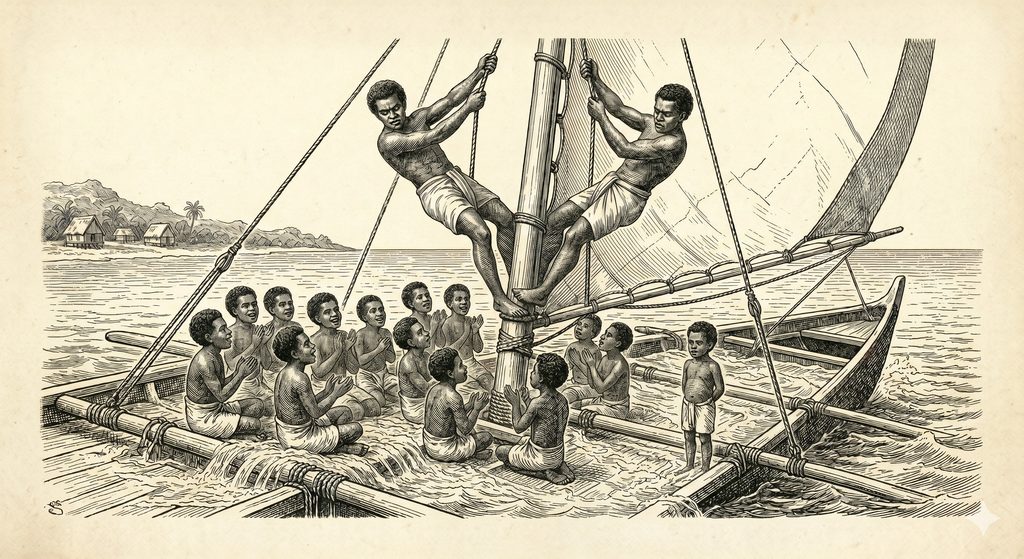
“Sit down on the deck,” said the two gods, “and we will climb the mast and sing you our beautiful song.” So the children all sat down.
The two gods climbed. When they reached the top they began to sing, and the children below clapped their hands and cried out that the song was good.
This is what the gods sang: “Tuvana -i-colo, tuvana-i-ra, ko Nasali ka coka baba, ko Burotu esa vuni tuga, ko Burotu esa vuni no i ra” which in Fison’s book translates to: “Tuvana inland! Tuvana below! Nasali is plainly in sight. Burotu, we are hiding it.”
The children clapped and sang along and did not notice what was happening above them. All the while the two gods were pulling downwards on the mast as hard as they could.
So hard did they pull that they pressed the canoe under the water, and all the children were drowned.
When the Levuka men came back down to the beach their canoe was gone. They saw nothing but the dead bodies of their children washed back and forth by the waves.
They had come from Bau with their families and sailed the length of Fiji and bargained with gods and found land at the end of the earth. And now they stood on that shore and pulled their children from the water.
That was a day of much weeping as they buried their little ones along the shore of Ono, far from every place their fathers had ever known.
Burotu, the island the gods sang about, has never been found. The people of Matuku know it. On their shores they sometimes find strange burnt-out fishing torches unlike any made in these islands, with handles of shell.
When they pick them up they say: “See the torches from Burotu.” They set them down carefully and say nothing more.
The chief called Mara knew it too, he who was later hanged at Bau for rebellion. He swore by the dead that he would find Burotu and went sailing after it for many days with a full crew.
The island has been seen sometimes with the sun shining full upon it, but when those who have seen it steered towards it, it grew fainter and fainter until it vanished like a cloud, and they sailed over the very spot where it had been and found only open water. Mara did not find it.
No one has found it since the day the two gods climbed the mast at Ono and sang it out of sight.
To this day, when the moon shines at night on the Ono passage, it is said you can hear the voices of the drowned children still singing.

