
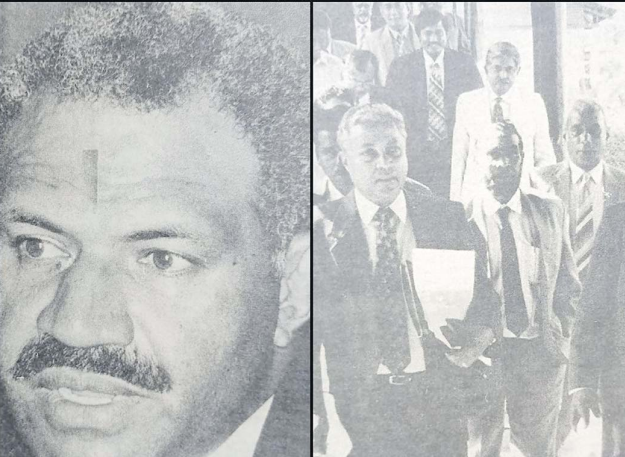
IT was, by any measure, an improbable alliance. In June 1992, Mahendra Chaudhry, the man whose Finance Ministry Rabuka had been snatched at gunpoint five years earlier during the 1987 military coups — agreed to install his erstwhile tormentor as Prime Minister of Fiji.
The arrangement was born not of goodwill but of pure arithmetic.
Rabuka’s Soqosoqo ni Vakavulewa ni Taukei (SVT) had won only 30 of the 37 indigenous Fijian seats in the newly elected 70-seat Parliament, falling short of the outright majority required to govern.
Worse, a fierce internal challenge had emerged.
Josevata Kamikamica — the technocratic former finance minister backed by former prime minister Ratu Sir Kamisese Mara and the traditional eastern chiefly establishment — was threatening to split the indigenous vote on the parliamentary floor.
Kamikamica, to his proponents, was well educated, fiscally disciplined, and a product of the aristocratic civil service elite.
To the establishment, Rabuka was seen as an undisciplined commoner who had disrupted Fiji’s natural social order with his 1987 coups.
Faced with the prospect of losing the premiership to a rival within his own camp, Rabuka turned to the Fiji Labour Party and its 13 Indo-Fijian seats.
The FLP became the kingmaker.
Price of support
The price was steep.
In exchange for its floor votes, Labour extracted a written agreement binding Rabuka to four concrete commitments: an immediate and comprehensive review of the discriminatory 1990 Constitution; a review of the Agricultural Landlord and Tenants Act (ALTA) to address expiring land leases; the revocation of anti-labour reforms enacted by the post-coup interim government; and the scrapping of Value Added Tax.
Chaudhry, ever the pragmatist, was asked by journalists why he was backing the man who had deposed him.
“He has somewhat mellowed,” he said.
“I have noticed changes in him as he becomes more mature.”
It was a characteristically calculated answer.
The deal gave Rabuka his majority and it also gave Chaudhry leverage.
Patience wears thin
For twelve months, that leverage went largely unused.
Rabuka governed, but the four conditions gathered dust.
By mid-1993, Chaudhry’s patience had visibly expired.
In June of that year, Rabuka delivered a televised address announcing that the Great Council of Chiefs would need to be consulted before any constitutional changes could proceed.
“The process will take time,” Rabuka told the nation, insisting it was “far better and more helpful and productive to be patient.”
Labour’s response was withering.
In a statement that same week, Chaudhry asked publicly: “Who is running this country — the GCC and the provincial councils, or elected representatives of the people? If so, then why are we going through this democratic charade of a parliamentary process?”
The question was not merely rhetorical.
It was a declaration that the arrangement was on life support.
Walkout
The constitutional question dominated the opening of the new parliamentary session.
President Ratu Sir Penaia Ganilau’s speech to the joint sitting of Parliament on June 21, 1993, sought to reassure, promising the review would be complete in time for the 1997 elections and that a successor to ALTA would be in place by 1995.
But within 24 hours, the deputy speaker had resigned.
Navin Maharaj, who also served as the FLP’s secretary-general, handed his letter to Speaker Dr Apenisa Kurisaqila, saying he could see “definitely clear indications” that the SVT had “no intention of having speedy discussions on a question of a review.”
He revealed that the FLP had written to Rabuka twice seeking a meeting and had received no acknowledgement.
On 23 June 1993, thirteen FLP members of parliament walked out of the chamber.
At a press conference afterwards, Chaudhry was blunt.
“I don’t trust him anymore,” he said of Rabuka.
“We gave him our conditional support, and we are entitled to withdraw that support. The whole process of reviewing the Constitution has been talked about for a year now and nothing has been done yet.”
He went further, accusing the Prime Minister of being controlled by external forces.
“The Prime Minister does not need to go to the GCC to discuss Labour Reforms and Value Added Tax,” Chaudhry said.
And when asked whether his actions might destabilise the economy, his response was unequivocal: “I think people’s political rights are more important than the economy.”
The walkout was immediately criticised.
Opposition Leader Jai Ram Reddy of the National Federation Party called it premature and gave his assurance that the NFP would not follow suit.
But the damage was done.
Rabuka’s government survived in the short term by leaning on the NFP for parliamentary support, but the political ground had irrevocably shifted.
Budget revolt
The end came in November 1993.
Kamikamica, who had spent more than a year plotting his revenge from the government backbenches, chose the annual budget as his weapon.
He led five dissident SVT MPs across the floor to vote against their own government’s financial plan.
With the FLP also voting against — using the occasion, as Chaudhry had always intended, to demonstrate that the power once given could be taken away — the budget fell.
Rabuka’s government collapsed.
Kamikamica and the opposition had miscalculated.
They expected Rabuka to resign, clearing the way for Kamikamica to assemble a new majority.
Instead, Rabuka immediately advised the President to dissolve Parliament and call a snap election for February 1994.
On the campaign trail, he framed the crisis as a story of betrayal and indigenous solidarity, running against “traitors” within and enemies without.
Election aftermath
The electorate responded decisively.
Rabuka’s SVT swept back with 32 of the 37 indigenous seats.
Kamikamica’s faction, which broke away to form the Fijian Association Party, was routed.
The FLP suffered its own punishment, dropping from 13 seats to just 7, as Indo-Fijian voters, alarmed by the instability the walkout had helped precipitate, shifted their support back to the NFP.
Long view of history
In retrospect, the episode is a masterclass in both the possibilities and the limits of parliamentary leverage politics.
Chaudhry had engineered the deal, enforced its terms through public pressure, and ultimately weaponised its collapse.
Yet the short-term political costs for Labour were severe.
Rabuka, the man Chaudhry had accused of running a “democratic charade,” emerged from the wreckage stronger than before.
The irony is not lost on history.
The 1990 Constitution — the central grievance that had unravelled the deal — was eventually reviewed and replaced by the landmark 1997 Constitution, widely regarded as a genuine step toward racial equality in Fiji’s governance.
And Mahendra Chaudhry, despite the setbacks of 1993 and 1994, would go on to become Fiji’s first Indo-Fijian Prime Minister in 1999.
At 84, he remains in politics.
Some bargains, it seems, take decades to pay out.
The following historical analysis was compiled with information from The Fiji Times archives and library, specifically the newspaper coverage from the months of June, July and November 1992, 1993 and 1994.

