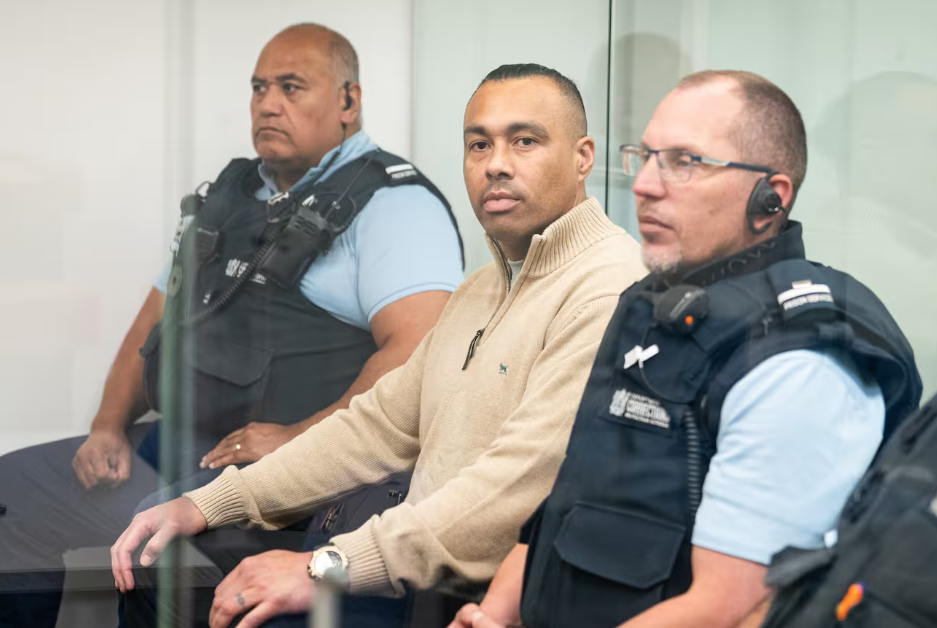
Samuel Vaisevuraki described himself as a businessman who facilitated sales.
In reality, he was a drug dealer involved in importing, supplying or offering to supply almost 100kg of methamphetamine and cocaine.
He also conspired to import up to 500kg of methamphetamine and significant quantities of cocaine and MDMA.
His drug operation came to an abrupt halt after he was discovered carrying $16,000 in cash during a routine traffic stop.
Over six months in 2023, Vaisevuraki, with help from a network of associates in New Zealand and abroad, was responsible for importing significant quantities of drugs by air and sea.
At his recent sentencing in the High Court at Wellington, the 47-year-old pleaded guilty to importing, possessing for supply, offering to supply, or supplying 65.756kg of methamphetamine, 30kg of cocaine, and 3kg of MDMA.
He also admitted conspiring to import half a tonne of methamphetamine, 25 to 35kg of cocaine, and 20kg of MDMA.
Vaisevuraki’s 27.5 year sentence was believed to be the longest imposed for drug offending in the Wellington courts.
His offending was made worse because it was committed while on parole, following his release from prison for previous large-scale drug offending.
After his recall to prison for the latest offending, he attempted to bribe a prison guard, passing a note asking him to bring a cellphone and a $100 Prezzy card into prison. In return, he offered to pay the guard $25,000.
Airports and ocean-going vessels
At his sentencing on Friday, Justice Victoria Heine outlined the extensive summary of facts, which ran to 60 pages.
In 2021, Vaisevuraki was jailed for seven years for his involvement in large-scale importation and distribution of methamphetamine.
Released in March 2023, he was ordered to complete a community-based drug rehabilitation programme.
While completing that course, Vaisevuraki re-established a commercial drug enterprise, importing, conspiring to import, and otherwise distributing methamphetamine and cocaine on a large scale, using encrypted software.
Vaisevuraki sold methamphetamine for $160,000 a kilo and, according to the summary, charged a 40% fee for managing the importation of drugs into New Zealand.
It outlined how the drugs arrived from Canada, Fiji and South Africa, some on FedEx freight planes.
At airports, staff involved in Vaisevuraki’s operation uplifted packages, bypassing Customs and border control.
Vaisevuraki and his associates referred to those different routes and methods as “doors”, describing the doors as “open” or “closed”, depending on whether that route or method was available at the time.
Part of an international drug syndicate or exaggeration and grandiosity?
At sentencing, Justice Heine considered whether Vaisevuraki’s role in the offending was lesser, significant or leading.
The Crown, represented by Anselm Williams and Maia Childs, submitted the offending was at the most serious level.
Williams pointed to the defendant’s substantial international networks, including his claims that he was part of an “international drug syndicate” and connected to the Sinaloa Cartel.
He submitted that his overseas associates were likely wholesale exporters or employees of these people, while Vaisevuraki headed the New Zealand operation.
The Crown said Vaisevuraki also recruited others and regularly distributed significant quantities of Class A drugs to dealers throughout the country.
Dale Dufty, Vaisevuraki’s lawyer, challenged that, suggesting the Crown had overstated his client’s role, which he described as at the upper end of significant.
Dufty pointed out there was nothing to independently corroborate Vaisevuraki’s claims that he led or managed the wider operation, reminding the court that his client was prone to exaggeration and grandiosity.
At best, he said, the evidence suggested his client acted as a key point of contact or distribution point within New Zealand and submitted that a gang, or other gang members, controlled the upstream supply and on-supplied it to him through his networks.
‘You stood to gain tens of millions’
Justice Heine told Vaisevuraki it was clear he had embellished aspects of his offending, noting he didn’t have “legitimate control of companies, politicians, airports and corporate business”, as he told one report writer.
The judge said she had to sentence on the basis of the summary of facts.
“It is clear that you directed and organised buying and selling on a commercial scale, had substantial influence on your associates, had an expectation of substantial financial gain and had close links to the international source of your drugs. These are all indications of a leading role,” she said.
Adopting a starting point of 32 years for the drug offending, Justice Heine applied uplifts for the charge of bribing an official and the fact the offending occurred while Vaisevuraki was on parole, resulting in a global starting point of 34 years and six months’ jail.
“You stood to gain tens of millions in revenue from your offending, and methamphetamine destroys communities and lives. A lengthy starting point is entirely appropriate, given the seriousness of your conduct.”
Taking into account Vaisevuraki’s personal circumstances, the judge applied a 15% discount for guilty pleas and a further 8% for personal factors, including exposure to violence in the family home and prolonged abuse during primary and intermediate school.
As a result, Vaisevuraki had been diagnosed with dissociative identity disorder (DID) and PTSD, which the report writers noted were significantly associated with criminal offending.
“The reports tell me that your particular background growing up has produced in you a need to make something of yourself, and to impress others, particularly older males.
“These can be seen in your grandiose text messages. It has also produced a range of clinically diagnosed psychological conditions which in part lead you to dissociate from reality.
“I can see how that could have led you to attempt this scale of offending, perhaps without fully thinking it through.”
The judge refused to apply a discount to reflect Vaisevuraki’s addiction, describing the link between offending and addiction as “spurious”.
“Your operation could not have been run by someone with a meaningful addiction to drugs, and you have described yourself as a ‘businessman’.”
On 11 charges, Justice Heine jailed Vaisevuraki for 27 years and six months.
She declined to impose an MPI, noting that under the law Vaisevuraki would spend at least nine years and two months in jail.
“I am not satisfied that imposing an MPI, which is 10 months longer, would have any meaningful impact in achieving the purposes of sentencing.”
The quantities are staggering: police
Detective Regan Duncan said the sentence reflected the seriousness of the offending and the significant harm large-scale drug importation and distribution causes to communities.
“Organised drug offending of this scale fuels addiction, violence and wider harm across New Zealand.
“He has now been held accountable for his actions, and the sentence sends a clear message that those involved in importing and distributing illicit drugs will face serious consequences.
“Police will continue to target those who profit from the misery these drugs cause,” the statement said.