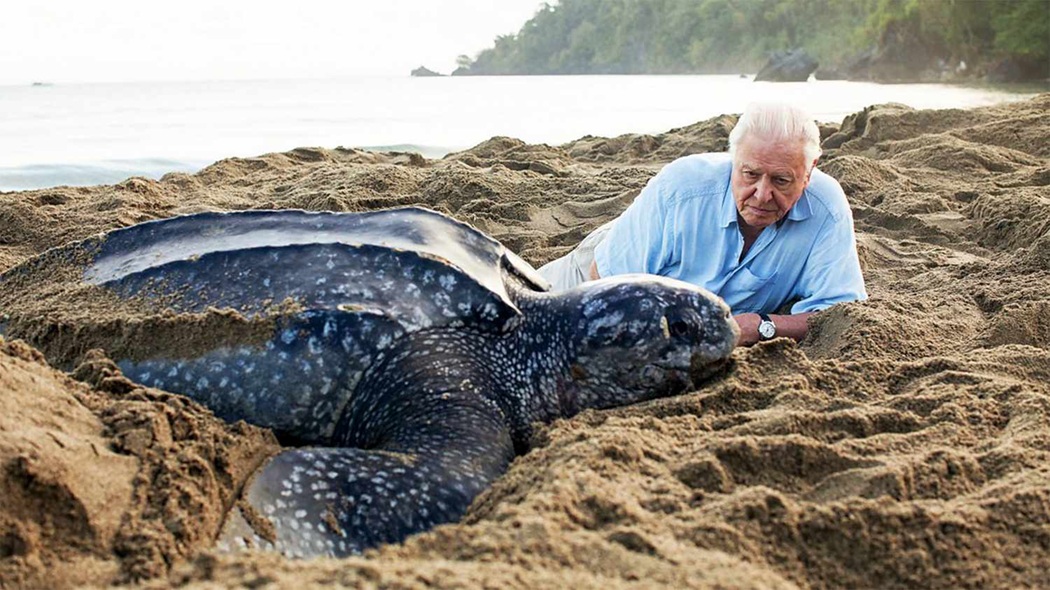
I will not see how that story ends but, after a lifetime of exploring our planet, I remain convinced that the more people enjoy and understand the natural world, the greater our hope of saving both it and ourselves becomes,” wrote Sir David Attenborough last year.
The centurion who has undoubtedly been our planet’s most passionate advocate and arguably the greatest naturalist who has ever lived turned 100 on Friday last week.
A life spanning a century has placed this centenarian in a rare category of human experience, where he has not only witnessed the changing face of the Earth but helped the world see it more clearly.
We all carry our own memories of Sir David.
For many, it is his unmistakable voice, always calm, reverent, quietly urgent, that first introduced us to the hidden dramas of the natural world.
From the depths of the oceans to the frozen poles, from dense rainforests to fragile coral reefs, he has been our guide through ecosystems we might otherwise never have known existed.
Even in the era of Gen-Z streaming and digital distraction, his influence has not waned.
If anything, it has deepened.
What sets Sir David apart is not merely his longevity in broadcasting, but his relentless pursuit to protect and preserve life on Earth. His work has never been content with admiration alone.
It has consistently demanded awareness of beauty, yes, but also of fragility and loss.
Through decades of landmark documentaries, he has documented the splendour of nature while steadily drawing attention to the accelerating damage caused by human activity, particularly industrialisation and unsustainable consumption.
Vanua, veiwekani and a shared responsibility
In the Pacific, where the relationship between people and nature is deeply interwoven, Sir David’s message finds powerful resonance.
The Fijian concepts of vanua and veiwekani extend beyond land and kinship; they speak to a spiritual and practical responsibility to the environment and to each other.
Fiji, an archipelago of more than 300 islands blessed with vibrant ecosystems and extraordinary biodiversity, could well be described as the kind of living classroom Sir David has spent his life documenting.
One imagines he would marvel at its coral reefs, mangroves, and rainforests, and at the intricate balance that sustains island life.
Yet even here, as across much of the world, that balance is under strain.
Over recent years, neglect, greed and short-sighted development which is increasingly being driven by exploitative commercial interests and political mismanagement, are placing these natural systems at risk.
A life that helped the world see nature
As Sir David turns 100, it is fitting not only to celebrate his extraordinary life but to reflect on the message he has refined over decades, that humanity stands at a turning point.
The final chapter of Earth’s story, he insists, is not yet written. It is ours to shape.
Born on May 8, 1926, in London, David Attenborough grew up on the campus of University College, Leicester, where his father served as principal. Surrounded by academia and natural history collections, his fascination with fossils and wildlife began early. He was the middle of three brothers, his elder sibling Richard Attenborough later becoming an Oscar-winning actor and director.
During the Second World War, the family also sheltered two Jewish refugee girls from Germany, a formative experience in empathy and human responsibility.
He studied geology and zoology at Clare College, Cambridge, graduating in 1947 with a degree in natural sciences. Following two years of National Service in the Royal Navy, primarily in North Wales and the Firth of Forth, he joined the BBC in 1952 as a trainee producer despite not owning a television at the time.
Revolutionising natural history broadcasting
His breakthrough came in 1954 with Zoo Quest, a pioneering series that moved wildlife filmmaking out of zoos and into natural habitats. It marked a revolution in broadcasting.
By 1965, he had become controller of BBC Two, where he oversaw the introduction of colour television in Europe and commissioned groundbreaking programmes, including Monty Python’s Flying Circus. Yet administration was never his calling for long. In 1973, he stepped away from management to return to field filmmaking.
What followed became a golden era of natural history storytelling: Life on Earth, The Living Planet, The Blue Planet, Planet Earth, and many more. These series did more than document wildlife; they reshaped global understanding of biodiversity and ecological interdependence.
Encounters with the wild
His career has been defined by “firsts”—capturing behaviours and species never before filmed.
From mountain gorillas in Rwanda playfully interacting with him in 1979, to a blue whale surfacing beside his boat off California, to lyrebirds in Australia mimicking chainsaws, his encounters often bordered on the surreal.
In Antarctica, he sat among 600,000 king penguins. On Christmas Island, he remained still as millions of red crabs swarmed around him. Each moment revealed not only nature’s wonder but its resilience and precision.
Honours, family and legacy
Sir David’s honours reflect his global impact. He has been knighted twice, most recently in 2022 by King Charles III.
More than 50 species have been named after him, a scientific tribute to his contribution to biological awareness.
He was married to Jane Elizabeth Ebsworth Oriel for 47 years until her passing in 1997, and they had two children.
A turning point for the planet
In his later years, Sir David’s message has sharpened.
The tone is still hopeful, but increasingly urgent.
He has repeatedly warned that the world is approaching a critical decade in which decisions will determine the trajectory of climate stability and biodiversity recovery.
He speaks not of despair, but of responsibility: a belief that ecosystems can recover if given space, protection and time.
Nowhere is this more evident than in his advocacy for the oceans. After a century of life, he has described the marine environment as the planet’s most vital system.
Coral reefs, fish populations and deep-sea ecosystems possess an extraordinary capacity for renewal, if human pressure is reduced and protection is enforced through marine sanctuaries.
Bearing witness to a fragile Earth
His philosophy has its foundations firmly in a simple but profound idea, that people protect what they understand.
Without exposure, there is no care; without care, no action. It is for this reason that he has dedicated his life to bearing witness, to showing humanity what is at stake.
As Sir David Attenborough marks a century of life, his legacy is not simply one of storytelling, but of stewardship.
He has given voice to the voiceless, visibility to the unseen, and urgency to the overlooked.
In doing so, he has asked humanity a question that remains unanswered, how do we wish the story of our planet to end?
The answer, as he has always reminded us, lies not in the past he has documented, but in the future we now choose to create.