The first thing a child notices about a bridge is not necessarily who built it. It is why the bridge is there.
Whether it allows her to cross a river safely on the way to school. Whether her parents can carry produce to market. Whether an elderly relative can reach a clinic without turning a short journey into a dangerous one.
In Papua, where mountains, rivers and limited transport links can isolate communities, such questions can be more immediate than the politics surrounding them.
As Indonesia marks the 81st anniversary of the Tentara Nasional Indonesia (TNI), Papua offers a complicated picture of what military service can mean in a remote and contested environment.
The Indonesian military’s presence in Papua is inseparable from the region’s security problems. Armed separatist groups have carried out attacks against civilians and public workers, while the security forces have also faced longstanding allegations of abuses and excessive use of force. Both realities are important to consider.
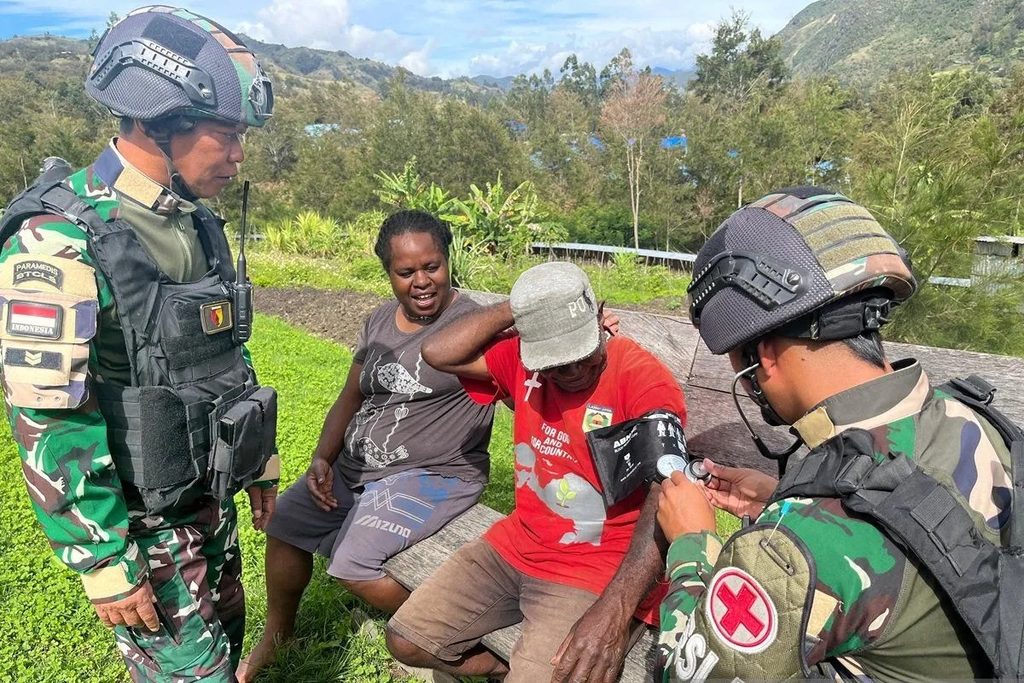
So does another aspect that receives less attention, that is the role military personnel sometimes play in providing logistical, medical, engineering and emergency assistance in communities where civilian services can be difficult to deliver.
Where geography shapes security
Papua’s geography changes the meaning of public services.
Mountain ranges divide communities. Rivers become barriers. Heavy rain can isolate villages. Some settlements remain accessible mainly by foot, small aircraft or helicopter.
In such circumstances, engineering and logistical capabilities can have a direct effect on civilian life. Military personnel have been involved in activities including bridge repairs, medical outreach, assistance to schools and community facilities, food distribution and emergency evacuations.
The Indonesian Government and military have also presented such activities as part of their broader approach to supporting communities in remote areas.
There is a legitimate question over where the responsibility of the military should end and that of civilian government should begin.
Military assistance should not become a substitute for functioning civilian institutions. But for a person living far from a hospital or road, the immediate question can be much simpler: does help arrive?
The security dilemma
That question exists alongside a difficult security environment.
In September, three civilian agricultural officials were killed in Jayawijaya while returning from work providing livestock assistance and agricultural advice.
Indonesian authorities have also reported recent attacks on civilian transport and other workers in Papua.
Amnesty International Indonesia has condemned recent killings of civilians and called for all parties to the conflict, including the military and armed pro-independence groups, to comply with international humanitarian law.
The risks extend to aviation, which is particularly important in a region where aircraft can provide the equivalent of a road into isolated communities.
In July, American pilot Nicholas F. Goselin was shot and killed after landing at Balinggama, while his aircraft was burned. Indonesian authorities said the flight was conducting a humanitarian mission.
These incidents illustrate why security cannot be separated entirely from development in Papua. A teacher cannot easily remain in a community where schools are unsafe. A health worker cannot provide services if access routes become dangerous. A pilot cannot connect isolated communities if aircraft are targeted.
Yet the existence of an armed threat does not remove the obligation of security forces to protect civilians and operate within the law.
That is the difficult balance at the heart of Papua’s security debate.
No single Papuan experience
There is also no single Papuan experience of the Indonesian military.
Some communities and civil society organisations have raised serious concerns about military operations, civilian casualties and human rights. Those concerns require evidence, investigation and accountability.
Other communities have received medical assistance, infrastructure support, emergency evacuations or other forms of military assistance.
One experience does not invalidate the other. A family grateful for an evacuation does not necessarily endorse every military operation. A community concerned about military conduct does not necessarily reject every form of assistance.
This distinction is important to highlight because Papua is often discussed through broad political categories when the experiences of individual communities can be considerably more complicated.
The standard should be conduct
Military assistance cannot erase misconduct.
A bridge does not cancel an abuse. A medical outreach programme does not remove the need to investigate civilian harm. Equally, allegations against the security forces should not automatically obscure legitimate assistance provided to communities.
The appropriate test is therefore conduct.
Are civilians protected? Are armed groups and ordinary residents distinguished? Are security operations proportionate and lawful? Are communities treated with respect? Are allegations investigated? Are personnel held accountable when wrongdoing is established?
These are questions of professionalism rather than politics.
They are also questions familiar to military institutions beyond Indonesia.
The Republic of Fiji Military Forces has long combined its traditional defence responsibilities with peacekeeping, disaster response and humanitarian assistance.
In 2025, the RFMF took part in a regional Humanitarian Assistance and Disaster Relief exercise involving French, New Zealand and Australian defence personnel, aimed at strengthening its capacity to respond to disasters.
Fiji’s defence relationship with Indonesia is also developing.
In August, 14 RFMF personnel participated in Exercise Garuda Canti Dharma III in Indonesia, a multinational peacekeeping exercise involving more than 700 personnel from 22 countries.
Fiji’s Ministry of Foreign Affairs described the exercise as part of growing defence cooperation, including military training, professional exchanges and peacekeeping capacity-building.
The comparison should not be overstated. Fiji and Papua have very different histories, political circumstances and security environments.
But there is a common principle, modern military institutions are increasingly judged not only by their ability to respond to security threats, but also by how they operate among civilian populations and contribute to humanitarian and peacekeeping efforts.
What disappears from the headline
The difficulty in covering Papua is therefore not simply distinguishing between truth and falsehood.
Individual reports of violence may be entirely accurate. So may reports of military assistance.
The problem arises when one set of realities becomes so dominant that another disappears.
The bridge disappears. The medical visit disappears. The classroom disappears. The evacuation disappears.
But so too would the victims of alleged abuses disappear if reporting focused only on military assistance. Neither selective criticism nor selective celebration provides a complete picture.
The TNI’s anniversary therefore offers an opportunity to look beyond the uniform without looking away from the responsibilities that come with it.
The Indonesian military does not need to be romanticised. Nor should its personnel be reduced to a single political description.
In Papua, the more useful question is what happens beyond the uniform: whether a soldier protects or harms, builds or destroys, assists or abuses, respects civilian life or places it at risk.
For communities living in some of the world’s most difficult terrain, those distinctions are not abstract.
They can determine whether a child reaches school, whether medicine arrives, whether a teacher stays, whether a plane lands safely, whether a farmer reaches market — and whether people caught between competing forces can live their ordinary lives with greater security.
That is the standard by which any military institution, in Indonesia, Fiji or elsewhere, ultimately has to be measured.
This commentary draws on reporting and documentation from ANTARA News, Associated Press, Human Rights Watch, Human Rights Monitor, Indonesian government and military sources, and local Papua media. These sources were used to verify recent attacks on civilians and aviation personnel, the abduction of women in Jila, the killing of agricultural officials in Jayawijaya, and examples of military-supported healthcare, education, church repair, infrastructure, food assistance, clean water and civilian evacuation in Papua.