
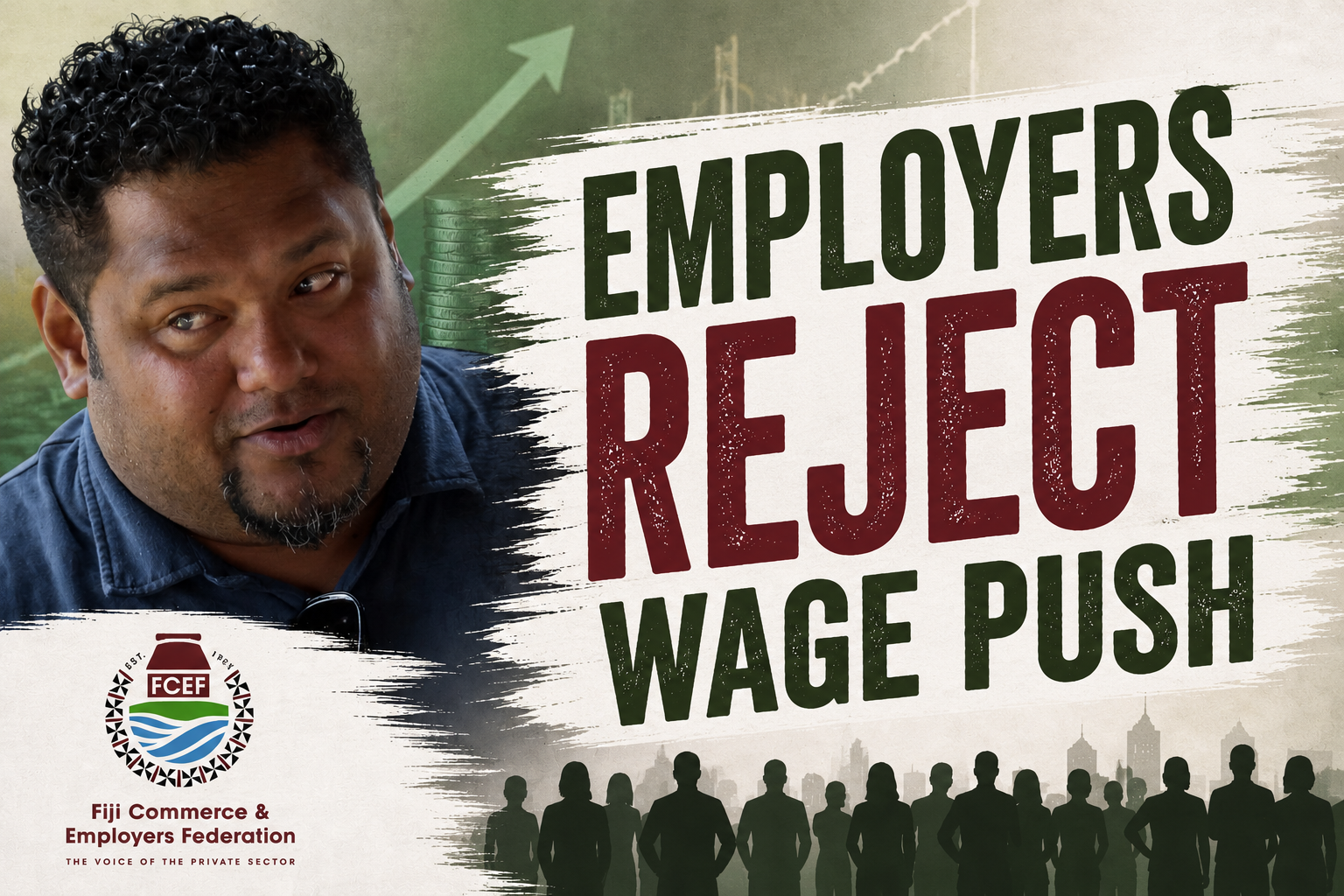
The Fiji Commerce and Employers Federation says calls for an $8 per hour living wage must be carefully balanced against economic realities, warning that businesses and Government are already struggling to remain sustainable while maintaining employment.
FCEF chief executive officer Edward Bernard said the Fiji Trades Union Congress’ push for a new wage system was not being made in good faith at a time when employers were facing mounting financial pressures.
“Demanding for a new wages system in an economic climate where businesses and even the Government is trying to survive and continue to employ workers, is not good faith on the part of FTUC,” Mr Bernard said.
He said while the Federation supported decent work and fair wages that improved living standards, wage policies also needed to consider enterprise sustainability, productivity and economic growth.
Mr Bernard said Fiji continued to face several economic challenges, including low productivity, widening skills gaps, high youth unemployment and rising freight and production costs.
He referenced a recent World Bank warning that Fiji’s economic growth could fall below three per cent unless reforms were accelerated, productivity improved and fiscal discipline strengthened.
FCEF also highlighted that Fiji’s minimum wage had increased significantly over the past decade.
According to the Federation, the national minimum wage has risen by 115 per cent since 2015, increasing from $2.32 to $5 an hour, while wages have increased by 86.6 per cent over the past three years alone.
The organisation claimed Fiji’s minimum wage was now more than 60 per cent higher than Papua New Guinea’s despite PNG having a much larger economy.
Mr Bernard said most industries were already paying above the minimum wage and noted that FCEF had recently advocated for standardised meal allowances across sectors through submissions to the Wages Council.
He also pointed to the impact of remittances, saying household incomes had been boosted through the estimated $1.4 billion received from overseas.
Mr Bernard said international labour standards, including those recognised by the International Labour Organization and the Universal Declaration of Human Rights, required countries to consider local economic conditions and business sustainability when determining living wages.
“In many jurisdictions such as New Zealand, living wage is not compulsory,” he said.
He added that determining a living wage was complex because it needed to account for factors such as the number of dependents and income earners within households.
FCEF has also backed Prime Minister Sitiveni Rabuka’s response to the FTUC proposal, supporting calls for wage reviews to be transparent, evidence-based and grounded in economic conditions and cost-of-living considerations.

