WHAT started as a simple idea to share a family recipe has grown into a business bringing the flavours of Fiji and the Pacific to Australian homes.
For Fuzz Ali, the journey began with a bottle of chilli oil inspired by her grandmother’s chutney recipe.
There was no physical shop, no shelves filled with Pacific products and no large range of goods to offer customers.
Instead, there was one product, an online store, and a belief that Fijian and Pacific flavours deserved a place in everyday Australian kitchens.
Together with his partner, Ilai Jikoiono, Ali established Fiji Pantry as an online business in 2024.
The first product was a Fiji-style chilli oil, made using a recipe inspired by the flavours he grew up with in his grandmother’s kitchen in Sigatoka.
Unlike the crispy chilli oils commonly found in shops, their product had a chunky texture, a slow-building heat and a mixture of star anise and cinnamon.
It sold out almost immediately after its launch.
For Mr Ali, that response was an encouraging sign that customers were interested in discovering something different.
“We started Fiji Pantry as an online store in 2024, and it began with one product: a Fiji-style chilli oil,” he said.
“The recipe is based on my grandmother’s chilli chutney. It is not the crispy, crunchy style of chilli oil you see everywhere. It is chunky, with a slow warming heat and a bit of star anise and cinnamon through it.”
The success of the first product encouraged the business partners to expand their range.
They introduced their own curry powder and chilli olive oil before looking for other products made by producers across Fiji and the Pacific.
Their decision to start online was deliberate.
Rather than immediately investing in a physical shop, they wanted to test the market, understand what customers liked and gradually build a business around products that could be stored and delivered.
He said pantry products were a good starting point because customers could try unfamiliar flavours without making a big commitment.
“A bottle of chilli oil, a packet of curry powder or sea salt harvested in Taveuni is a low-risk way for someone to try an unfamiliar flavour.
“It has a long shelf life, it sits in the cupboard, and if they fall in love with it, they come back and buy it again and again.”
The idea was to make Pacific ingredients accessible to people who may not have previously cooked Fijian food.
For him, the business was also a continuation of his lifelong connection to food.
Born in Sydney but raised in Suva, he spent much of his childhood around his maternal family in Sigatoka.
Some of his earliest memories came from his grandmother’s kitchen, where traditional food and family recipes were part of everyday life.
“I learned to eat at my grandmother’s table in Sigatoka, where whitebait fritters came straight from the river, and the chutney was always on the table.”
Those memories would later influence the products he developed with Mr Jikoiono.
Food had also played an important role in their lives before Fiji Pantry.
He and Mr Jikoiono had previously operated a cafe in Nadi and established a fashion label called Zuber, which had a flagship store in Suva and was stocked at the Sofitel, Sheraton, and Kokomo.
They had experience working together in business, but food remained a strong part of their interests.
Mr Ali also built a career in food writing, broadcasting, and television.
He writes the Flavour with Fuzz column for Better Homes and Gardens Australia, contributes recipes to SBS Food and hosts Mapping South Asian Food on SBS Spice.
He also appears on Channel 7’s The Morning Show.
Before returning to Australia, he hosted programs on Fiji One and this year launched Food Stories, a series he created and hosts for Fiji One, filmed entirely in Sydney.
His work in food media has helped him share recipes and stories with audiences.
However, Fiji Pantry has provided an opportunity to make the ingredients available to those who wanted to try the dishes themselves.
“You can read a recipe for kokoda or a curry, but if you cannot buy the ingredients, it stays on the page. We wanted people to be able to walk in, pick up what they need and go home and cook.”
As the online business grew, they began looking beyond their own products.
They wanted to introduce goods from small producers across the Pacific and provide them with an opportunity to reach customers in Australia.
One of their products is Fiji Sea Salt, traditionally harvested and made by House of Salt in Waiyevo, Taveuni.
The range includes plain sea salt, as well as varieties with Fijian kumquat and Fijian chilli.
They also stock honey from Niue, coconut oil from ethically sourced Solomon Islands coconuts and chilli sauce from Fiji.
Other products include ghee, pantry staples, and handwoven pieces from Rise Beyond the Reef.
The business has also expanded into frozen products imported from Fiji, supporting farmers growing dalo, cassava, rourou, uto and other traditional food crops.
He said finding producers, tasting their products, and introducing them to Australian customers was one of the most enjoyable parts of running the business.
Pacific Trade Invest has also helped the couple connect with suppliers across the region and provided information about exporting products to international markets.
As the product range increased, so did the business partners’ ambition.
In July this year, they opened their first physical Fiji Pantry shop at 17 Darley Street in Darlinghurst, Sydney.
The move from an online store to a physical shop was another important step in making Pacific products more accessible.
He said the location was chosen because they wanted to introduce their products to people outside the traditional Pacific community.
“We opened in Darlinghurst, which is nowhere near where the Pacific community traditionally lives in Sydney.”
The decision meant they could not rely on an established Pacific customer base and had to work towards attracting people unfamiliar with their products.
However, he said the response from the community and Australian customers had been encouraging.
Fijians and other Pacific islanders have travelled across Sydney to visit the shop, while residents have also shown interest in trying the products.
The couple has since introduced Baked by Fiji Pantry, allowing customers to pre-order cassava cake, custard pie, lolo buns and pistachio cake for collection.
They are also planning monthly kava and canapé evenings and small pantry dinners.
However, moving from an online business to a physical store has brought new challenges.
Getting products from small Pacific producers to Sydney can be slow and expensive.
When the shop opened, some products were still making their way across the ocean, meaning the shelves were filled gradually.
The two also manage almost every aspect of the business themselves.
Mr Ali handles the food development, media work, and storytelling, while Mr Jikoiono manages operations, orders, and the day-to-day running of the business.
He also films and edits their online content.
Mr Ali said their online presence remained an important part of reaching customers and sharing the stories behind their products.
“We have always worked that way: I am the face and the voice, and Ilai makes it all happen.”
Despite the challenges, they are now looking at expanding production of their chilli oil, Fiji Sea Salt, and curry powder.
They also want to introduce more Pacific producers and eventually see their products stocked in shops beyond Darlinghurst.
For other Fijians hoping to establish businesses overseas, Mr Ali said starting small and believing in the product were important.
“Start with one thing you are proud of and do it properly.
“We started with one bottle of chilli oil, not a shop.”
For Fiji Pantry, the journey from an online store to a physical shop has shown what can grow from a simple idea.
What began with a recipe from her grandmother’s kitchen is now helping introduce the flavours of Fiji and the Pacific to a wider Australian audience.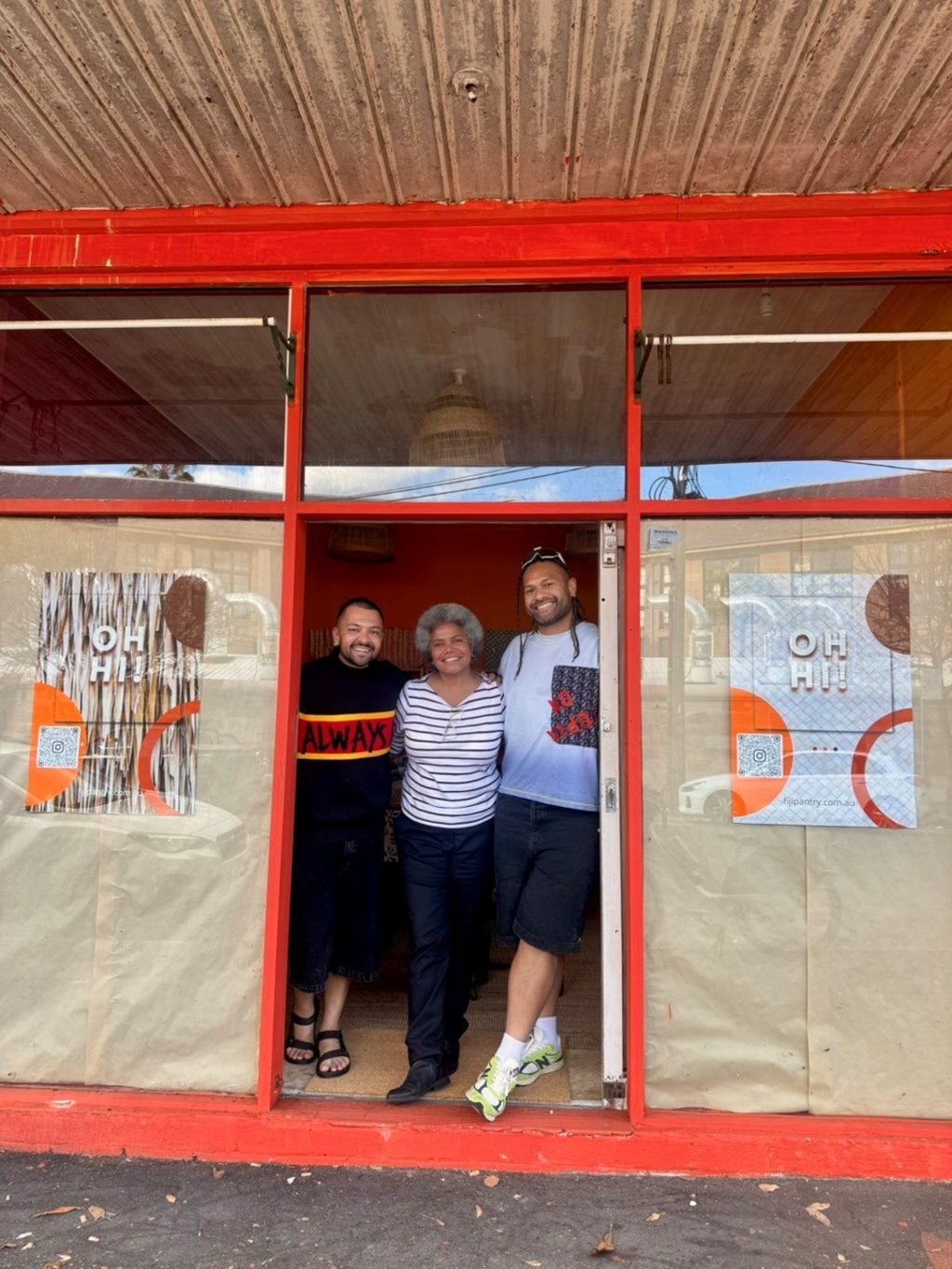
Fuzz Ali and his business partner Ilai Jikoiono pictured with deputy speaker of Parliament Lenora Qereqeretabua in front of their shop in Sydney. Picture SUPPLIED/FUZZ ALI