
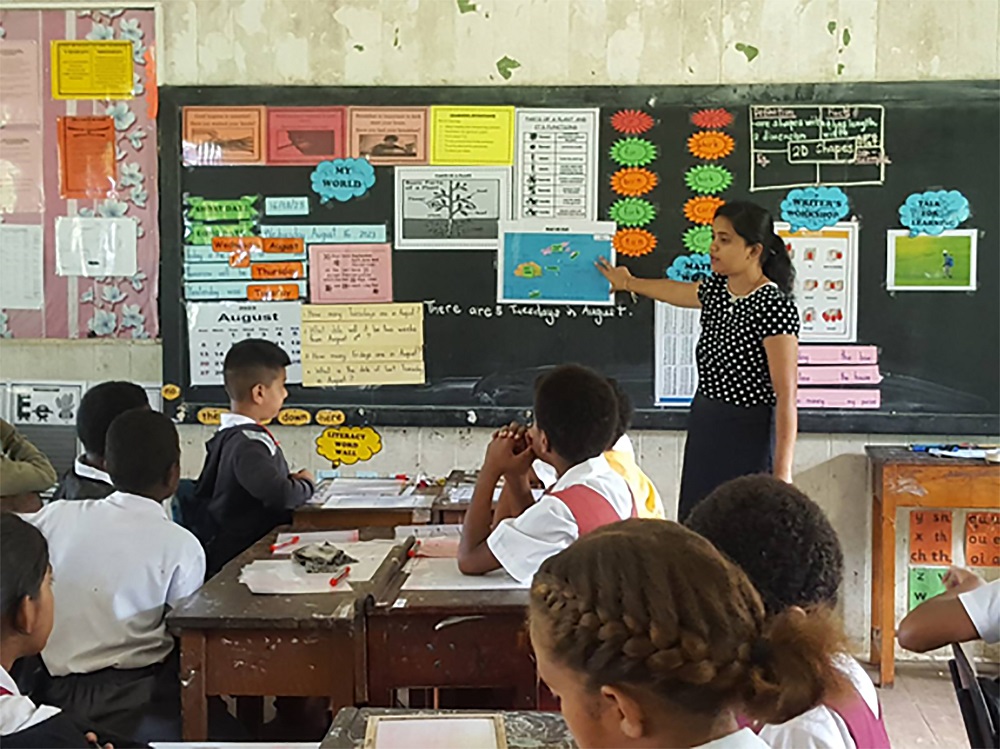
Last year through the initiative of Ministry of Education to uplift numeracy and literacy standards in Fiji, new methods of teaching was introduced where primary schools piloted explicit learning as part of their morning routine. While these strategies are new to teachers, they have proven to be an effective way to elevate the standards of numeracy and literacy in Fiji. New syllabi were developed and handed over to piloted schools across the nation for trial. The syllabi provide clarity on what should be taught at each year level. They are supported by yearlevel scopes and sequences that offer elaborations for each outcome and recommend when each outcome should be taught within the school term.
Morning routine
The morning routine is a daily lesson structure planned for each weekday, consisting of four quadrants:
• Learning to talk;
• 100 Days of learning,
• Sentence of the day; and
• Calendar.
These quadrants are interchangeable. Every morning, the teacher dedicates 30 minutes to the morning routine and repeats the concept daily.
This routine helps students form the habit of structured learning and establishes automaticity. In essence, the morning routine serves as a multi-faceted literacy lesson.
What makes it highly effective is its alignment with the three crucial ideas of developing knowledge schema, which many children of this generation base their learning on.
Another goal is to instil routine habits in a child. These habits are formed in our working memory, and daily practice accelerates a child’s learning. Wholeschool implementation is the most effective approach.
The lesson structure maximises their learning over time, and it’s notable that when students progress from one grade to the next, the structure remains the same.
The morning routine is the recommended reading method as it establishes mastery.
Benefits of morning routine in Fiji classrooms
The morning routine and explicit instruction have significant benefits in the classroom when they are well-planned, precise, authentic, and monitored. When students develop the habit of the morning routine, they qualify for automaticity.
Through the practice of the morning routine in classrooms worldwide, several benefits have been observed. These include students arriving at school on time with their routines established.
Students are ready to learn immediately, become independent learners, and form groups with peers of similar expertise (ability groups).
The fundamental benefit is using schema to construct knowledge (constructivism), which frontloads students with information, whether it’s knowledge schema or procedural schema. It ensures that learning outcomes are achievable.
Pre and post assessment
During the initial days of the pilot program, students are assessed with the Waddington Assessment, and their achievements are recorded. With the morning routine and explicit learning methods, students are scaffolded throughout the year.
When students are assessed again postintervention, improvements are noted. They are assessed in numeracy, literacy, and writing.
Students Learning through morning routine The morning routine habits enable students to build schema, which is crucial for gradual knowledge acquisition.
It also enhances a child’s vocabulary, which is often deficient in today’s students. Knowledge is taught, contributing to mastery, and with mastery comes automaticity.
Pavlov’s theory of conditioning
The morning routine is arguably supported by Pavlov’s theory of classical conditioning. Students are conditioned in that 30-minute structure daily.
This conditioning helps them acquire further knowledge. Schema is a crucial part of this process. Students form a habit of gaining knowledge daily, and it is delivered rapidly and accurately, akin to how Pavlov’s dogs were classically conditioned.
Novice to expert The morning routine helps students at any academic level improve their writing. Students develop excellent habits, and seating arrangements play a vital role.
Challenged students sit in front rows to benefit from direct teacher attention, while students sit in ability-based rows to receive focused activities. The morning routine audience adopts the idea that explicit instruction can transform novices into expert writers.
Students encounter knowledge in the morning and use it throughout the day, transforming from novices to experts.
Success of morning routine in Fiji classrooms
The success of the morning routine largely depends on careful planning and a deep understanding of effective teaching strategies. I have personally tried it in my own class, and the feedback has been excellent.
If teachers embrace the morning routine approach, we may be on the cusp of a new era of learning in Fiji. While it may initially be time-consuming, with daily practice, teachers and students will be well-prepared in advance.
My advice to teachers is that the morning routine is a promising way forward for achieving excellence in education.
Success stories of a teacher
It’s great to hear about Kalesi Vuirewa’s dedication to teaching and the positive impact she has had on her students at Lomawai Primary School in Sigatoka. Morning routines and explicit teaching can be effective strategies for lower primary education, as they provide structure and clarity for young learners.
The fact that Mrs Vuirewa introduced morning routine and explicit teaching last year and has seen her students benefit from it is a testament to her commitment to their education.
Establishing a consistent morning routine can help students start their day on the right foot, promoting a productive and focused learning environment. Furthermore, the ability to integrate other subjects into the morning routine is a valuable skill for teachers.
Cross-curricular integration can make learning more engaging and meaningful for students, as they can see connections between different subjects and realworld applications of their knowledge.
Mrs Vuirewa’s efforts in implementing these teaching strategies and adapting them to the needs of her students are commendable.
Her dedication to improving the learning experience for her students is likely making a positive impact on their education and future prospects.
• DINESH PRASAD is a school teacher. The views expressed in this article are his and not of The Fiji Times.

