
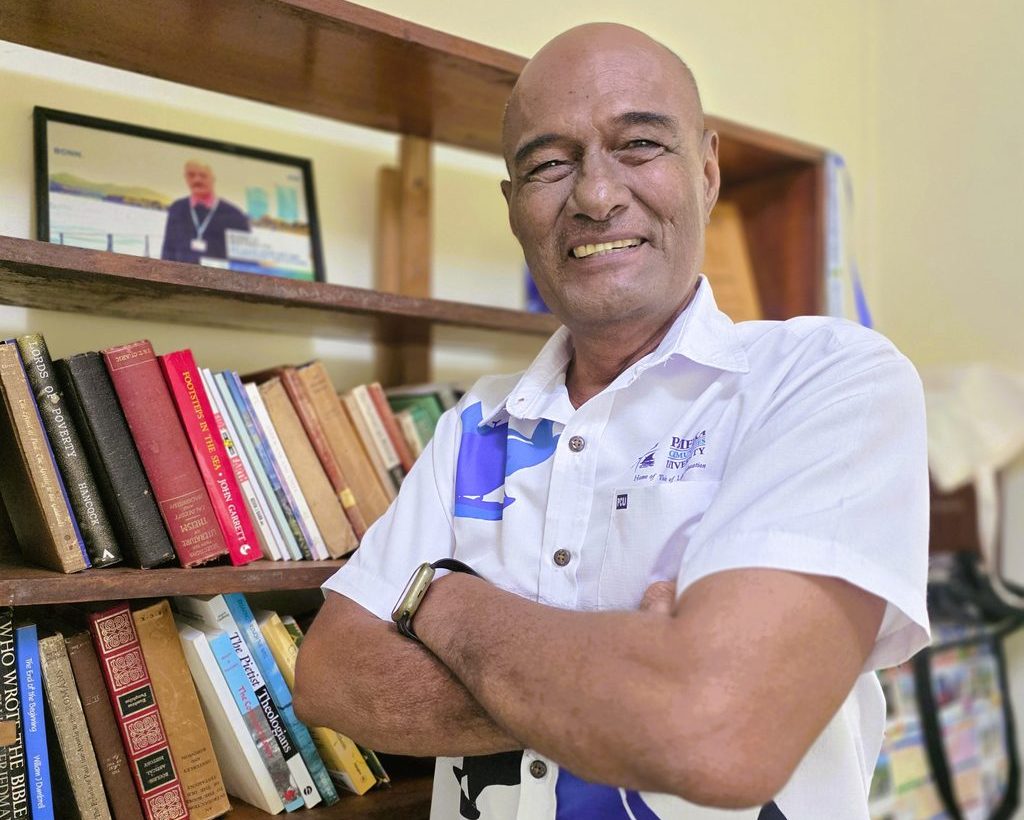
Tafue Lusama strongly believes that climate change is not an abstract debate framed by distant models and projections.
It is lived reality, measured in eroding coastlines, vanishing food sources and the slow unravelling of cultural identity in his home country of Tuvalu.
“Tuvalu has been used as the image of a disappearing country,” he said.
“But that also ties to the uncertainties that statement brings.”
As the director of the Institution for Climate Indigenous Knowledge at Pasifika Communities University, the ordained minister and theologian is advancing an approach that challenges the dominance of Western frameworks in climate discourse.
He argued that Pacific solutions in order to effective and meaningful must be rooted in indigenous knowledge, values and lived realities of the people on the frontline.
Tuvalu’s vulnerability, he explained, is not simply geographic but existential.
With its already limited landmass under constant pressure from coastal erosion, even small losses carry devastating consequences.
“Losing permanent land to the sea means losing life for the people.”
That statement in itself underscores the stark human cost behind rising sea levels.
A fragile ecosystem
Food security, once sustained through intimate knowledge of the ocean, is increasingly fragile.
Coral bleaching is affecting fish stocks, while changing conditions make traditional fishing practices less reliable.
“It costs more to grow fish today than in the past,” he said, pointing to the economic strain now placed on subsistence lifestyles.
At the same time, the quiet erosion of indigenous knowledge systems is unfolding.
Traditional medicinal plants, long relied upon by community healers, are disappearing as ecosystems shift.
“The plants which the healers use as remedies are starting to disappear because of the changing climate,” Dr Tafue said.
This layered crisis, he argued, requires a fundamental shift in how climate change is understood.
“We need a holistic understanding of what is happening to the people and to nature,” he said.
“Life is interconnected. We live, the land lives, the ocean lives, but if we lose the land and the ability of the ocean to sustain us, then we suffer. Everything suffers.”
His theological grounding deepens this perspective, framing climate change not only as an environmental issue but as a moral and spiritual one.
“Jesus came for the most vulnerable,” he said.
“So, my work aligns with addressing the issues that suppress the vulnerable.”
Challenging dominant narratives
Yet translating this worldview into policy remains a persistent challenge across the Pacific.
Dr Tafue points to what he describes as a lingering colonial mentality, where externally sourced expertise is often prioritised over local knowledge.
“We have been brainwashed that there is one centre of truth,” he said, adding that many continue to believe “whatever comes from outside is better than what we have”.
This mindset is reflected in the continued reliance on foreign consultants in national climate strategies, even as local expertise grows.
At the same time, donor-driven frameworks often dictate the terms of engagement, requiring Pacific nations to align with externally defined criteria that only recently began recognising indigenous knowledge.
Global climate negotiations under frameworks such as the United Nations Framework Convention on Climate Change illustrate this imbalance.
While Pacific nations have been among the most vocal advocates for urgent action, Dr Tafue argues they are still constrained by the language and structures of others.
“We are fighting on their playground and not using our playground to push our issues,” he said.
According to Dr Tafue, the challenge is not to reject Western science, but to bring it into genuine dialogue with indigenous knowledge systems — something he admitted has yet to be fully realised.
“There has never been an attempt to synchronise Western science and indigenous knowledge on climate,” he explained.
“We need experts from both streams.”
Building Pacific-led solutions
At the institutional level, his work is focused on building that bridge.
His vision for the institute centres on engaging directly with communities to document indigenous climate knowledge and translate it into policy-relevant frameworks.
“We engage with communities, document what they know and codify them into policy language,” he said, with the aim of influencing both national and regional climate policies.
Equally central to this vision is the next generation.
Dr Tafue is particularly concerned about young Pacific Islanders who, after years in urban education systems, find themselves disconnected from their cultural roots when they return home.
The institute’s programs aim to address this gap by combining academic learning with community-based knowledge.
“They learn from the classroom, then they go into the community to learn from their elders,” he explains. “When they come back, they bring those two together.”
This dual approach not only strengthens technical understanding but also reintroduces young people to the practical realities of their own cultures — from ecological knowledge to traditional weather forecasting.
Such knowledge, Dr Tafue emphasised, is grounded in observation, experience and generations of lived expertise.
“They are not just talking theoretically,” he said of the leaders he hopes to nurture.
“They talk with the knowledge that backs them.”
Reclaiming the narrative
Ultimately, Dr Tafue’s work and passion is about reclaiming agency in the climate conversation.
It is about ensuring that Pacific voices are not only heard, but respected on their own terms, as well as grounded in knowledge systems that have sustained island communities for generations.
While the task is complex, for the Tuvaluan academic and theologian, it is essential.
As climate pressures intensify, the survival of places like Tuvalu may depend not only on global action, but on the Pacific’s ability to define its own path forward, drawing strength from both tradition and innovation.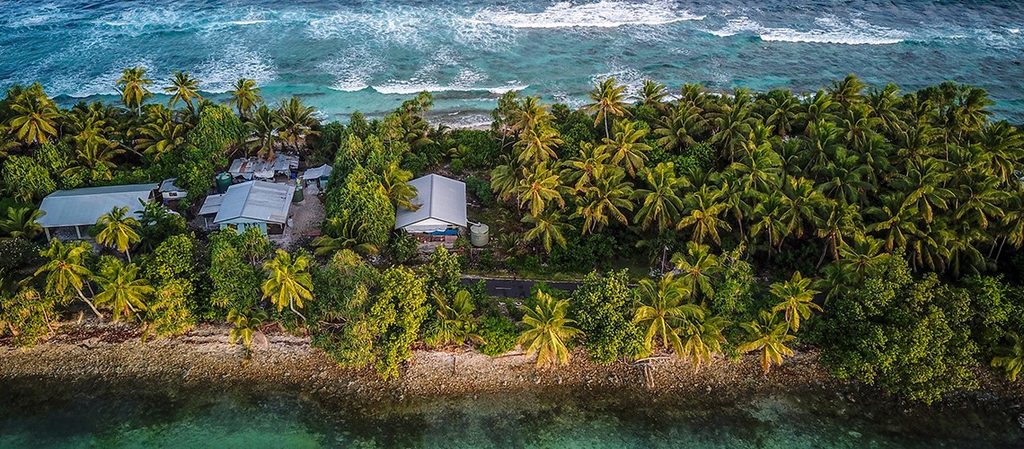
Coastal erosion threatens the fragile shorelines of Tuvalu, where rising seas and changing ecosystems are placing growing pressure on land, livelihoods and cultural survival in one of the world’s most climate-vulnerable nations. Picture: UNDP

