STRENGTHENING disaster preparedness for families and church communities is the main objective of the Church Agencies Network Disaster Operations (CAN DO) project as they work in collaboration with the Adventist Development and Relief Agency (ADRA) Fiji to ensure people in Fiji are disasterready through a partnership with churches.
It is through such partnership and disaster preparedness messaging carried out at community level in Fiji that a group of men from St. Francis of Assisi Community Wailekutu, outside of Lami, were empowered to prepare themselves for the uncertain future brought about by the global pandemic, COVID-19 that hit Fiji in April 2020. Disaster Ready in CAN DO Fiji aims to save lives, alleviate suffering and enhance human dignity during and in the aftermath of conflict, disasters and other humanitarian crises, is a project funded by Australia’s Department of Foreign Affairs and Trade under the Australian Humanitarian Partnership.
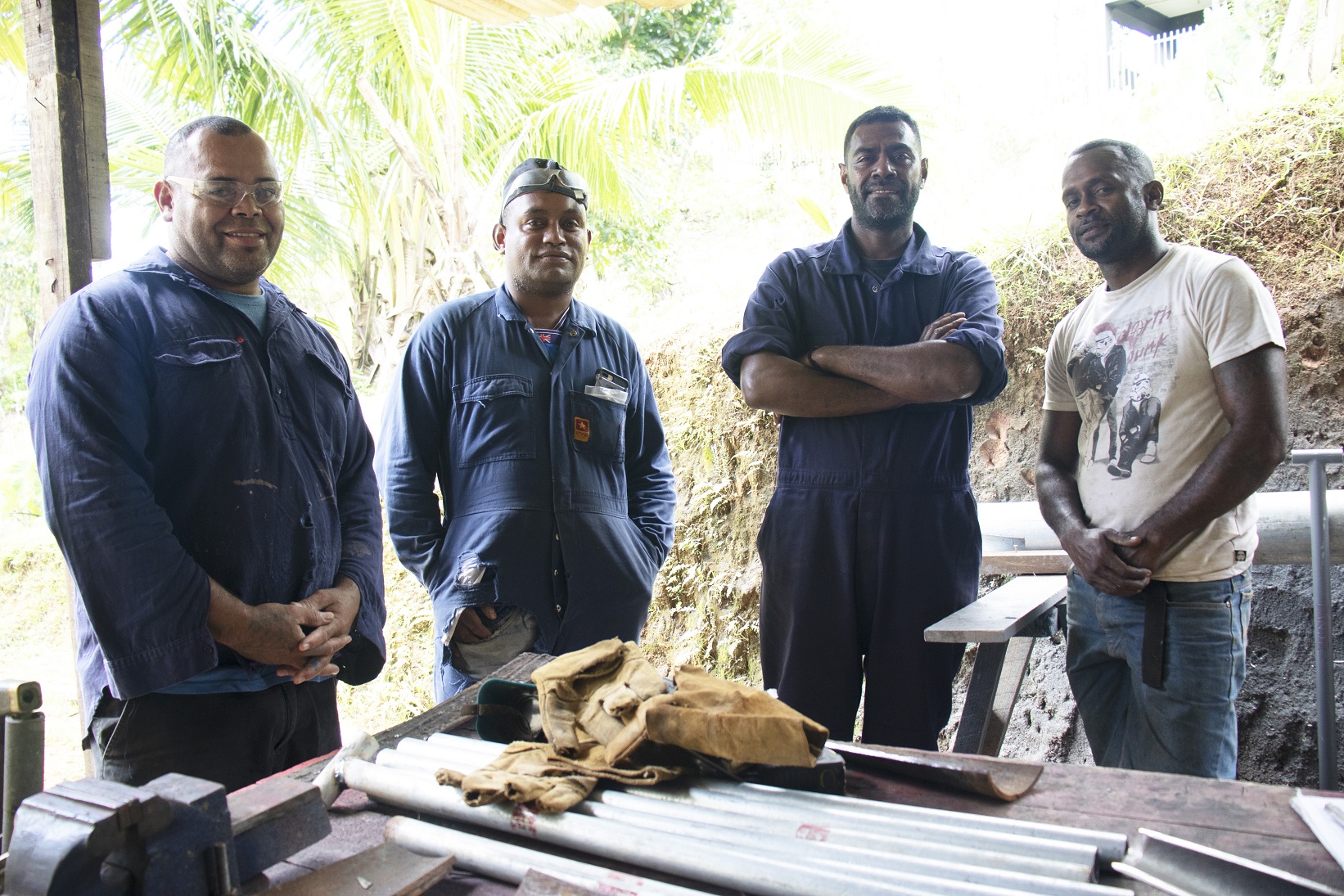
Belonging to the Immaculate Conception Parish Lami of the Roman Catholic Church, the community-led by a group of four men – Saviriano Yaqovu, Filipe Ketedromo, Farasiko Mainakavika and Tobia Ravuniwa – from the St Francis of Assisi Community began with their communal work of farming to address food security as people began to lose employment right across Fiji.
It wasn’t long that the immediate impacts of COVID-199 were felt, with members losing their jobs, reduced hours or work, and no market under the tourism sector. This did not dishearten the group as they continue to utilise whatever is available in their area to plant vegetables and root crops for their individual families, to begin with.
“We knew that the only way out of this global pandemic declared disaster in Fiji was the land. With that in mind, we continued to plant daily as a group ensuring that we have sufficient supplies of vegetables and root crops for the future for our families and potential to extend to our community’s survival,” Tobia Ravuniwa, community leader, said.
“We continued working as a group starting off with home gardens and using any available land in the area such as the roadside space to plant. We have been fortunate that some landowners and the Roman Catholic Church of the Archdiocese of Suva have been good enough to temporarily allow the usage of their land. In return we plant and clean-up those areas.”
Ravuniwa revealed early vegetable harvest have not only benefited their families and community members, but they have been distributing it within the church and also to the vulnerable members of their community such as single mothers, elderly of all races, residents of Father Laws Home and to the affected children of Marist Convent Primary School.
It was during one of their planting sessions that one of the shovels used for digging broke, birthing a new idea for the team to start their welding business to produce genuine and quality planting equipment. The idea was realistic one as Farasiko Mainakavik, now their business finance manager, and a former member of the group were both welders by profession until they lost their jobs at Fiji Fish Company Ltd and various workshops respectively.
“At the beginning, it was just farming for our own consumption.
We thought why don’t we start making our own equipment when we broke our shovel and there was no turning back for us,” workshop manager Mr Ketedromo said.
“We wanted to first produce good quality shovel-now termed Post-Hole Spade and realised that it was really good and stronger as we were able to even break cement blocks with it. Our post hole spade was also multi-functional as it served as a Post Hole Spade, digging fork, digging spring and even a crow bar. We started to sell it individually and in our parish church with the assistance of our parish priest Reverend Father Beniamino Kaloudau.
We got good feedback from the buyers. One day, the team from ADRA Fiji, Caritas and CAN DO came for their usual awareness session and they were informed of what we have been doing.”
Seeing the good work and to add value to the initiative in producing good quality products, the CAN DO TC Harold recovery project became the first major client of 594 post hole spades to be part of the agriculture kits distributed in Kadavu as the farmers in Kadavu had a high preference for the post-hole spades over the shovels sold at the hardware shops as the affected communities in Ravitaki and Tavuki district are able to recover and rebuild their lives after the cyclone.
“Because of the deal, we registered our company which is now called Farming and Welding Solutions, with custom made posthole spades which has generated income for us and we plan to diversify our products,” Ravuniwa said.
In the process, they have expanded their scope of work employing other unemployed family heads in the area to work on their farm, with the land given by the Archdiocese of Suva Roman Catholic Church and the assistance of their parish priest.
“We submitted a special request to utilise an idle land in Wailekutu that belongs to the Roman Catholic Church. Money received from the small business is now used to pay for labour to plant dalo which we will harvest and sell to further help the business. Apart from the business side of things, we are glad for the opportunity to help others by providing them with work during the difficult times where most of our community members have lost their jobs and reduced hours due to the direct impacts of COVID-19.
We now have nine more people employed in our farm.”
Also employed is a former inmate who has had difficulty in securing a job.
“We do not provide a source of income to our church members only. We open it to people from outside our community that needed a job to feed their families. It is not always about us but the underprivileged that we can serve in the community. We have been empowered to start our own business and to be able to help others improve their livelihoods.”
Ravuniwa, who recently attended one of the CAN DO Workshops, said the CAN DO project promotes its principles of inclusiveness, bridging the gap by working together with other denominations and does not segregate people based on their religion, race or gender so it is the same principle that the group upheld.
He said they hope to continue working on their business to generate employment and improving the livelihood of the people, especially during this difficult time.
“We are thankful to ADRA Fiji and CAN DO for the opportunity and partnership directly at the community level in addressing the socio-economic impacts of COVID-19 and to be able to prepare better for the cyclone season with the boost in working closely with our business, women and youth. We believe that this is made possible through funds provided by DFAT through the Australian Humanitarian Partnership program.”
• Losalini Bolatagici is the communication officer for Adventists Development & Relief Agency Fiji and is a former journalist with this newspaper. The views expressed in this article are the author’s and not necessarily shared by this newspaper.