
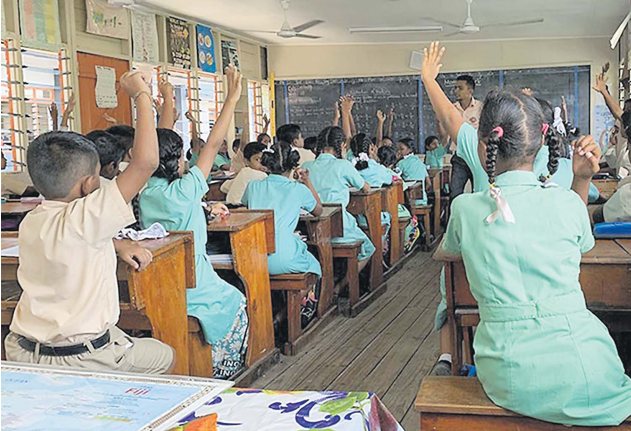
The revelation that Fiji’s escalating HIV epidemic is increasingly affecting young people, forcing teachers to identify and support students at risk, is cause for concern. It works both ways though.
The fact that teachers are now expected to take on this role, coupled with the reality that growing HIV numbers are reaching our schools, does present a frightening scenario.
In fact, come to think of it, our teachers are sort of hard done by when you break things down further.
Just yesterday, we highlighted teacher shortage as a major national concern.
We are facing a crisis, with about 1000 vacancies across primary, secondary, early childhood, special and inclusive education. Schools are struggling to replace staff, and students continue to miss valuable classroom time.
Speaking at the School Management Association of Fiji’s 11th National Conference in Suva this week, Fiji Teachers Union general secretary Muniappa Goundar said the shortage had persisted for the past three to four years as teachers resigned to pursue other careers or migrated to Australia and New Zealand in search of better opportunities.
He argued that Fiji was effectively training teachers for overseas workforces, leaving local schools to deal with the consequences.
He said this had been compounded by around 600 secondary-trained graduates teaching in primary schools while being classified as unqualified and receiving lower salaries despite performing the same duties.
Equal work, he believes, deserves equal pay, and the salary disparity is one reason teachers continue to leave the profession. He also attributed the exodus to poor remuneration, increasing workloads, delayed salary payments for new graduates, limited opportunities for career advancement and the absence of meaningful salary increases.
Now we have this latest HIV challenge added to their responsibilities. And that is placing additional pressure on teachers. The National Substance Abuse Advisory Council has sounded the alarm.
Speaking at the national conference in Suva yesterday, acting chief executive Josua Naisele said schools had become a critical point for early intervention as HIV infections continued to surge among young Fijians.
He revealed that Fiji had recorded 5676 cumulative HIV cases by the end of 2025, including 2016 new infections last year alone. Cases among children aged 10 to 14 have increased since 2015, while infections among 15 to 19-year-olds have risen even more sharply over the same period.
Now we learn that young people under the age of 25 accounted for 58 per cent of all new HIV cases recorded in 2025.
Understandably, there will be questions about what is driving this trend. That means confronting issues such as peer pressure, family dysfunction, trauma, poverty, limited adult supervision, drug abuse and the sharing of contaminated needles. This is when we must strengthen counselling services, referral pathways and child protection systems so vulnerable students can be identified early and supported before they fall through the cracks.
Teachers are educators, mentors and often the first adults to notice when something is wrong. They have a critical role in nurturing our children, but they cannot and should not be expected to carry the weight of every social problem alone.
If we expect them to stand on the frontline of this growing HIV crisis while continuing to educate the next generation, then we must consider better resources, stronger support systems and policies that value their work. We have got to place their plight on a very high plane.

