
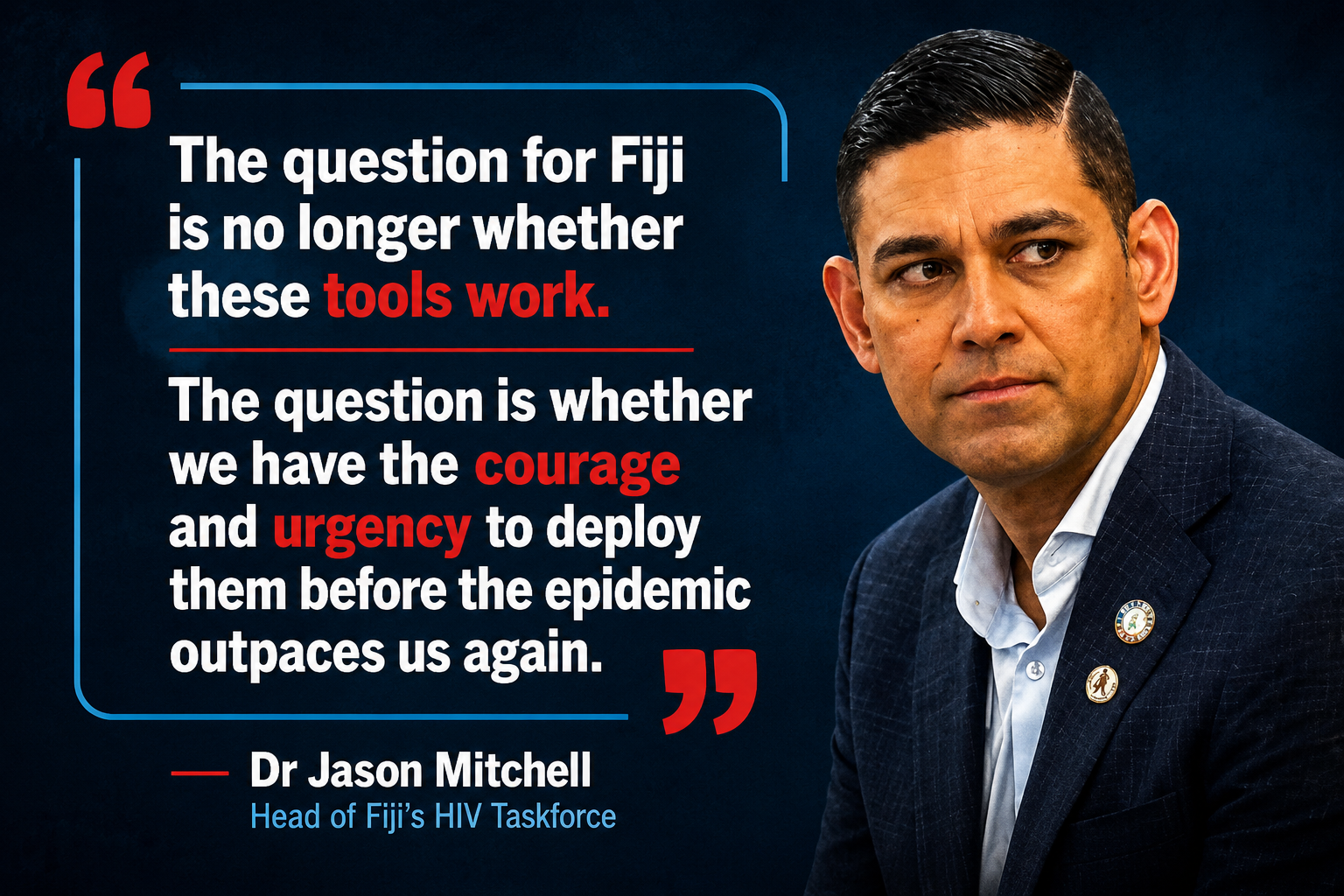
The head of Fiji’s HIV Taskforce, Dr Jason Mitchell, has called on the country to make the long-acting HIV prevention drug lenacapavir (LEN) a central part of its response to the growing HIV epidemic.
In a social media post following the International AIDS Conference (AIDS 2026) in Brazil, Dr Mitchell said the conference had demonstrated what could be achieved when science, political leadership and public health work together.
“Brazil International AIDS Conference (AIDS 2026) has reminded the world what is possible when science, political leadership and public health align,” he said.
Turning to Fiji’s response, Dr Mitchell said the country could no longer rely on a single prevention strategy as HIV infections continue to rise.
“We need to position long-acting lenacapavir (LEN) as a central pillar of our HIV prevention response. This is not about replacing condoms or behaviour change, it is about recognising the reality of our epidemic.”
He acknowledged that while condoms and behaviour change programmes remain important, they have not been enough to keep pace with the rapid spread of HIV.
“Condom use remains low and inconsistent. Behaviour change interventions are important, but they take time and have not kept pace with the speed at which HIV is spreading. We cannot rely on any single intervention.”
Dr Mitchell said Fiji needed a comprehensive approach centred on combination prevention.
“A generalised epidemic demands combination prevention, with biological interventions at its core.”
He said twice-yearly lenacapavir, alongside oral pre-exposure prophylaxis (PrEP), condoms, post-exposure prophylaxis (PEP), treatment, sexually transmitted infection services and harm reduction programmes, offered an opportunity to significantly reduce new HIV infections if implemented quickly and on a large scale.
Dr Mitchell said discussions at AIDS 2026 reinforced that scientific breakthroughs would only have an impact if they were made accessible and affordable.
“Recent discussions at AIDS 2026 reinforced that breakthroughs like LEN will only change epidemics if they are made accessible, affordable and delivered to the people who need them most.”
He concluded by saying Fiji now faced a critical decision.
“The question for Fiji is no longer whether these tools work. The question is whether we have the courage and urgency to deploy them before the epidemic outpaces us again.”

