
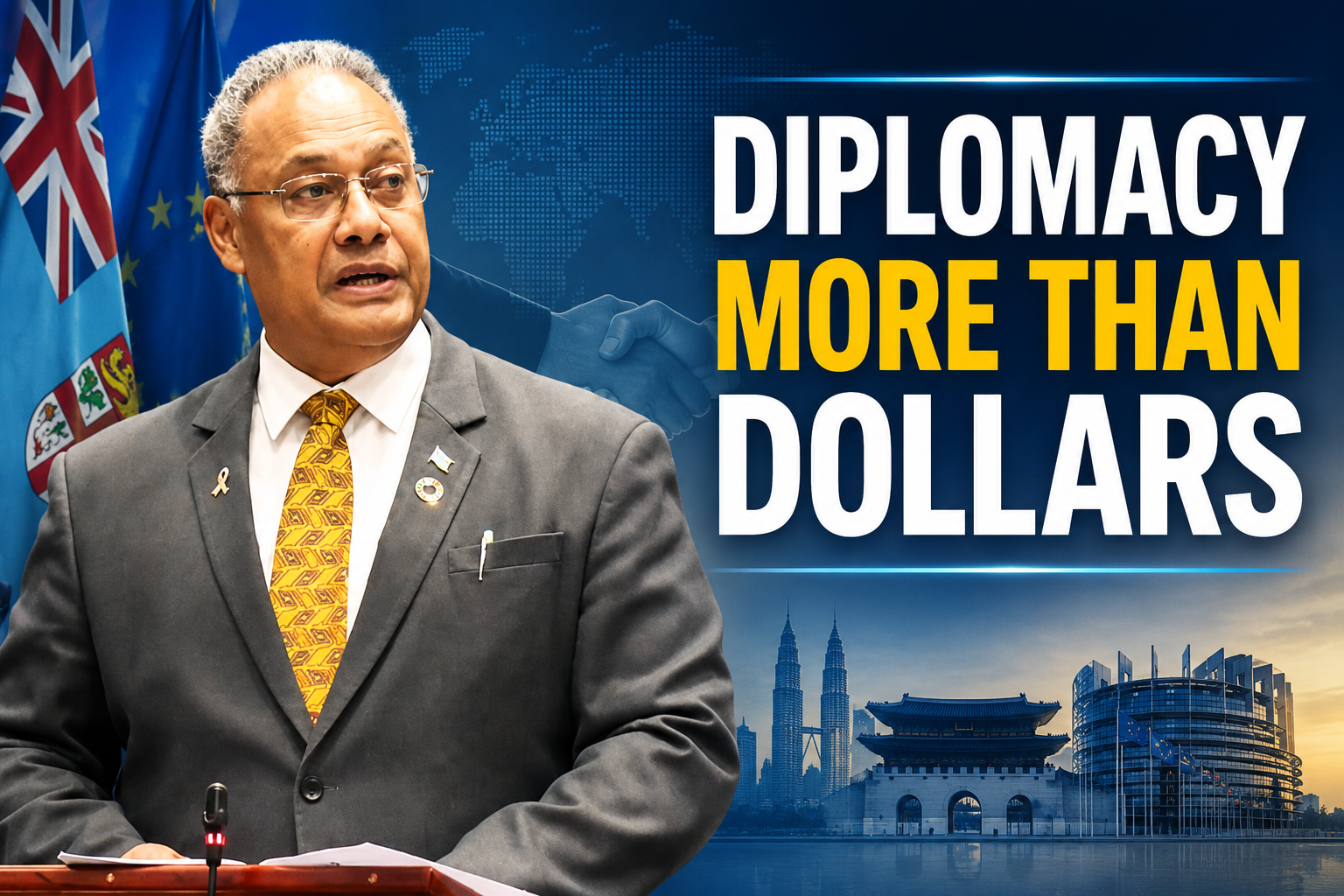
The cost of withdrawing Fiji’s diplomatic presence from key international capitals cannot always be entered neatly into a spreadsheet, Foreign Affairs Minister Sakiasi Ditoka told Parliament last week.
Mr Ditoka made the comments while reflecting on Fiji’s decision during the COVID-19 period to step back from its diplomatic presence in Kuala Lumpur, Seoul and Brussels.
“There is a cost, Mr Speaker, Sir, that cannot always be entered neatly into a spreadsheet,” he said.
“Relationships cool, institutional connections weaken, opportunities are missed, and partners can reasonably begin to ask whether Fiji still values the relationship the same way they do.”
Mr Ditoka said diplomatic relationships required continuous attention and could not simply be suspended and expected to resume years later from where they had stopped.
“In both capitals, we were disappointed that Fiji had stepped back from relationships our partners continued to value,” he said.
“These were friendships, and they are still friendships built over many years, and our partners had invested considerable goodwill in Fiji.”
Mr Ditoka acknowledged the severe economic and fiscal pressures Fiji faced during COVID-19 but questioned why the strategic approach taken to preserve Fiji Airways had not also been applied to diplomatic missions.
He credited the former government for recognising Fiji Airways as a strategic national asset despite pressure facing the airline during the pandemic.
“On that principle, they were right,” he said.
“However, it does also raise a legitimate question. Why was the same strategic thinking not applied to Fiji’s diplomatic presence in Kuala Lumpur, Seoul and Brussels?”
Mr Ditoka said Malaysia was at the heart of ASEAN, Seoul was the capital of a major global economy and longstanding development partner, while Brussels was central to Fiji’s engagement with the European Union and important trade and development relationships.
“COVID itself does not remove the strategic importance of diplomatic relationships,” he said.
“Diplomacy does not cease because aircraft stop flying. Indeed, periods of international crisis occur precisely when relationships between countries matter the most.”

