
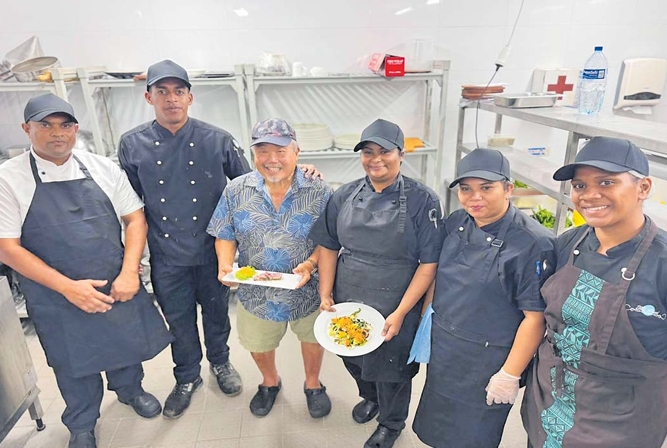
WHILE many visitors come to Pacific Harbour’s, South Pacific Pearl Resort for its white sandy beaches, ocean views and weekend escape, they may often find themselves returning for something far more memorable, that’s on the plate.
For decades, Fiji’s tourism industry has sold paradise to the world while serving menus that could have come from almost anywhere.
Imported vegetables, herbs, meat, cheeses and of course an “imported” menu. Ironically, some of the country’s freshest seafood, tropical fruits and traditional root crops were more likely to end up on staff meals than in front of paying guests.
That, according to renowned chef and “Kana Vinaka” author Colin Chung, is a mindset that has taken decades to change.
Last week, the celebrated chef spent several days at The Pearl Resort mentoring its kitchen brigade, introducing new techniques and showing chefs how local ingredients could become restaurant-quality dishes capable of standing alongside international cuisine.
The result was a specially curated menu that showcased Fiji’s own produce, from locally caught opakapaka and grilled octopus to ota, hearts of palm from Sigatoka valley, roasted root crops and Seremia chiffon tart.
More than a meal
For Mr Chung, the philosophy is remarkably simple.
Visitors do not travel thousands of kilometres to eat food they can already find at home.
They come looking for the taste of Fiji. “So tonight’s dinner focuses on things that are actually out of Kana Vinaka” Mr Chung said.
“I see that most hotels and hospitality businesses are still using a lot of imported foods. “So the idea is to stop the importation… our guests who are coming from overseas mostly want to eat local anyway.”
The menu itself reflected that philosophy.
Guests began the evening with tuna tataki served with ponzu before moving to grilled octopus accompanied by ota, hearts of palm and lime dressing.
The main course featured grilled opakapaka served with roasted root crop hash cake, moca, bora and pineapple salsa before finishing with a Seremia chiffon tart and lime sorbet.
Every ingredient had been sourced locally. It is, in many ways, proof that world-class dining does not necessarily require imported ingredients.
A changing mindset
Mr Chung recalls arriving in Fiji more than three decades ago to find local produce largely absent from hotel menus.
He said that while Kana Vinaka, published almost a decade ago, was intended to encourage greater use of local ingredients, the hospitality industry was initially slow to embrace the idea.
Today, however, he sees a very different picture. “There is immense interest from chefs, hotel owners and eco resorts because it’s cheaper, it’s fresher and it supports the local community,” he said.
That interest was evident inside The Pearl’s kitchen.
After opening copies of Kana Vinaka during the training sessions, several members of the culinary team lined up to purchase the book.
For Mr Chung, it was a sign that younger chefs increasingly see local cuisine not as a limitation, but as an opportunity.
But the shift is not simply about changing recipes.
It is also changing where hotels buy their food.
Resort Head chef Mohammad Shakeer Khan said the resort now wants to work more closely with local farmers and market vendors rather than relying so heavily on imported products.
“We’re trying to get engaged more with our local farmers and market vendors so we can buy directly from them,” Chef Khan said.
“It’s fresh, and we’re promoting more of the local products.”
That relationship stretches well beyond the kitchen.
When hotels purchase directly from nearby producers, more money remains within local communities.
Farmers gain reliable buyers
Hotels receive fresher ingredients and ultimately guests experience food that genuinely reflects Fiji.
It is the very definition of the increasingly popular “farm-to-plate” movement now gaining momentum around the world.
The economics of local food
While sustainability often dominates conversations around local sourcing, economics are proving just as persuasive.
Global food prices have risen sharply over recent years, especially with the recent ripple effects coming out of the Middle East, making imported ingredients increasingly expensive for hotels.
Mr Khan admits those rising costs have helped reshape attitudes within commercial kitchens.
“Somewhere down the line, we lost that interest and demand of using local produce,” he said.
“But now, since everything is so expensive… chefs have a totally different mindset.”
“They’re coming back to using local products to bring food costs down.”
For chefs, however, the benefits extend beyond lower costs.
Learning to cook with ingredients growing just outside the resort’s gates expands their skills while encouraging greater creativity. Mr Khan said the recent training had shown his team how many ingredients had been available all along.
“It teaches the chefs the broader picture of what things they can utilise. It’s just in front of them.”
Selling the taste of Fiji
Consumers around the world are increasingly seeking locally grown produce and authentic regional cuisine.
Chef Chung told this newspaper, he believes Fiji should do exactly the same.
“The movement toward eating local is happening worldwide,” he said. “When people come here, we’ve got to sell the local food.”
That does not mean abandoning international cuisine altogether. Instead, it means giving familiar dishes a distinctly Fijian identity. And the Pearl does this wonderfully. Some of the resorts more unique A lasagne layered with local vegetables instead of pasta.
Their frittata built around kumala instead of potatoes. Classic recipes reimagined through local ingredients. Their aim is not to replace tradition.
It is to celebrate it in new ways.
The taste of a place
Perhaps that is what made the evening at The Pearl feel different.
It was never simply about serving grilled fish or octopus.
It was about telling a story through ingredients grown in Fiji’s own soil and harvested from its own waters.
For too long, many hotels have looked overseas for inspiration while overlooking what was already available at home.
If chefs like Colin Chung and Mohammad Khan had their way that is beginning to change.
Because in a destination famous for its natural beauty, perhaps the next great tourism experience will not be found on the beach.
It will be found at the dinner table.

