
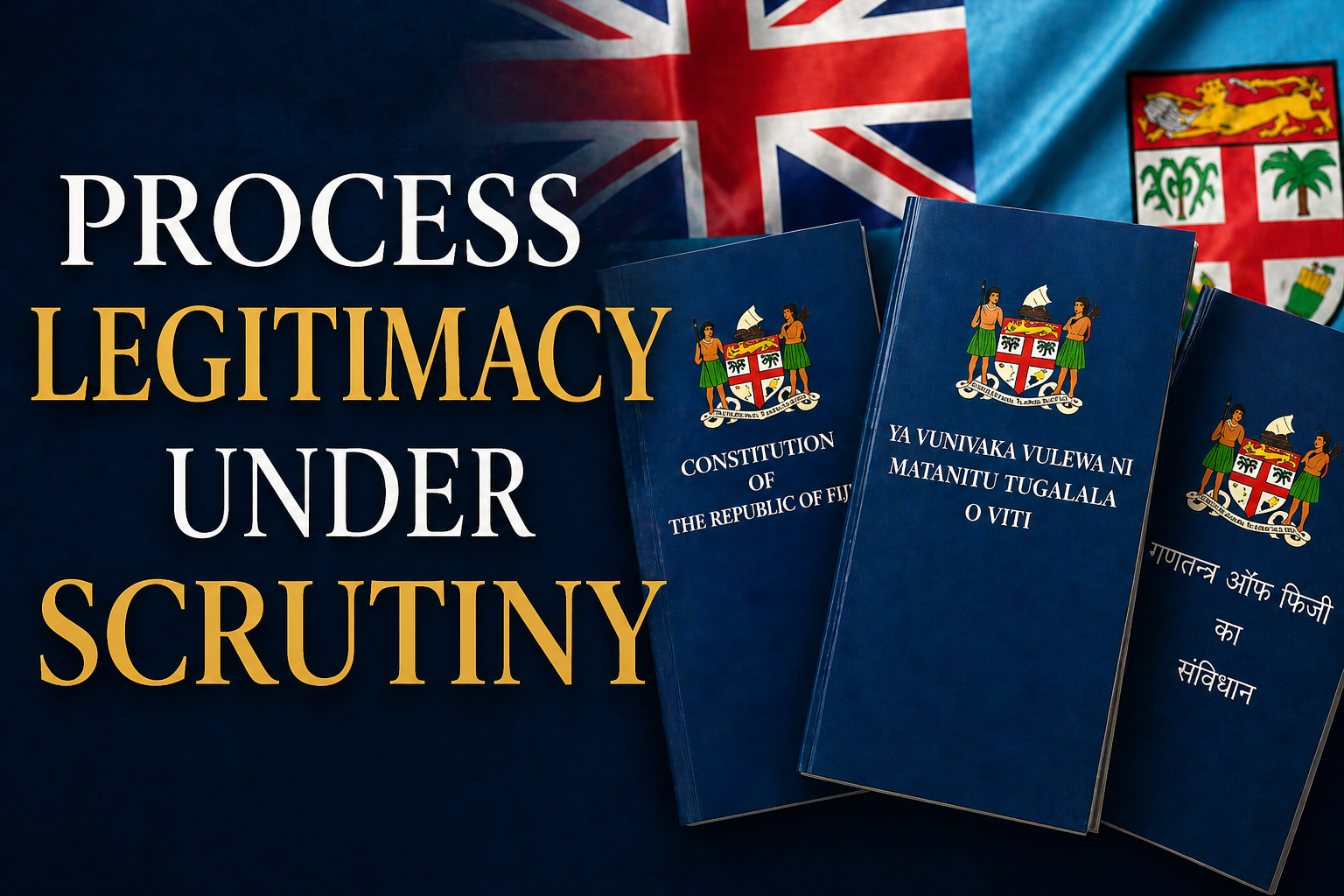
Concerns are mounting over the transparency and inclusiveness of Fiji’s ongoing constitutional review, with Dialogue Fiji warning that the current process may fall short of democratic expectations.
Executive Director Nilesh Lal questioned how public views are being measured, despite assurances from the Prime Minister that the Constitution will reflect “what the people want.”
“The PM has said that the Constitution will reflect what ‘the people’ want. However, how can this be actually determined without a clear and transparent mechanism?” Lal said.
“The people of Fiji are not a homogenous group. Without a systematic process for recording, publishing, and analysing submissions, there is no objective way to determine what the people want, or how those views are considered and reflected in the constitution draft.”
Dialogue Fiji also raised concerns about accessibility, noting that many consultation venues are located in predominantly iTaukei communities, which could limit broader participation.
The organisation said improvements in transparency, inclusivity and structure were necessary to ensure the review process addressed concerns about democratic legitimacy.
The review itself has been framed as a response to a perceived “democratic deficit” in the 2013 Constitution of Fiji, with critics arguing that the deficit stems more from how the document was formulated rather than its content.
Lal warned that unless strengthened, the current process risks repeating similar shortcomings.
“Transparency is the cornerstone of any genuine constitutional review,” he said. “What we are seeing instead is a process marked by opacity. Consultations are being conducted behind closed doors, with no systematic effort to document or publish submissions.”
He added that in an era where technology allows for livestreaming and easy online publication, the lack of transparency was “unacceptable.”
Lal pointed to the 2012 constitutional process led by Yash Ghai as a benchmark, noting that it involved extensive nationwide consultations and more than 7,000 publicly accessible submissions.
“The Ghai Commission ensured that every submission could be scrutinised by the public,” Lal said. “That level of accountability is entirely absent in the current process.”
Dialogue Fiji further noted the absence of a centralised platform or website to track submissions, leaving the public reliant on selective reporting.
“How can the people of Fiji keep track of what is being submitted?” Lal asked. “How can submissions be systematically analysed, or verified, if they are not recorded and made publicly available?”

