
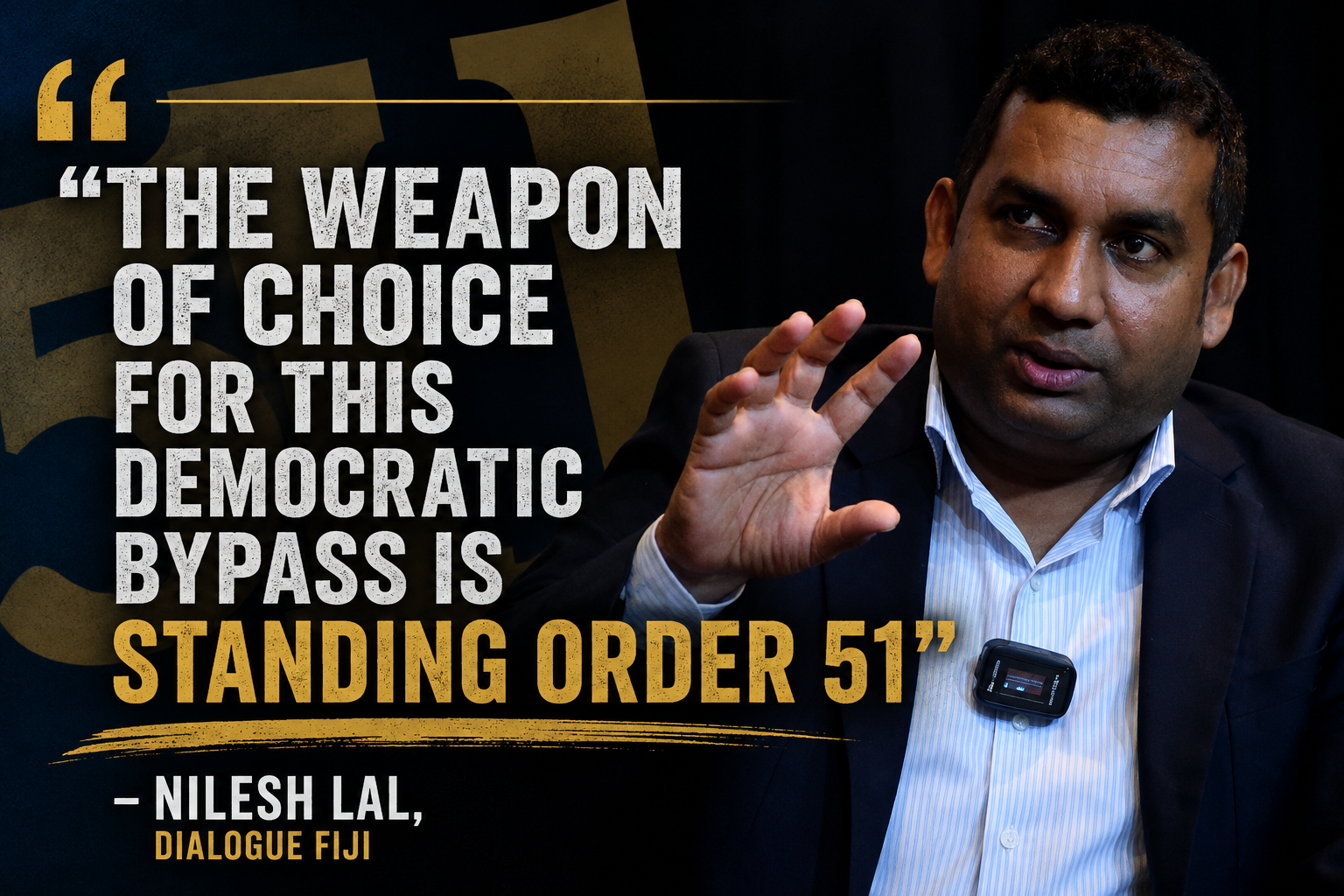
Dialogue Fiji Executive Director Nilesh Lal has called for the repeal of Parliament’s Standing Order 51, arguing that it allows governments to bypass democratic safeguards and push legislation through Parliament without adequate scrutiny or public input.
Lal said laws affect every citizen and should only be enacted after a process that allows those impacted to have a meaningful opportunity to contribute to their development.
He said parliamentary committees, public consultations and debates exist to ensure competing viewpoints are considered, weaknesses in legislation are exposed and unintended consequences are identified before laws become binding.
“When a government can ram legislation through parliament sheerly through the brute force of its numbers, it ceases to be democratic. It violates the very principles of accountable governance,” Lal stated.
While acknowledging that emergencies such as natural disasters, public health crises and national security threats may require urgent legislation, Lal argued that mature democracies place safeguards around such powers.
He pointed to the Ghai Draft Constitution, which proposed a two-thirds parliamentary majority before legislation could be fast-tracked, ensuring bipartisan support for genuinely urgent measures.
According to Lal, the 2013 Constitution lacks those protections, leaving the decision to bypass normal legislative processes entirely in the hands of the government of the day. He said Standing Order 51 allows a Bill to move through multiple stages in a single sitting, restrict debate and bypass parliamentary standing committees without any requirement to prove urgency.
“Under Standing Order 51, a motion to consider a Bill ‘without delay’ can be moved without notice at any stage of a Bill’s progression,” he said.
Lal said the issue should concern all citizens regardless of political affiliation because constitutional safeguards are designed not for good governments, but for future governments that may abuse power.
He also accused the current Government of abandoning positions it held while in opposition. Lal noted that leaders who once criticised Standing Order 51 for undermining transparency and public participation have retained the provision despite amending parliamentary standing orders twice since taking office.
“Yet, the hypocrisy of power is a bitter pill for the electorate to swallow,” Lal said, arguing that governments often condemn excessive executive power when out of office only to embrace it once in power.
He said Fiji must move beyond what he described as “convenient democracy” and instead pursue systemic reforms that strengthen accountability and public participation.
“Because true democracy, where the people are heard, where debates are robust, and where power is kept in check, is something genuinely worth defending,” Lal concluded.

