
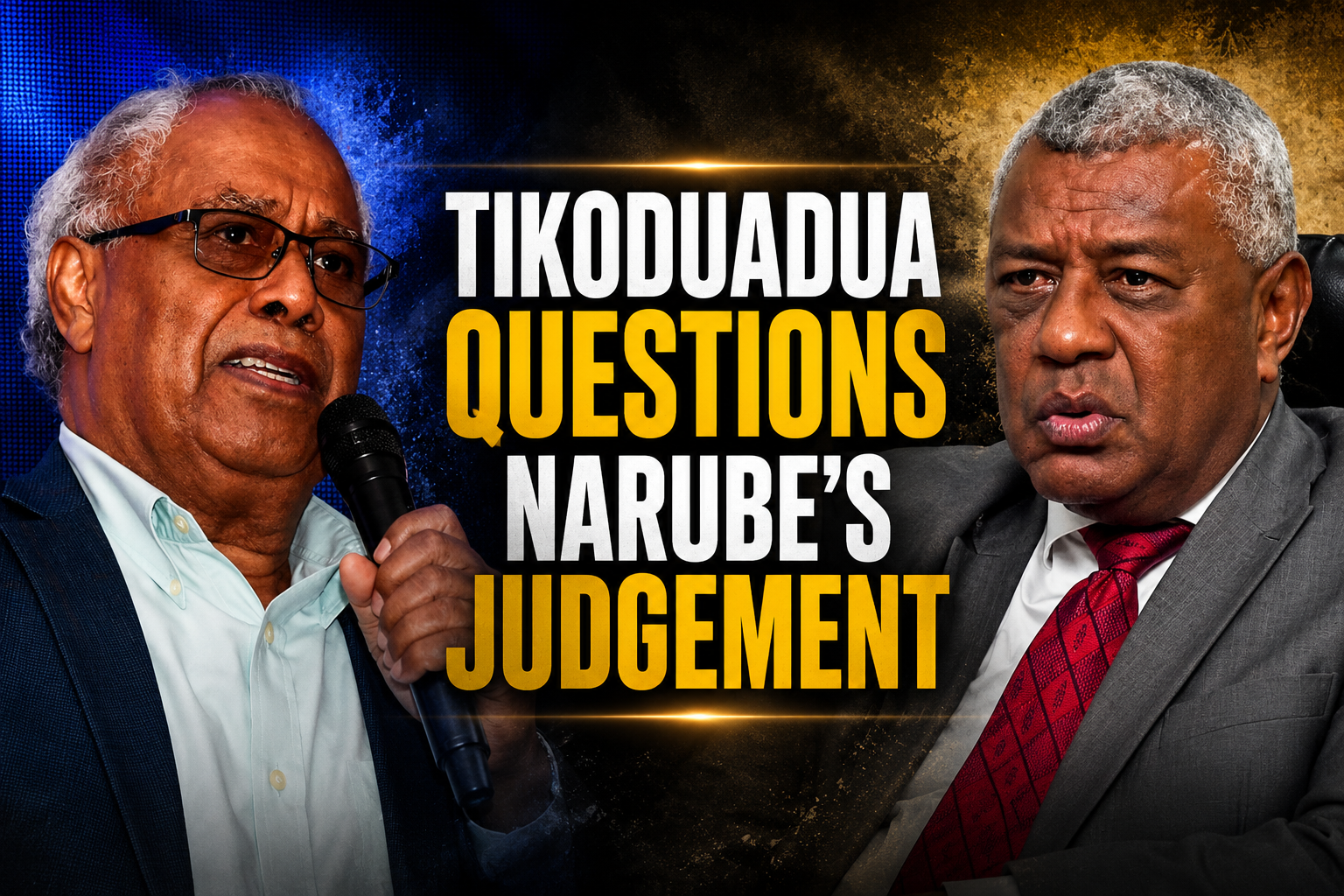
Minister for Defence and Veterans Affairs Pio Tikoduadua has launched a strong criticism of Unity Fiji leader Savenaca Narube, arguing that his recent comments on the Republic of Fiji Military Forces demonstrate a lack of understanding of national security and civil-military relations.
In a statement issued today, Tikoduadua said the issue went beyond political disagreement and raised fundamental questions about leadership and governance in Fiji.
He said Fiji’s history, marked by the coups of 1987, 2000 and 2006, required leaders who understood the complexities of managing relations between elected governments and the military.
“This is not a minor political disagreement. It goes to the question of whether a person understands the responsibilities of government in a country like Fiji,” he said.
“Our history is not theoretical. The military has been central to some of the most difficult periods in our national life.”
Tikoduadua accused Narube of believing that civil-military relations could be managed through “public attacks, sweeping statements and simple campaign lines.”
“That approach is not only shallow. It is dangerous,” he said.
“In Fiji, the relationship between elected government and the military must be handled with firmness, constitutional clarity and maturity.”
The Defence Minister said civilian authority over the military remained essential but argued that it must be exercised through legal discipline and institutional understanding rather than confrontation.
He revealed that Fiji had faced significant tensions following the 2022 General Election and said careful engagement had been required to protect constitutional government.
“I know how close Fiji was in 2023 to the shadows of 1987, 2000 and 2006,” Tikoduadua said.
“The country was not served by loud statements. It was served by discipline, restraint, engagement and a clear insistence that the Constitution must be respected.”
He warned that an approach based on confrontation could create instability and undermine efforts at reform.
“Civilian authority is not strengthened by recklessness. It is strengthened by legal discipline, institutional understanding, and a clear plan for reform.”
Tikoduadua also argued that Fiji’s security challenges extend well beyond the military, citing drug trafficking, transnational crime, border security, cyber threats and climate-related pressures.
“These are not issues for a leader who only knows how to make a political point,” he said.
“They require someone who understands how the national security system works and how the different institutions must be made to work together.”
While acknowledging Narube’s expertise in economics, Tikoduadua said national security required a different set of skills and judgement.
“He may understand economics. He may understand budgets. But national security is not the same as economic commentary,” he said.
The minister maintained that democratic oversight of the military remained crucial, but reforms had to strengthen rather than weaken state institutions.
“The elected government must lead. The Constitution must be supreme. The military must remain within its lawful role.”
Tikoduadua concluded by saying Fiji needed leaders who could protect democracy while maintaining stability.
“Fiji does not need a leader who treats the military as a convenient political target. Fiji needs leaders who understand the burden of keeping the country stable.”

