
The first drops of rain had already begun to fall when we arrived at Bau Landing just after dawn.
It was a little after 6am on Thursday, July 23. I had left home earlier carrying a sevusevu, waiting by the roadside for transport before making the journey east.
Beside me was photographer Timoci Dawai, affectionately known as Jim, our cameras and notebooks packed away against the damp morning.
Grey clouds hung low over the Rewa Delta as a cool wind swept across the water. It was hardly inviting weather for a boat ride, yet no one seemed discouraged.
Instead, there was a quiet sense of purpose.
Before long, we found ourselves helping women from the household of the Roko Tui Bau carry baskets, mats and ceremonial gifts aboard the boat bound for Bau Island. It was a simple act, but one that immediately reminded us that this was not merely an event to be observed. It was a communal obligation shared by everyone with a place in the vanua.
We had travelled to witness one of Fiji’s oldest surviving customary ceremonies – the duki.
A tradition spanning generations
For many Fijians, the word duki is familiar, yet few have had the opportunity to witness the ceremony firsthand.
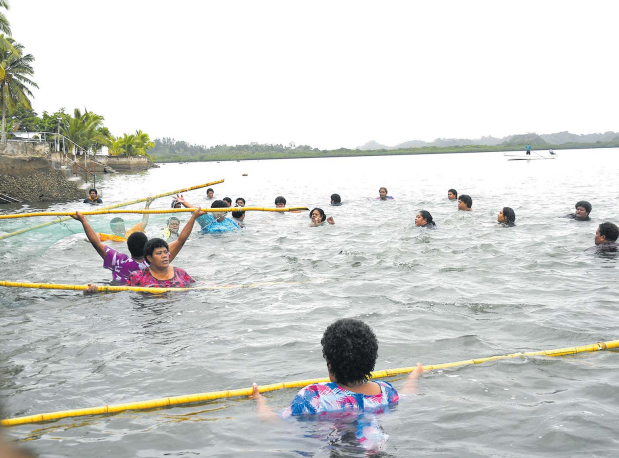
Traditional herald and spokesman of the Turaga na Vunivalu na Tui Kaba, Tunitoga Aisea Jack Komaitai, explained that the duki signifies the lifting of the tabu placed on Bau’s traditional fishing grounds following the death of a high-ranking chief.
“I know that almost all members of the media were present here earlier this year during the burial of the Turaga mai Naisogolaca, former President and Speaker of Parliament, Ratu Epeli Nailatikau,” he said.
Following the burial, the liga tabu – the traditional grave diggers and custodians of chiefly funeral rites – entered the waters surrounding Bau.
Their symbolic act marked the beginning of a traditional fishing prohibition over the surrounding qoliqoli.
Only after the duki is performed can that restriction be lifted.
Mr Komaitai said this custom is reserved only for chiefs and chiefly women of the highest rank within Bau.
“The duki performed for the late Ratu Epeli comes after 100 days of mourning,” he said.
“Sometimes it can even stretch to a year, depending on discussions between the bereaved family and the vanua.”
The ceremonies that began with the duki eventually culminated in the vakataraisulu on Saturday, July 25, formally bringing to a close the traditional mourning observances for the chiefly household of Naisogolaca.
More than a fishing ceremony
To an outsider, the duki may appear to centre on fishing.
In reality, it is about much more.
Mr Komaitai explained that every stage of the ceremony follows customs handed down by Bau’s ancestors without alteration.
“Everything performed is according to the ancient customs passed down to us by our ancestors. Nothing new is added,” he said.
Preparation for the ceremony begins well before participants enter the water.
Those involved observe vakatatabu – traditional restrictions requiring participants to abstain from certain activities during the period leading up to the ceremony.
For women, this includes abstaining from intimacy with their husbands or partners, among other customary obligations.
Such practices, Mr Komaitai said, reinforce discipline, respect and spiritual readiness before undertaking an important duty for the vanua.
The ceremony is therefore as much about personal commitment as it is about communal participation.
Unity above everything
Perhaps the strongest message emerging from Bau was that the success of the duki depends not on individuals, but on collective unity.
Everyone from Bau’s three villages participated.
That included those born on the island, members of the chiefly household and those who had married into the community.
“The important factor is that all those participating need to be united and bonded closely in regard to the ceremony and their duty to the vanua,” Mr Komaitai said.
He also drew parallels with Christian teachings.
“This is Biblical as well in nature, as the Scriptures teach us that where there is unity, God commands His blessings.”
The values of love, togetherness and mutual respect, he said, have long been intertwined with Bau’s customary practices.
He cautioned that divisions within the community could undermine not only the spirit of the ceremony but also its outcome.
“The moment someone starts criticising the presence of someone or complains why they are participating, that’s when the problem arises and the duki will not succeed in terms of the fish they will be able to get.”
Whether viewed spiritually, culturally or symbolically, the message remains consistent – harmony within the community is essential.
Passing knowledge to the next generation
This year’s duki was particularly significant because, for many participants, it was their first experience taking part in the ancient ceremony.
Those who had participated in previous duki guided younger members through every stage of the process.
“The others who have participated before were there providing guidance and advice,” Mr Komaitai said.
“This is done to ensure the traditions are passed down to the youths of Bau.”
The last duki was held in 2016 following the passing of former Vice-President and Roko Tui Bau, Ratu Joni Madraiwiwi.
Earlier ceremonies were also performed following the passing of the late Vunivalu and Governor-General, Ratu Sir George Cakobau.
Recognising the rarity of these ceremonies, officials from the Ministry of iTaukei Affairs were also present to document proceedings.
Their recordings and documentation will become part of the ministry’s archives, helping preserve the ceremony for future generations.
As the rain eased and the day’s rituals unfolded around us, it became evident that the duki is far more than a customary observance marking the reopening of fishing grounds.
It is a living expression of identity, responsibility and continuity.
On Bau, tradition is not preserved in books alone.
It is carried in memory, practised through ceremony, strengthened by unity and entrusted to each new generation willing to step into the water and honour those who came before them.

