
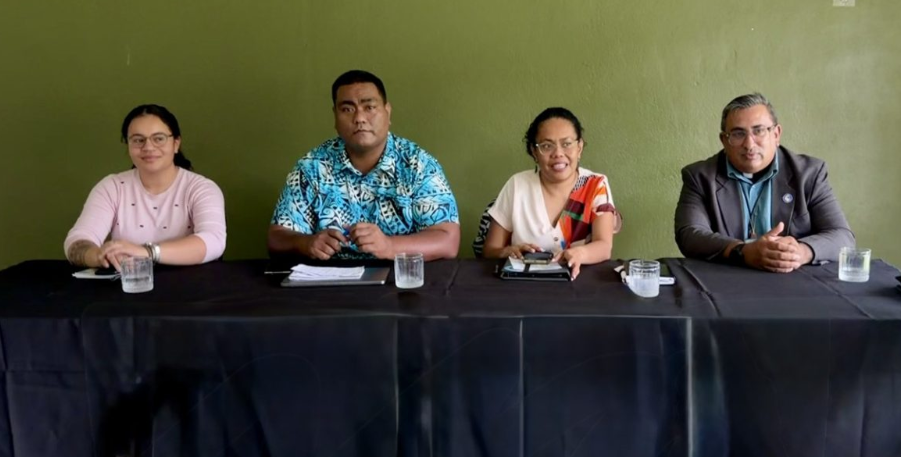
Civil society organisations are raising concerns over what they describe as a lack of transparency and inclusion in regional deep-sea mining discussions being held in Fiji this week.
The concerns were raised on the opening day of the International Seabed Authority’s Pacific Small Island Developing States regional workshop in Suva, titled the “Deep Seabed Sustainable Blue Growth Initiative”.
The Pacific Regional Non-Government Organisations Alliance, which includes the Pacific Conference of Churches, Fiji Council of Social Services, Pacific Network on Globalisation and Greenpeace Australia Pacific, questioned the structure and agenda of the forum, claiming it favoured countries backing deep-sea mining while limiting participation from civil society and non-sponsoring Pacific states.
PRNGO Alliance Chair Joey Tau said the workshop appeared heavily tilted toward states with direct mining interests.
“We are extremely concerned that the current agenda is inappropriate to the Pacific context; as it stands, it clearly centres states that have an interest in deep-sea mining, with relations and benefits to the mining industry,” Mr Tau said.
“Such regional workshops must ensure equal visibility and space for non-sponsoring States, particularly those advocating for precautionary approaches and environmental safeguards.”
He also questioned the International Seabed Authority’s focus at the meeting.
“We also challenge the ISA in its mandate to encourage policy discussions on effective protection of the marine environment and not just on the economics, exploration and exploitation,” he said.
Fiji Council of Social Services executive director Vani Catanasiga criticised the exclusion of civil society groups from the workshop.
“The ISA came in to conduct a workshop, but they excluded civil society organisations. Why has that been allowed?” Ms Catanasiga said.
“The ISA is excluding a body of knowledge that is needed for concrete conversations that also takes into consideration the well-being of the Pacific people.”
Pacific Conference of Churches general secretary Reverend James Bhagwan said deep-sea mining conflicted with Pacific cultural and spiritual ties to the ocean.
“For Pacific peoples, there is nothing sustainable about deep-sea mining when it violates our cultural and spiritual connection to the ocean,” Reverend Bhagwan said.
“The ocean is not an empty space. It is not simply a resource. It is our common home, our provider, our ancestor, our climate regulator, and part of God’s creation.”
Pacific Network on Globalisation Oceans Campaigner Laisa Nainoka warned that deep-sea mining would have destructive impacts beyond mining zones.
“There is no such thing as sustainable deep-sea mining. Harm does not become harmless just because we rebrand it,” Ms Nainoka said.
Greenpeace Australia Pacific Political Coordinator Rae Bainteiti described the concept of “sustainable blue growth” through deep-sea mining as misleading.
“Calling the destruction of our ocean floor ‘sustainable blue growth’ is deceptive, biased, and wrong – it is bluewashing the biggest modern threat to the Pacific,” Mr Bainteiti said.
He claimed Pacific Island countries would receive little economic benefit under the current International Seabed Authority benefit-sharing regime while mining companies stood to gain billions.
The PRNGO Alliance is calling on the ISA to include civil society voices in future discussions, avoid pro-mining bias and place greater emphasis on environmental protection, precautionary approaches and independent science.
According to the alliance, 40 countries worldwide — including seven Pacific nations — have already called for a moratorium or precautionary pause on deep-sea mining.

