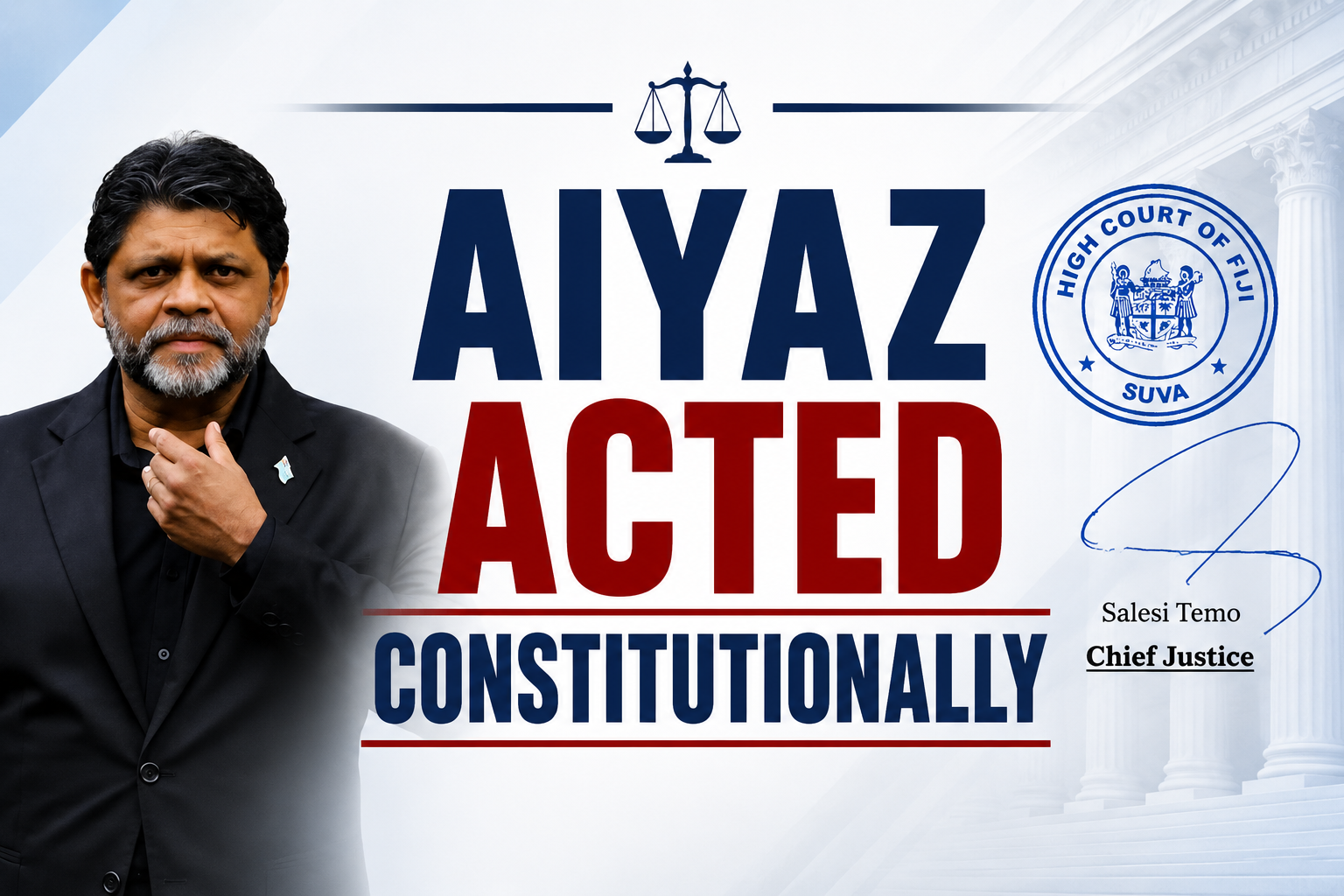
Chief Justice Salesi Temo has ruled that former Attorney-General Aiyaz Sayed-Khaiyum did not abuse the authority of his office when he signed agreements relating to former Supervisor of Elections Mohammed Saneem’s contract, finding there was no evidence to support the prosecution’s allegations.
In his judgment delivered today, Chief Justice Temo said the prosecution had failed to establish the essential elements of the offence of abuse of office under Section 139 of the Crimes Act.
The prosecution alleged that Sayed-Khaiyum abused his office by executing a second Deed of Variation and Addendum relating to Saneem’s employment, agreeing to pay or waive additional tax arising from his back pay without the approval of the President or the Constitutional Offices Commission.
However, the Chief Justice found the evidence demonstrated that the President had already authorised the Prime Minister, in his capacity as Chair of the Constitutional Offices Commission, to execute the terms and conditions of Saneem’s employment.
Quoting from the President’s letter of appointment dated January 15, 2021, Justice Temo highlighted the direction:
“Your re-appointment shall be subject to such terms and conditions as prescribed in your contract of employment, which shall be executed between you and the Prime Minister in his capacity as the Chair of the Constitutional Offices Commission.”
Justice Temo said that direction was constitutionally valid.
“In my respectful view, His Excellency was empowered to make the above direction by virtue of sections 76(4) and 135(3) of the 2013 Constitution. Those sections give His Excellency the power and authority to make the appointment and set the terms and conditions of that appointment.”
The Chief Justice concluded that all agreements signed by the Prime Minister and Acting Prime Minister concerning Saneem’s employment were constitutionally authorised.
“All the contract of service were constitutionally valid, as the same had been authorized by His Excellency the President.”
Justice Temo also rejected the prosecution’s claim that Sayed-Khaiyum had agreed to unlawfully pay or waive Saneem’s tax liability through the second Deed of Variation.
He found the State’s interpretation of the contractual clause was fundamentally flawed because it ignored the requirement that any tax treatment remain subject to the laws of Fiji.
The court noted that Fiji’s Constitution and Income Tax Act prohibit the waiver of taxes outside the law and that the employment contract itself contained a severability clause rendering any unlawful provision ineffective.
“Because of the above, the first part of clause 2.1(aa) of the second Deed of Variation… ceased to exist. It was constructively deleted, as a matter of law.”
Justice Temo was critical of the interpretation placed on the contractual provision before the matter was referred to police.
“It was none of the Fiji Election Office’s officials’ business to put a flawed interpretation on Clause 2.1(aa)… and later unnecessarily reporting the same to police.”
The Chief Justice ultimately found the prosecution had failed to prove key elements of the charge.
“There was no evidence to say that Accused No. 1 agreed to pay or waive the additional deductible taxes of Accused No. 2.”
He concluded that there was no evidence Sayed-Khaiyum had abused the authority of his office or committed an arbitrary act prejudicial to the Government of Fiji.
“I find no evidence that Accused No. 1 had abused the authority of his office and in this case, he had not done any arbitrary act that was prejudicial to the rights of the Government of Fiji.”