
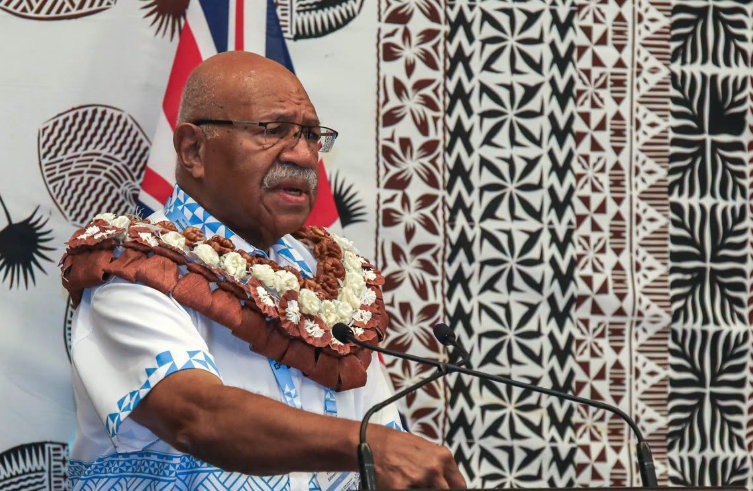
Prime Minister Sitiveni Rabuka says effective ocean governance and maritime security must go hand in hand as Pacific nations confront growing threats across the region’s vast maritime domain.
Speaking at the inaugural Pacific Transnational Crime Summit 2026 at the Fiji Marriott Momi Bay Resort, Mr Rabuka highlighted discussions held during last week’s inaugural Melanesian Ocean Summit 2026 in Port Moresby.
He said one of the summit’s major outcomes was the endorsement of the Melanesian Ocean Corridor of Reserves Declaration, known as MOCOR, which aims to establish a connected network of Marine Protected Areas across Melanesia and the wider Pacific.
While primarily focused on ocean governance and conservation, Mr Rabuka said the initiative also carried major security implications for the region.
He warned that illegal fishing, maritime trafficking, environmental crime, illicit resource extraction, and organised criminal activity were increasingly intersecting across Pacific waters.
Mr Rabuka said stronger regional cooperation through initiatives such as MOCOR would improve maritime surveillance, enforcement co-ordination, and protection of sovereign marine resources.
He described the initiative as a practical expression of the “Ocean of Peace” concept — ensuring the Pacific remains a region of lawful use, cooperation, and collective stewardship rather than exploitation by criminal networks.
The summit brought together Pacific leaders, police ministers, commissioners, and international partners to discuss regional security challenges.
Rabuka highlights expanding criminal threats
PRIME Minister Sitiveni Rabuka has warned that the same Pacific Ocean that unites island nations is also becoming a pathway for transnational organised crime.
Speaking at the inaugural Pacific Transnational Crime Summit 2026 this week, Mr Rabuka said criminal networks were increasingly exploiting the region’s vast maritime borders and institutional vulnerabilities.
He said Pacific nations were facing growing threats from illicit drug trafficking, cybercrime, money laundering, human trafficking, illegal fishing, environmental crime, and online exploitation.
“For generations, the Pacific Ocean has connected our islands, our economies, our cultures, and our peoples,” Mr Rabuka said.
“However, we must also recognise the changing strategic realities confronting our region.”
He warned that climate change, economic pressures, porous borders, and rapid technological change were creating opportunities for organised criminal groups to expand their operations across the Pacific.
Mr Rabuka said the issue was not only a law enforcement concern but also a human security challenge, with crime undermining development, weakening institutions, and exploiting vulnerable communities and youth.
Transnational crime in Pacific no longer a distant concern
PRIME Minister Sitiveni Rabuka has warned that transnational crime in the Pacific is no longer a distant concern, but a growing and immediate threat to regional stability.
Opening the Pacific Transnational Crime Summit 2026 this week, Mr Rabuka said the region is increasingly being used as a transit route for illicit drugs, with worrying signs that some Pacific Island countries are becoming destination markets.
“This trend is deeply concerning,” he said, adding that it is placing heavy pressure on policing, border security, justice systems, health services, and communities across the region.
He said Pacific nations are also facing a rapid rise in cybercrime, financial scams, online exploitation, and money laundering, all of which operate across borders and challenge traditional law enforcement responses.
Mr Rabuka further highlighted the ongoing risks of human trafficking and people smuggling, particularly for vulnerable groups, saying these crimes undermine human dignity and weaken the social fabric of Pacific societies.
He also pointed to illegal fishing and environmental crime as major threats to marine ecosystems that support livelihoods, food security, and economic stability.
“These threats are interconnected, adaptive, and transnational by nature.”
Mr Rabuka stressed that no Pacific nation can confront these challenges alone, calling instead for stronger regional cooperation as the foundation of an effective response.

