
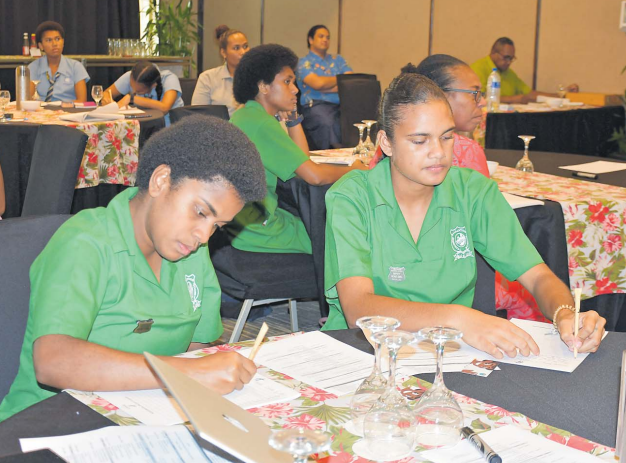
SEX education in schools needs to be expanded to reflect the real-life risks and challenges young people face.
Medical Services Pacific (MSP) project lead Christine Nikola shared this following a student engagement program under the “Na Bula E Dua” campaign aimed at strengthening awareness around HIV and drug use.
The initiative recently brought together students from three schools in the Central Division as part of a broader effort to empower young people with accurate and practical information.
Ms Nikola said the project created a platform for students to engage directly with stakeholders and civil society organisations (CSOs) to help co-design effective information, education and communication (IEC) materials.
“We are piloting this campaign in six schools already,” Ms Nikola said.
“This includes Delainamasi Government School, Ballantine Memorial School and Nasinu Secondary School in the Central Division, and Tilak High School, St Thomas Secondary School and Delana Primary School in the West.”
Ms Nikola said the campaign message, “Na Bula E Dua,” had been well received by students, with growing recognition as outreach continued.
“When we go into schools now, students see us, so we see that the message resonates.”
She added that even if students take away one key message from the year-long project, it would be considered a success.
The program focuses on HIV prevention, drug awareness and connecting students to support systems, including referral pathways such as the Child Helpline 1325, as well as services provided by the Ministry of Education and the Ministry of Health.
Ms Nikola said the awareness sessions spanned from Year 1 through to Year 13 and have received ethical approval from both ministries.
She noted that while comprehensive sexuality education is already part of the school curriculum under Family Life Education, the MSP initiative aims to go further by addressing emerging issues more directly.
“We want to dig deeper because of the crisis that we’re currently facing in our country.”
The “Na Bula E Dua” campaign is funded by The Church of Jesus Christ of Latter-day Saints and the Pacific Community (SPC).
Youth lead HIV service demand
YOUTHS are emerging as the largest group accessing HIV-related services in Fiji.
This was highlighted by country director of Medical Services Pacific (MSP), Kesaia Tuidraki while
outlining the organisation’s Moonlight Outreach Program.
Dr Tuidraki said one of MSP’s key strengths was its ability to “meet people where they are,” particularly
through targeted outreach initiatives designed to reach high-risk populations.
She said the Moonlight Outreach Program operates during evening hours, with mobile teams visiting
locations known to be frequented by key disadvantaged populations.
“As the name suggests, these outreach sessions are only conducted at night… our outreach team goes out
to areas where we know we would find our key vulnerable population,” she said.
Dr Tuidraki explained that these groups included female sex workers, injecting drug users, men who
have sex with men, and transgender individuals. However, she noted a significant shift in who is
actually accessing these services.
“What we’ve seen is most of those individuals that are accessing our services at night are young girls and
boys who are injecting drugs.”
She said the strong turnout of young people was an unexpected trend, as the program was initially
designed to target other high-risk groups.
“They’re coming in, they are accessing our services.”
Dr Tuidraki said MSP’s approach goes beyond HIV testing, offering a comprehensive package of sexual
and reproductive health services.
These include family planning, counselling, cervical screening for women, and prostate screening for
men.
“So, it’s not just a sort of like a one HIV service but it’s that integrated approach that we use which is
what we see really works.”

