
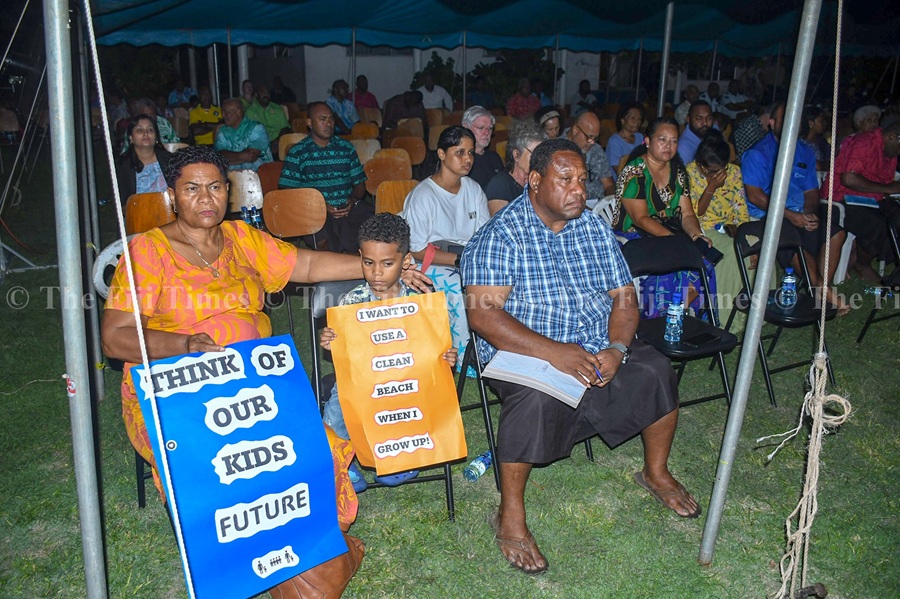
The proposed waste-to-energy project by The Next Generation has, over the past month, drawn both strong support and sharp criticism.
While the Government continues public consultations with communities it considers “affected”, voices from within and outside Fiji are increasingly calling for a more structured and technically grounded approach to large-scale infrastructure projects.
Fijian Tier 1 engineer based in the United Arab Emirates, Dobui Tukana, is among those urging caution, suggesting that the question is no longer whether Fiji needs modern infrastructure but whether it is building the right projects, in the right way, and for the right reasons.
Drawing from experience in major infrastructure developments in the United Kingdom and the Middle East, he argues that Fiji must strengthen its national planning systems before advancing projects of this scale.
“I am speaking out because I have seen what ‘Best-in-Class’ looks like in the UK and the Middle East,” Mr Tukana said.
“We are seeing a pattern across Fiji, from the rivers of Macuata to the shores of Vuda.
“Projects are being pushed through without following the proper sequence of consent and technical appraisal.”
According to Mr Tukana, this approach risks undermining public trust and weakening safeguards meant to protect landowners and communities.
Engineering mismatch and scale concerns
So at the centre of his technical critique is the scale of the proposed plant.
Waste-to-energy facilities rely on consistent fuel supply, in this case, waste, to operate efficiently.
Mr Tukana notes that Fiji produces approximately 200,000 tonnes of waste annually, yet an 80-megawatt plant would require close to 900,000 tonnes to function at optimal capacity.
“To make it ‘viable’ for a developer, a plant of that scale would require roughly 900,000 tonnes of fuel.
“This gap forces a commercial necessity to import 700,000 tonnes of foreign waste.
“That isn’t efficiency, it’s an ‘Import Trap’.”
In contrast, he suggests a smaller, 15–20MW plant would better align with Fiji’s waste profile, even if it results in different cost efficiencies.
The key trade-off, he argues, is between commercial profitability and national sustainability.
Renewable energy targets at risk
Fiji has committed to achieving 100 per cent renewable energy by 2035, but Mr Tukana believes large waste-to-energy plants could complicate this goal.
He explains that such facilities typically require long-term power purchase agreements, often spanning 30 years, which lock countries into continued waste burning, including carbon-heavy materials like plastics.
Additionally, these plants operate as baseload systems, meaning they run continuously and cannot easily adjust output.
This inflexibility may conflict with renewable sources like solar and wind, which fluctuate throughout the day.
Beyond engineering concerns, Mr Tukana identifies what he calls a “structural governance gap”.
He points out that advanced infrastructure projects typically require digital standards such as Building Information Modelling (BIM) and Digital Twin systems, tools not yet fully embedded in Fiji’s procurement frameworks.
“Having delivered complex infrastructure in the UK and high-spec industrial clusters in Saudi Arabia and the UAE, I know that Tier 1 projects require BIM Level 2 (Building Information Modelling) and Digital Twin integration.
“Fiji’s current procurement doesn’t yet mandate these sophisticated digital standards.
“While our local engineers are brilliant, they haven’t been given the ‘technical theater’ to practice these specific thermal-integration skills on this scale.
“We don’t need to avoid these projects, but we must mandate that international partners provide genuine technology transfer and mentorship to local firms as a strict condition of the contract.”
Environmental and regulatory risks
Environmental safeguards are another major concern.
During the consultations, we’ve heard managers from prominent resorts in the Western Division including Outrigger resorts who are concerned about the development being a huge risk to the water quality.
Even Fiji’s permanent representative to the United Nations, Filipo Tarakinikini, questioned the environmental, health and long-term national implications of the project.
Mr Tukana has also called for environmental clarity after references and international benchmarks such as the Industrial Emissions Directive (IED) and UK waste management standards, particularly in relation to toxic by-products like fly ash.
“Specifically, I am looking for the management of ‘Fly Ash’.
“Burning waste creates a toxic residue that must be stored in a specialised, lined, and monitored Hazardous Waste Cell.
“The Vuda EIA is silent on the long-term containment of this residue.
“If we don’t follow international standards for ash management, we are inviting a groundwater disaster.”
Mr Tukana claims this is an issue not clearly addressed in the current environmental impact assessment for the Vuda project.
Conditions for support
Despite his criticism, Mr Tukana does not reject waste-to-energy outright.
Instead, he outlines three conditions under which he would reconsider his position:
- Relocating the project to an existing contaminated “brownfield” site;
- Reducing the plant size to better match local waste production; and,
- Releasing full feasibility and environmental reports without disclaimers.
These measures, he argues, would align the project more closely with both environmental and national interests.
Mr Tukana frames waste-to-energy as primarily a “waste management solution”, not an energy strategy.
“We should build WtE plants primarily to shrink our landfills and clean our environment.
“When we let ‘energy profits’ drive the scale of the plant, we end up with a project that is too big for the country to feed.
“WtE should be a public service that produces power as a byproduct, not a commercial power plant that happens to use waste as an excuse to import more.”
Mr Tukana is a Fijian civil engineer and Tier 1 infrastructure specialist currently working on major projects in the Middle East, with experience across the United Kingdom and Gulf region.
He holds a Master’s degree in Civil Engineering and Construction Management from the University of Derby, a Master’s in Business Management from Edinburgh Napier University, and a Higher National Certificate in Architecture and Design from University of Hertfordshire.
He has held senior leadership roles, including serving as Country Manager for Project Management in Saudi Arabia, where he managed a portfolio of 499 live projects supported by a workforce of about 20,000.
His background spans complex infrastructure delivery, combining technical engineering expertise with large-scale program and operational management.

