PACIFIC media does not need to become a technology company to keep pace with artificial intelligence. It needs to take control of what it already has.
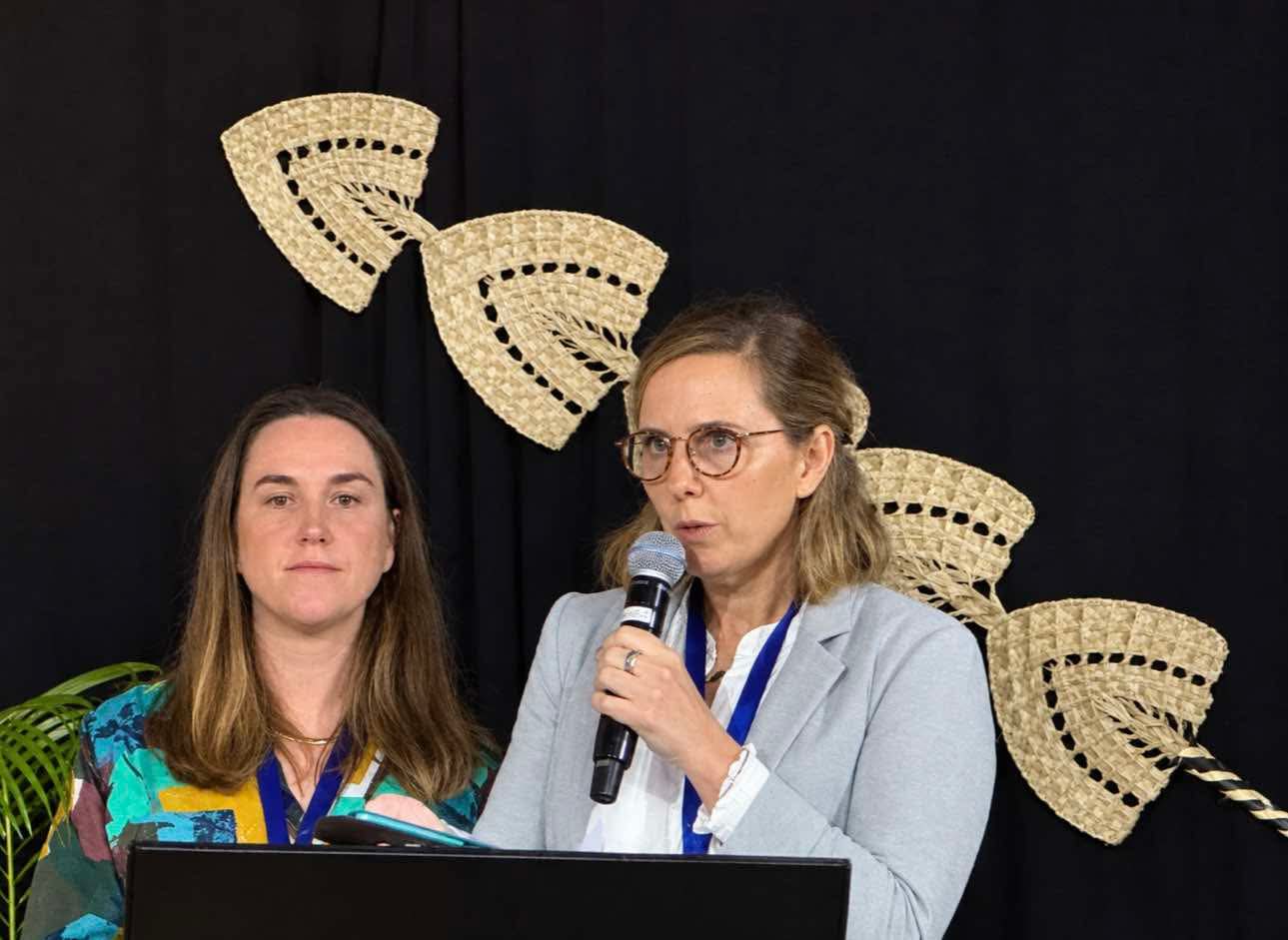
That was the central message at Wednesday’s Pacific Media Summit plenary on digital transformation, AI and new technology, where panellists urged Pacific newsrooms to stop trying to chase the rapid development of artificial intelligence and instead build their own foundations, protect their language and archives, and help their people understand the technology.
Participants were told that people will still come to Pacific media for what big tech cannot give them – trusted local stories told by their own people.
Jenni Ryall, founder and director of Other Labs, said the feeling of being left behind was not unique to the Pacific. It is felt across the media industry, and even by people who work in AI every day.
“You wake up, it has changed, there’s a new model released, there’s new tools out, there’s new policies you need to get across, it’s really, really overwhelming,” she said.
“That is how I feel every day, and I work in this space.”
She said the answer was not to run faster, but to pause and build foundations.
Together with Other Labs research lead Eira Martin Edwards, they have spoken to newsrooms from 11 countries instead of designing solutions from a desk in Sydney.
Their approach is to go back to basics, set policies and educate on how the tools work.
“Because if you get caught up and you’re overwhelmed, you never catch up. So we take it back to setting policies, educating on the basics of how these tools work.
“You can start with one tool and just get across it, just get in there and play. If you can use Word or a simple doc, using one of these tools, it can be as basic as that.”
Ms Edwards said research had to be ongoing. While rolling out the program, they are measuring the progress of each news organisation, looking at what is working, what is not, how it moves through internal structures, leadership culture and the intergenerational work between junior journalists and senior leaders.
Don Mann of Pacific Media Network said the real question for Pacific media is how to control their own history before it passes them by. His Auckland-based network is 33 years old and has 33 years of archived language data.
For him, self-determination comes down to two deliberate decisions.
The first is to form a formal commercial contractual relationship with Google to build their own tool in a closed environment.
“That was ours, and the intellectual property, everything within that tool belongs to us,” he said.
“It doesn’t belong to Google. We’re not giving our information away. We’re working in a siloed, confined environment where everything in there belongs to us.”
The second is to keep their archive.
“We have 33 years of specific, archived language data. I can imagine what Microsoft might want for that, to train their tool. We’re not giving that away. We hold on to it.”
He said the same principle applied to translation. When asked how Solomon Islands Broadcasting should translate English news to Solomon Pidgin when Pidgin is not standardised, he said translation alone does not work because context is lost.
“We’ve taken our own language material over 33 years of the way our language broadcasters communicate and we’re training our own model on that. We can only do it by using our own source material.”
Grant Sherlock, Digital Transformation Advisor, ABC International Development, said the gap for Pacific languages and Pacific culture in frontier large language models was still quite large, which made it difficult for Pacific organisations to access the same tools as others elsewhere.
He says the gap will narrow, as it did with earlier digital transformation, but the speed now made people feel it was insurmountable.
That leads to two common reactions – rushing in quickly because everyone else will or sitting back to wait until it settles. Neither works.
“There’s no point waiting until it’s completely narrowed, it’s a really good idea to take control of the conversation in your workforce now and to begin the adjustment process and to remove the fear and to replace it with understanding,” he said.
He said it can start with a single page, a traffic light system that shows what is allowed, what needs checking and what is not allowed, putting the onus on managers not just on young AI enthusiasts to lead the discussion.
Andrew Drummond, Editor in Chief, Australia Associated Press, said unlike Y2K, which was a point-in-time occurrence, AI is leaps and bounds ahead of the slow crawl of earlier digitalisation.
What matters more than capital is communication with teams about what the organisation is doing and what is expected of them. He said many people in newsrooms were already using AI without realising it, from spell check to transcription services like Otter.
“You have conversations with people in newsrooms about AI, and they don’t even realise that they are making use of it.
“There are some really basic tools that have been going on in newsrooms for a very long time. They don’t necessarily make the connection between using that and it being a piece of AI. They’re already in that world.”
His advice is to get people to dip their toes in and experiment, even outside their day job, to build trust and familiarity.
On the question of not having the infrastructure, the manpower, the skills or the machines, each panellist gave the same answer, “choose to own what you already have”.