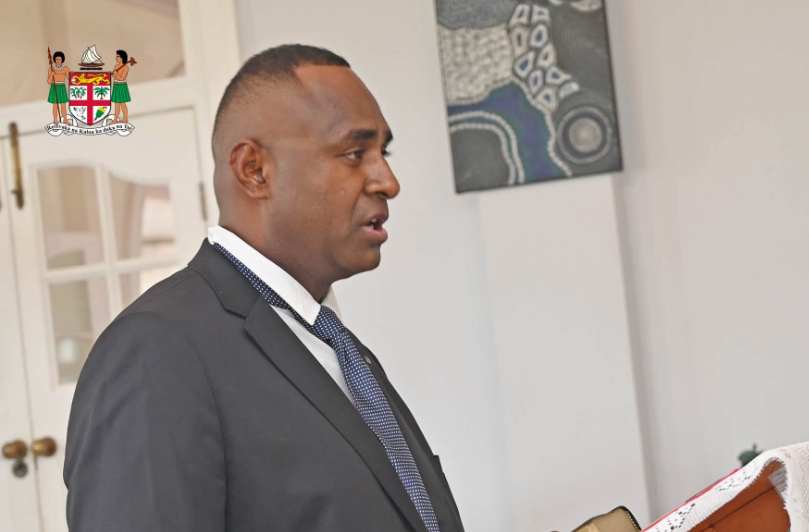
Finance Minister Esrom Immanuel has announced a significant expansion of investment in Fiji’s water and wastewater infrastructure, allocating $291 million to the Water Authority of Fiji (WAF) in the 2026-2027 National Budget to address ageing infrastructure, reduce water losses and improve services nationwide.
Presenting the Budget in Parliament, Mr Immanuel said Government had inherited a water sector facing major infrastructure challenges.
“Mr Speaker Sir, we inherited a critical crisis in the water sector with an ageing water infrastructure, where 50 percent of the water is lost through leakage.”
He said while the Viria Water Project had significantly increased water production capacity, Government’s priority had shifted towards reducing water losses and expanding capacity to meet future demand.
“Our wastewater sector is facing even greater challenges with urgent investment requirements,” he said.
The Budget allocates $81.4 million to continue upgrading and expanding water infrastructure, including improvements to water sources, treatment plants, reticulation systems, distribution networks and programmes to reduce non-revenue water.
Among the major projects is $7 million for the installation of a new 20-megalitre package treatment plant at the Tamavua Water Treatment Plant, scheduled for completion by June 2027 and expected to benefit around 150,000 people living between Suva and Togalevu.
A further $11 million has been allocated to install 11.73 kilometres of new water mains, construct a modern pump station and build two 5-megalitre reservoirs to improve water supply for approximately 14,000 residents in Sawani, Colo-i-Suva and Khalsa Road.
To strengthen future water supply for the Suva-Nausori corridor, Government has allocated $1.2 million for pipeline realignment between Savura Pump Station and the Tamavua Water Treatment Plant, together with $2 million for preparatory work to double the capacity of the Viria Water Treatment Plant from 40 to 80 megalitres, ultimately benefiting around 244,000 people.
Mr Immanuel also announced new projects in Navua and Wainadoi, extending from Naboro to Nabukavesi, with potential future expansion to Togalevu and Namelimeli, serving approximately 11,000 residents.
In Tailevu, WAF will extend water supply from Veinuqa to Kasavu, including construction of a new water main, pump station and a 3-megalitre storage tank at Davetalevu.
The Budget also funds major upgrades across the Western Division, including projects at Dreketi Feeder Road, Vuda and Wairabetia, benefiting around 18,000 people, while extending water services to previously unserved communities in Korovuto and Votua on the Coral Coast.
Further investment will improve water sources at Qalau and Nasivi in Ra and Tavua, benefiting approximately 32,000 people, while rehabilitation of the Nadrou and Varaciva pump stations in Ba will improve supply for around 55,000 residents.
In the Northern Division, projects include upgrades to the Benau Water Treatment Plant, water mains to Rara and Volanau in Labasa, a new storage reservoir at Raviravi, improvements at Naidriva in Savusavu and continued development of the Wainivasa water source in Taveuni.
Mr Immanuel said more than $16 million had been allocated to upgrade wastewater infrastructure, including improvements on Denarau Island, Pacific Harbour, and other localised wastewater treatment systems.
To address long-term sector challenges, Government is partnering with the Asian Development Bank (ADB) on the $300 million (US$135 million) Healthy Oceans and Water Security Improvement Project (HOWSIP).
The four-year programme aims to double the capacity of the Kinoya Wastewater Treatment Facility to 36,000 cubic metres per day, reduce water leakage from 50 per cent to 20 per cent, and improve coastal health and national water security.
Around $28 million has been allocated in the 2026-2027 Budget for implementation of the project.
As part of the initiative, WAF will establish a regional Water Academy, funded through a $10 million ADB grant, to strengthen technical and vocational skills required to manage Fiji’s water and wastewater systems.
The Budget also provides $10.5 million to maintain and expand rural water supply services across the country.
Mr Immanuel added that WAF was developing a new infrastructure development charges framework aimed at supporting future economic growth by providing a more sustainable and equitable approach to funding water and wastewater services for non-residential developments.